
Unlike past years, a guiding theme was absent in choreography and programming for this year’s Spring Dance Theatre, which opened Thursday at Cal State Fullerton. However, the Little Theatre’s lively crowd was proof this was no barrier to audience enjoyment.
Some common threads emerged between the performances, with the lights coming on in between pieces to allow the audience to take notes and reflect on each work.
In the opening piece, Abby Smelko’s “23:15,” dancers in pinstripe ankle pants and single-buttoned white shirts sauntered across the stage, exemplifying carefree urban sophistication. Cutout set pieces served as abstractions of skyscrapers, while low-key lighting design gave the impression of the near-midnight setting indicated by the title.
Smelko, a fourth-year dance major, said her inspiration came from the interplay between the artforms of jazz and dance. Her piece demonstrates this influence as an energetic but not overpowering opener.
“Being,” choreographed by student Caitlin Larsen, opened with dryad-like dancers wrapped in a large roll of sheer fabric. As the dance progresses, recognizably modern human figures join the spirits and mirror their moves.
The final part of this piece ended with one of the human dancers alone, set to wind chimes. The effect was haunting and tranquil, inspiring the audience to reflect on the course of their own lives.
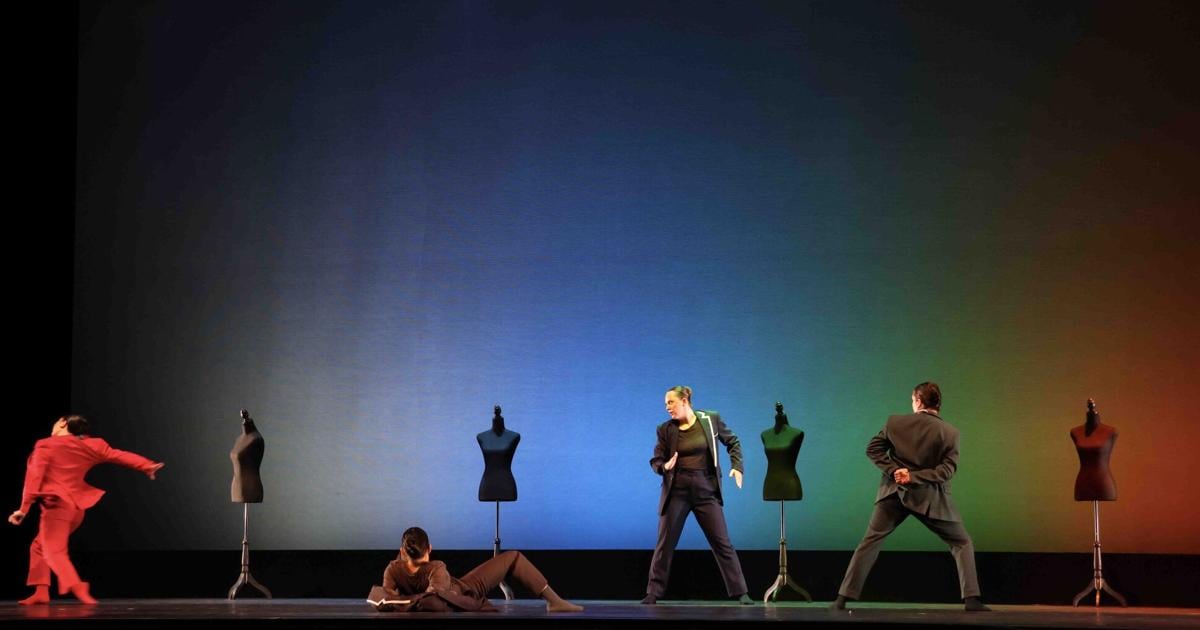
Following Larsen’s piece, “Overcurrent” shows people being animated not by spirits, but by jackets. The piece, choreographed by guest choreographer Derick McKoy Jr., demonstrated impressive technique on the part of the dancers, who moved like automata until granted agency by putting on colored blazers.
The dancers’ movements intensified into an explosive conclusion. “Overcurrent” is a piece that demands attention and gets it, and perhaps by design, holds it for longer than audiences might like.
CSUF alum and guest choreographer Omar Guillen choreographed “Self-Deception,” a piece about pursuing one’s dreams. The dancers are synchronized but fall out of phase, representing how people fall away from their dreams.
Corresponding with the dancers’ movements was a video backdrop, where orbs representing the dancers provided a top-down view of their movements. The track and graphics felt more at-home in an electronic music set, rather than the conceptual dance performance. Though the piece and the peripheral elements stand strong on their own, they don’t quite meet in the middle.
Associate professor Hassan Syed’s piece, “After the Last Sip,” takes a different turn. It is a powerful duet, and the harsh spotlight situates the dancers like living statues on the dark stage.
The impressive acrobatics by dancers Rain Lin and Anthony Huang contrast the tenuous, delicate moves they put on the drinking glass implied by the title, all backed by slow, minimal tracks.
The closing piece, student choreographer Miyeko Harris’ “In Continuum,” was much more lively. Smiling dancers clad in terracotta tones swayed on and off the stage in ever-changing groupings, illustrating Harris’ idea of “shared connections that dissolve in a continuous system of motion.”
David Salazar, a second-year business major, took notes during the performance as an assignment for his dance elective class. Two standouts for him were “Being” and “After the Last Sip.”
“I enjoyed the Spring Dance Theatre a lot more than I originally thought I would,” Salazar said. “I had originally gone with only the intention to get it over with as it was part of an assignment, but ended up enjoying it and really liking the creative choices that went with the performances.”
Professor Joshua Estrada-Romero, the coordinator of the Spring Dance Theatre, hopes audiences will be inspired by the concert.
“Many people can take that context from it and create a whole different storyline than the person next to them. So I just want them to find some kind of connection or inspiration from at least one of the pieces,” Estrada-Romero said.
The Spring Dance Theatre will run until May 9.