
In the decades following the historic voyage of Christopher Columbus to America in 1492, Mexico underwent much exploration and development – not to mention financial exploitation – by conquistadors under the aegis of the Kingdom of Spain.
But Spanish and other European explorers knew very little about the lands along the coast north of Mexico. Alta California had not been charted or mapped, and originally was thought to be an island.
Spanish explorers discovered the southern tip of Baja California in 1533. Seeing waters on both sides of the land, they assumed that it was part of one giant island instead of a lengthy peninsula. Even after explorers sailed to the top end of the Gulf of California, the misconception persisted.
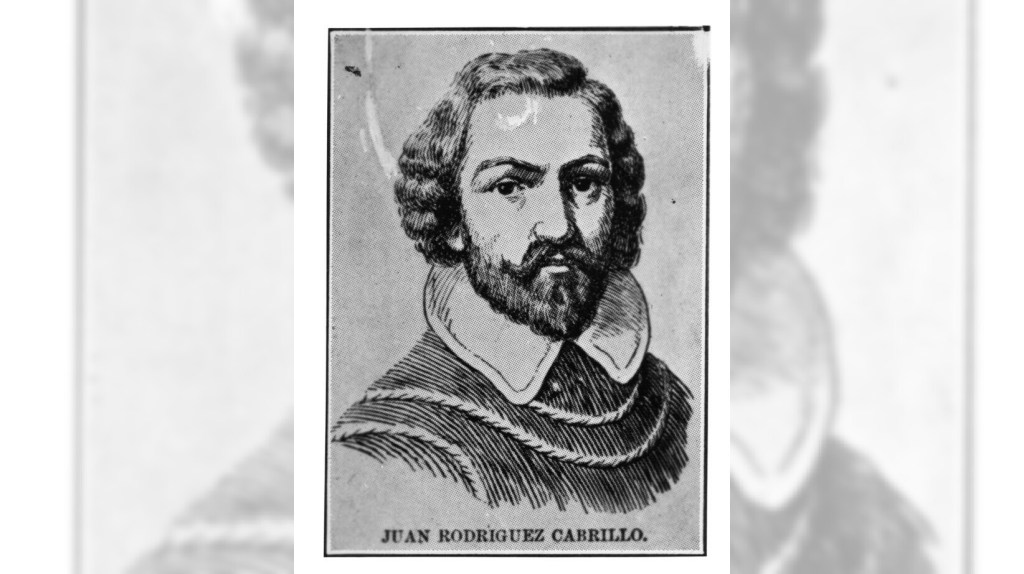
Born sometime between 1497 and 1500, Juan Rodriguez Cabrillo was a Portuguese adventurer who traveled to Havana as a young man. (His surname, added after his birth, is spelled “Cabrilho,” in Portuguese.)
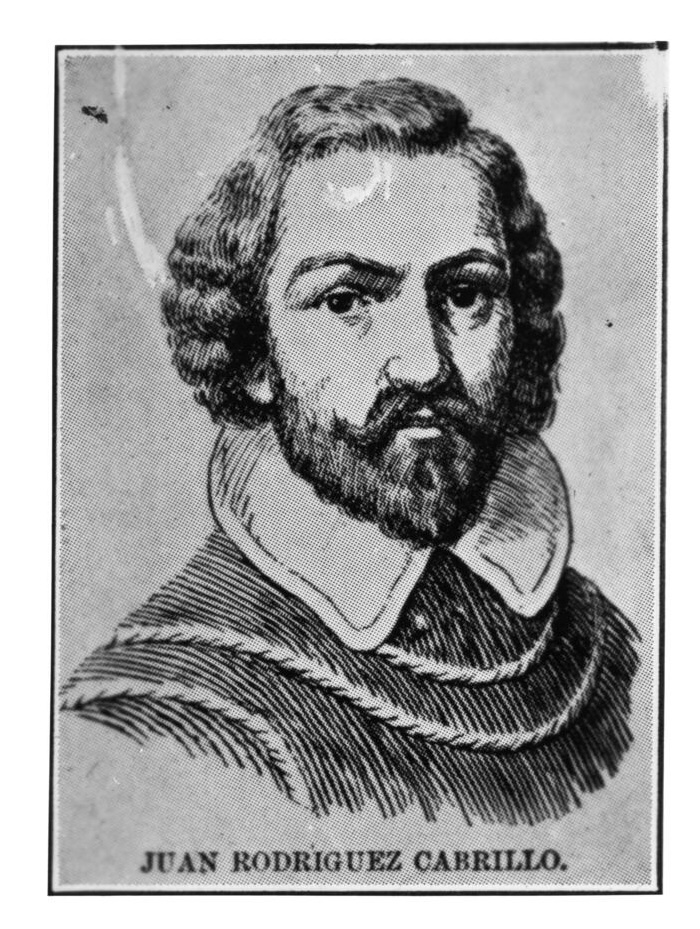
Juan Rodriguez Cabrillo. (USC Digital Library)
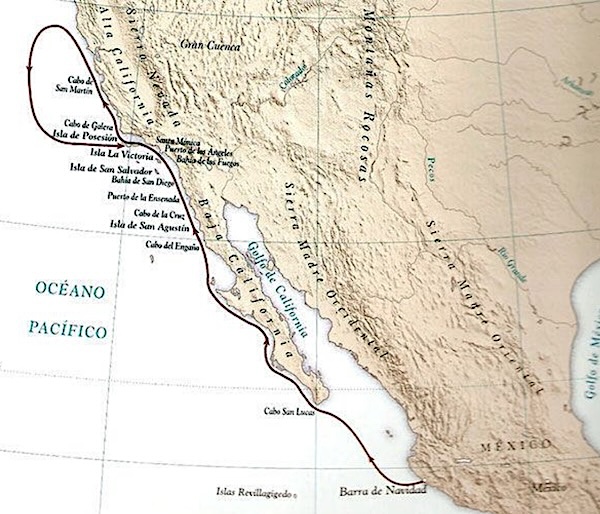
Undated map shows Juan Rodríguez Cabrillo’s sea route up the California coast during his 1542 voyage. (Islapedia website)
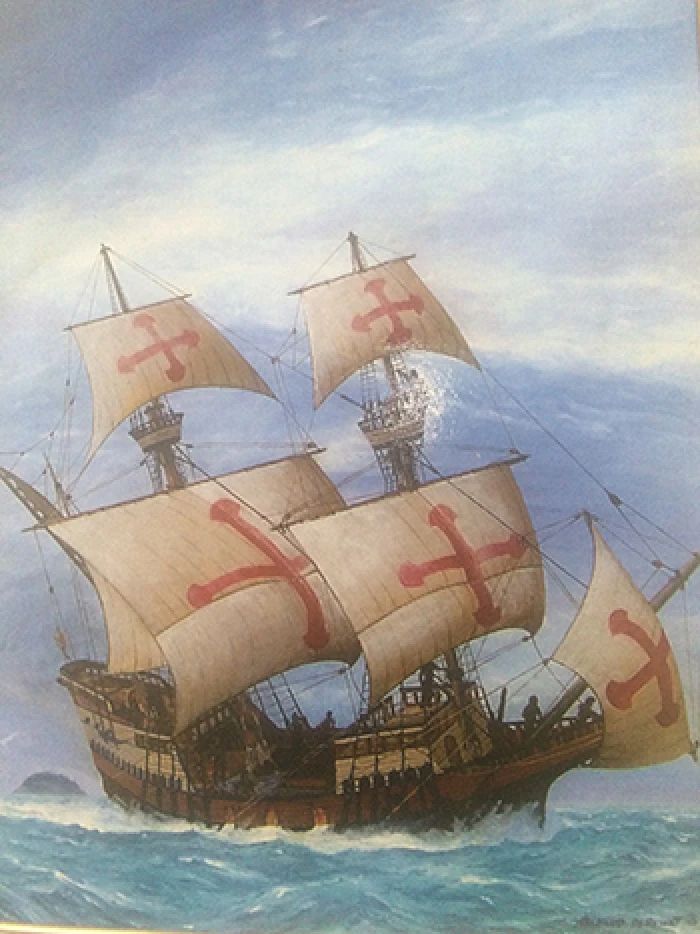
An undated painting of Juan Rodriguez Cabrillo’s flagship, the San Salvador. (National Park Service)
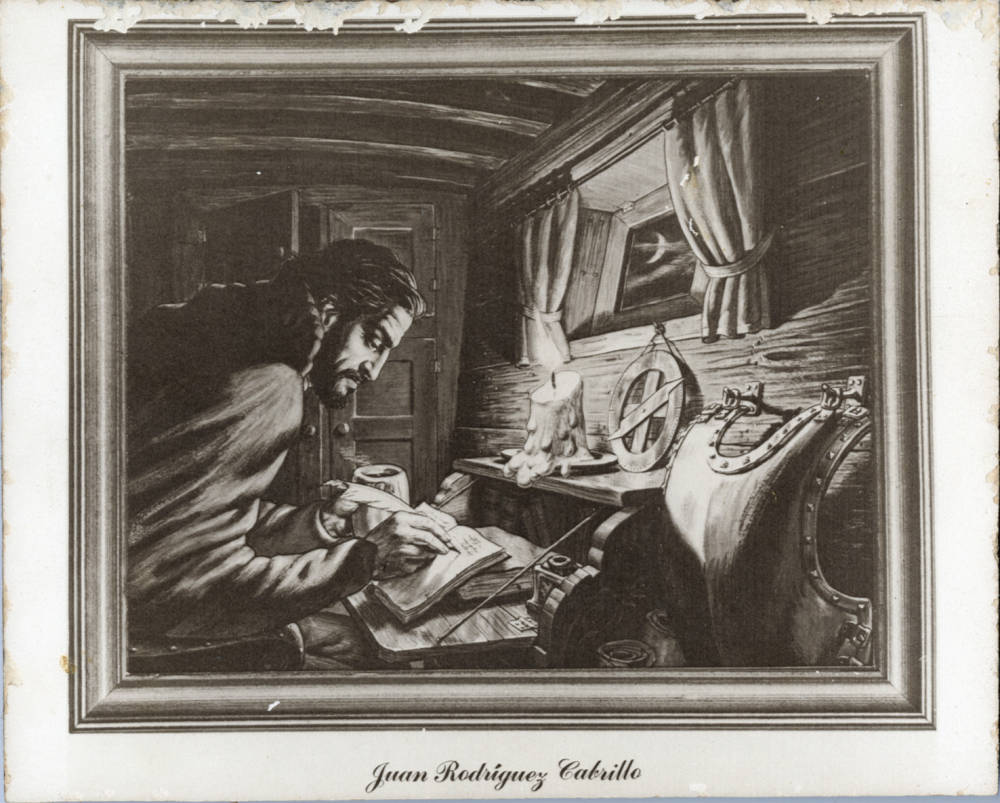
An undated drawing shows Spanish explorer Juan Rodríguez Cabrillo below decks on a ship, writing in a book with a feathered quill, a burning candle in front of him, a crescent moon in the window, and his breastplate at rest (right). Cabrillo was the first European to navigate the coast of present-day California (1542-1543). (Friends of the Malibu Public Library)
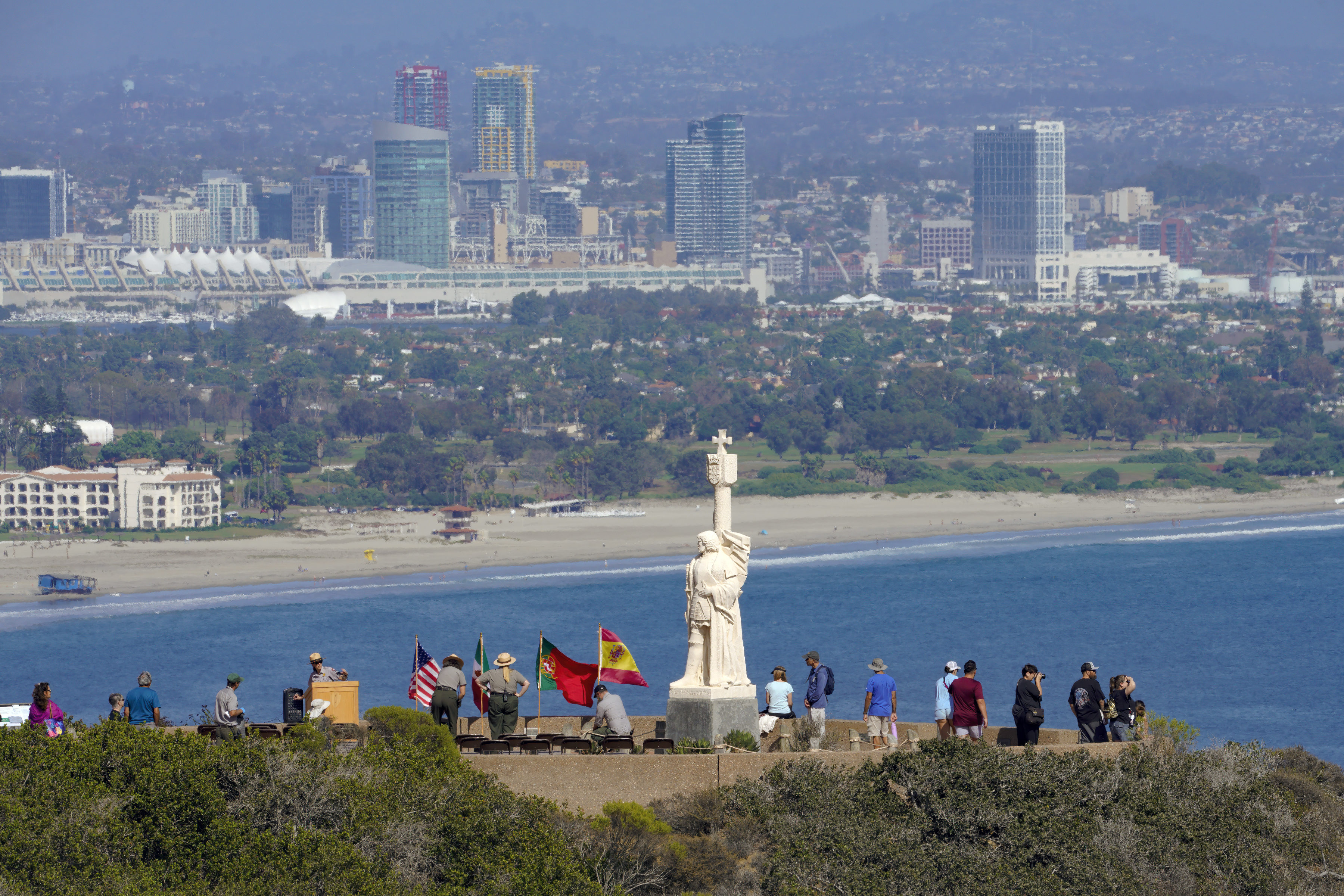
Visitors take in the view from the Juan Rodríguez Cabrillo statue at the Cabrillo National Monument at Point Loma overlooking San Diego Bay in San Diego. (Nelvin C. Cepeda / The San Diego Union-Tribune)
Show Caption
1 of 5
Juan Rodriguez Cabrillo. (USC Digital Library)
He initially served in a military role under Hernan Cortés, the Spanish conquistador who had conquered the Aztecs. Cabrillo later made a fortune through a gold mining venture in Nicaragua.
The Spanish government believed in the existence of the mythical Strait of Anián, a waterway that was thought to extend in some form from Alta California northward to Hudson Bay in Canada. If found, this would become a vital trade route connecting the Atlantic and Pacific oceans.
Anglo explorers would later call it the Northwest Passage during their search in the 19th century. Roald Amundsen made the first full passage by boat during his 1903-06 voyage. Global warming has made the route less ice-bound in recent years.
Back in 1539, Cabrillo was commissioned by the Spanish government in Mexico to explore the Alta California coast and hopefully find the Strait of Anián.
On June 27, 1542, he set out from mainland Mexico on a northern course along the western Baja California coast in command of three ships, the San Salvador, La Victoria and San Miguel. By late August, he had passed the point beyond which Europeans had explored the coast.
Cabrillo named the large bay into which he sailed on Sept. 28 as “San Miguel Bay” after one of his boats. We know it now as San Diego Bay. After a brief stop there, the boats continued northward.
On Oct. 7, he docked offshore at Santa Catalina Island. He named it after his flagship, “San Salvador,” and named nearby San Clemente Island “Victoria,” after his third ship.
The next day, Cabrillo sailed toward the mainland and discovered San Pedro Bay, which he called “Baya de los Fumos,” the “Bay of Smokes,” ostensibly because of smoke coming from fires made by the indigenous Tongva tribes living there.
There’s no physical evidence Cabrillo ever set foot on the San Pedro shore during his brief visit. The next day, the boats headed north into Santa Monica Bay and passed the rest of the Channel Islands, including uninhabited Anacapa and present-day San Miguel.
In subsequent days, the three ships continued north past Point Concepcion. By mid-November, they’d reached the Bay Area, but they missed out on San Francisco Bay itself, possibly due to fog or poor weather.
They turned around and headed back south, discovering Monterey Bay on their way down. The boats eventually returned to San Miguel Island for repairs and rest.
Sometime near Christmas Eve, Cabrillo climbed off the San Salvador to help out his men in a brief scuffle with Tongva attackers. He fell and broke a bone in either his arm or his leg, caught gangrene as result, and died on Jan. 3, 1543.
Though he is thought to have been buried on San Miguel Island, his remains have never been found.
His discoveries were not widely heralded at the time – Spain was probably disappointed that he failed to find the Strait of Anián – but he has since been acknowledged as the first European to explore the California coast.
A major National Park Service monument to him stands atop Point Loma, overlooking San Diego Bay. It was first built in 1913 and has been much expanded since then. Many streets and schools in the San Diego area are named after Cabrillo. A smaller monument to Cabrillo can be found on San Miguel Island, where he died.
Long Beach’s Cabrillo High School was named for him, as were Cabrillo Beach, Cabrillo Avenue, the Cabrillo Marine Museum and Cabrillo Avenue Elementary in San Pedro.
A different Cabrillo Avenue became one of Torrance’s first streets, dating back at least to 1913, the year after the city was founded.
Cabrillo College in Aptos near Santa Cruz was named for him. Monterey Bay has Cabrillo Point, and a major portion of California State Highway 1 from Santa Barbara to San Francisco has been named the Cabrillo Highway.
Sources: “Cabrillo, Juan Rodriguez,” Islapedia website. Cabrillo National Monument website. Daily Breeze archives. “In Search of California: Juan Rodriguez Cabrillo and the Great Northern Mystery’s Lure,” by Hadley Meares, May 7, 2015, PBSSoCal website. Los Angeles Times archives. “San Pedro: A Pictorial History,” by Henry Silka, San Pedro Bay Historical Society, 1984. Wikipedia.