
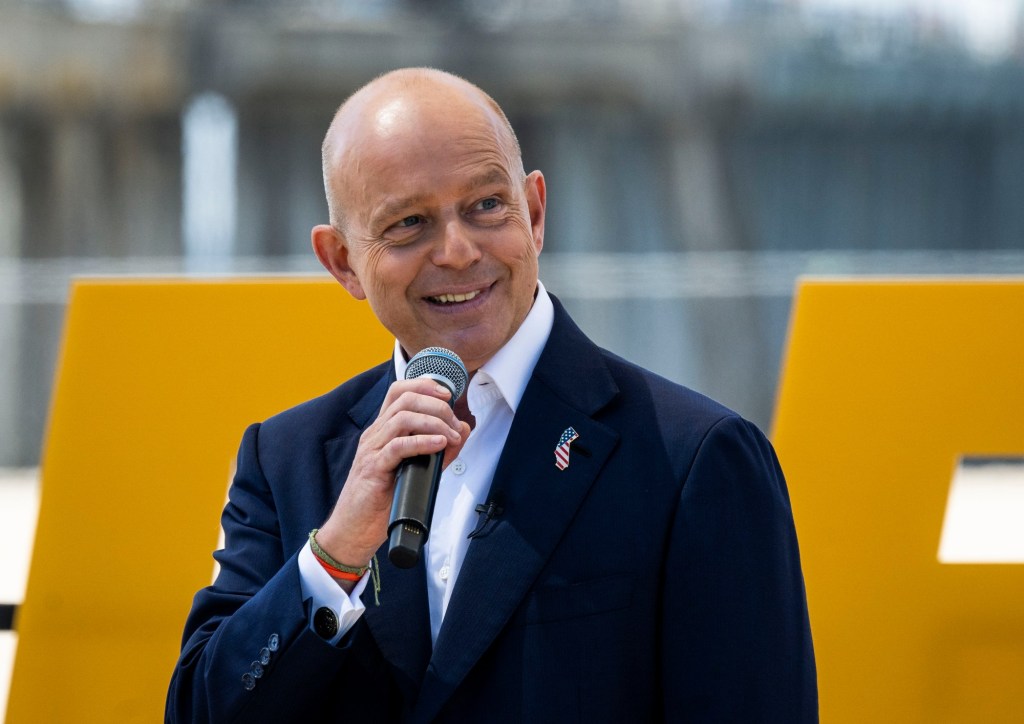
Ahead of the June primary election, the Southern California News Group compiled a list of questions to pose to the candidates who wish to represent you. You can find the full questionnaire below. Questionnaires may have been edited for spelling, grammar, length and, in some instances, to remove hate speech and offensive language.
Name: Steve Hilton
Current job title: Small Business Owner
Age: 56
Political party affiliation: Republican
Incumbent: No
Other political positions held: Director of Strategy to the Prime Minister
City where you reside: Atherton
Campaign website or social media: stevehiltonforgovernor.com
What is your top economic development priority for the state? How will you work with cities to achieve this? (Please answer in 250 words or less.)
My top priority is making California affordable again, because that is the foundation of economic growth. When the cost of living and the cost of doing business both get out of control, investment slows, jobs leave and opportunity disappears. That’s what’s happening right now.
Over time, the state has piled on layers of regulation, mandates and delays that make it unnecessarily difficult to build, expand or hire. Energy costs more, projects take longer, and uncertainty drives investment away.
The solution is not complicated. It requires fighting the three main drivers of cost and hassle in California: extreme climate dogma, corrupt union power and nuisance lawsuits. Democratic politicians cannot possibly deal with these problems because the party is completely captured by the climate lobby and is dependent for its funding on donations from the unions and trial lawyers.
California has every advantage. What we’re missing is a system that works. Fix that, and the jobs will come back.
Affordability continues to be top of mind for Californians. What is one specific area where the state could bring about immediate relief for residents? (Please answer in 250 words or less.)
The cost of driving hits people every single day, and working-class Californians are hit the hardest. Californians pay far more at the pump than the rest of the country, and that comes directly from state taxes, regulations and restrictions that have made our fuel system more expensive and less reliable. Suspending the gas tax should happen immediately. We should also cut vehicle registration fees, which have quietly become another major burden on working families. People feel this every time they fill up or renew their registration, and it pushes up the cost of everything else.
But the bigger issue is that Sacramento has made a series of policy choices that restrict supply and drive up costs. Reverse those, and prices come down.
Legislative Republicans this year called for a one-year suspension of the state’s gas tax. Meanwhile, another legislative proposal would consider charging drivers based on how much they use the roads as opposed to the fuel consumed. As governor, would you support any of these proposals? How else would you hope to alleviate prices at the pump for California drivers? (Please answer in 250 words or less.)
Yes. The gas tax should be suspended immediately. Californians are paying the highest gas taxes in the country and getting the worst roads. That tells you everything you need to know about how Sacramento is managing the system. People are being squeezed every time they fill up, and the response has been to pile on more costs. That has to stop.
This isn’t just about one tax. California has built one of the most expensive fuel systems in the country through bad policy. We’ve restricted in-state production, added layers of regulation and made the system more fragile and more expensive. That’s why prices are so much higher here than everywhere else.
I do not support a road usage charge or mileage tax. Californians are already overtaxed, and this would just be another way of charging people more, with real concerns about privacy on top of it. Cut costs now and fix the policies that caused the problem.
How do you propose to manage the state’s budget to ensure long-term fiscal stability? What areas would you consider for spending cuts, and, similarly, where would you like to see increased investment and why? (Please answer in 250 words or less.)
California doesn’t have a revenue problem. It has a spending problem. In just five years, the state budget has gone from around $200 billion to nearly $350 billion. And what do we have to show for it? The highest poverty rate in the country, the highest unemployment and the highest cost of living.
We’re taxing people more than almost anywhere else, and they’re still worse off. That’s why people and businesses are leaving.
We need a completely different approach. Reduce spending, root out fraud and waste and actually hold agencies accountable. I have established a California version of DOGE, and when I am governor, it will be incorporated in the state controller’s office to go through the budget line by line. Cutting spending is essential so we can cut taxes: to help ease the financial burden on working families and to make sure the economy can grow again. I’ve proposed making the first $100,000 tax-free and moving to a simple flat tax.
If we want budget stability, as well as growth and opportunity, we have to break the cycle of higher spending, higher taxes, and worse results.
One of the main concerns cited by opponents of a proposed billionaire tax is that it would push the state’s wealthiest residents to move elsewhere. Should this tax proposal qualify for the ballot and be approved by voters, what would you do as governor to ensure California remains a place where entrepreneurs and innovators want to live, so that the Golden State can continue to benefit as one of the world’s largest economies? And if it doesn’t pass, how would you propose the state pay for health care amid the Trump administration’s funding cuts? (Please answer in 250 words or less.)
This tells you everything about what’s gone wrong in California. The instinct in Sacramento is always the same: If something isn’t working, raise taxes again. We already have some of the highest taxes in the country, and people are leaving because of it. A billionaire tax would just accelerate that.
The real issue isn’t revenue. It’s how the money is being spent. We’ve poured hundreds of billions into this system and gotten worse results.
On healthcare, the first step is to stop making the problem worse, including policies like full taxpayer-funded healthcare for illegal immigrants, which are driving up costs and putting more pressure on the system. The answer isn’t more taxes. It’s a stronger economy and government that actually works.
Speaking of health care, should the state provide free or subsidized health care, such as Medi-Cal, to undocumented immigrants? Should there be any conditions placed on their eligibility? (Please answer in 250 words or less.)
Providing full, taxpayer-funded Medi-Cal coverage to undocumented immigrants is not sustainable, and it goes far beyond what other states are doing. In most of the country, benefits are limited. California has chosen to expand full-scope coverage at a time when the system is already under strain.
Even national Democrats agree. Democrats like Hakeem Jeffries have made clear they are not pushing policies like this at the federal level. So why are California Democrats continuing to expand it?
Meanwhile, families here are dealing with higher premiums, longer wait times and reduced access to care. Expanding benefits in this way adds cost and pressure to a system that is already struggling.
Emergency care should always be available. Beyond that, taxpayer-funded benefits should be focused on citizens and legal residents.
Would you continue to implement CARE Court, which is meant to help get people with severe mental illnesses off the streets? What changes, if any, would you make to the program? (Please answer in 200 words or less.)
No. CARE Court is not working, and it should be scrapped. The problem is not the idea of getting people into treatment, it’s that California doesn’t have a system capable of delivering that treatment.
For years, the state has focused on “Housing First” while ignoring the reality that many people on the streets are struggling with mental illness and addiction. Billions have been spent, and the problem has gotten worse.
We need a system built around treatment and recovery, with real capacity, including residential programs and secure facilities, and the requirement to get people into care when they cannot take care of themselves. Until that exists, programs like CARE Court are just a process without results.
As part of combating homelessness, elected officials often talk about the need to prevent people from losing their homes in the first place. What policies or programs should the state adopt to make housing more affordable for renters and homeowners? What do you propose the state do to incentivize housing development and expedite such projects? (Please answer in 250 words or less.)
California’s housing crisis is the direct result of political choices that have made it too difficult and too expensive to build. For years, Sacramento has layered on regulations, empowered unions to drive up construction costs and allowed trial lawyers to weaponize laws like CEQA to block projects.
We don’t build enough housing, prices go up and working families get pushed out. If we want affordability, we have to make it possible to build again. Real CEQA reform so it can’t be abused, cutting excessive fees and actually enforcing timelines so projects don’t sit for years. We also need to end the war on single-family homes and allow communities to build the kind of housing families actually want.
Right now, the state is trying to force dense development into communities that don’t want it, while blocking new housing in places that do. That makes no sense. Let growth happen where people are open to it.
Build at scale again, and prices come down.
What is a policy or project from the Newsom administration that you’d like to expand or continue? Is there something you’d change about the approach? (Please answer in 250 words or less.)
It’s honestly difficult to answer this question because the overall direction of the current administration has been so consistently wrong. Across the board, we’ve seen higher costs, worse outcomes and more bureaucracy, whether it’s housing, energy, homelessness or public safety.
One area where they’ve at least started to move is restricting smartphone use in schools. The administration has acknowledged the problem and required school districts to adopt policies, but it has stopped short of actually fixing it.
Right now, every district is left to come up with its own approach, which means inconsistent rules, uneven enforcement and, in many cases, no real change at all.
We need a clear, statewide standard. Phones should not be used during the school day. The evidence is overwhelming that constant phone use is damaging attention, learning and mental health, and schools need the backing to enforce real limits.
Conversely, name a policy or program from the Newsom administration that you’d want to eliminate or make major revisions to and explain the changes. (Please answer in 250 words or less.)
The problem is bigger than any one policy. What needs to be overhauled is the entire system of government that has taken hold in California over the last decade.
Across energy, water, forests, labor laws and the broader regulatory state, we’ve ended up with a model that is driven by ideology, captured by special interests and completely disconnected from results. The outcome is higher costs and crushed opportunities.
On energy, we’ve pursued an extreme agenda that has raised prices and weakened the system. On water, we’ve created a system of man-made scarcity instead of building the infrastructure needed for abundance. In our forests, overregulation has left millions of acres overgrown and turned them into tinderboxes, fueling the very wildfires we claim to be fighting.
On the economic side, laws like PAGA have turned labor enforcement into a jackpot for trial lawyers, hammering small businesses with endless lawsuits over minor technicalities. And across the board, a sprawling regulatory system now runs through hundreds of agencies, slowing everything down and driving investment out of the state.
This isn’t one problem. It’s a pattern. And it needs to be reversed.
Artificial intelligence has become a ubiquitous part of our lives. Yet public concerns remain that there aren’t enough regulations governing when or how AI should be used, and that the technology would replace jobs and leave too many Californians unemployed. How specifically would you balance such concerns with the desire to foster innovation and have California remain a leader in this space? (Please answer in 250 words or less.)
The biggest risk here isn’t that we don’t regulate enough, it’s that politicians who don’t understand this technology try to control it and end up choking it off. That’s how you fall behind.
This kind of change always creates anxiety; that’s understandable. The answer isn’t to freeze things in place; it’s to make sure people are ready to adapt. Right now, our education system isn’t doing that. We should be focused on giving people the skills to succeed as the economy changes, not trying to micromanage an industry moving this fast.
If we get that right, people will benefit from what’s coming instead of being left behind.
Last summer, President Donald Trump not only deployed federal immigration agents to California to carry out his mass deportation policy; he also federalized the National Guard and sent them to Los Angeles. How would you respond as governor should the president deploy more federal agents or troops to California again? (Please answer in 250 words or less.)
This should be handled with cooperation, not political theater. Under previous administrations, including President Barack Obama’s, immigration laws were enforced without this kind of performative conflict. What’s changed is California’s approach, where sanctuary policies and political posturing have made coordination more difficult and created unnecessary tension.
As governor, my focus would be on ensuring that the law is enforced in a way that is consistent, lawful and focused on public safety. That requires working with federal authorities, not against them. The goal should be simple: uphold the law and keep people safe without turning it into a spectacle.
What’s a hidden talent you have? (Please answer in 250 words or less.)
I like cooking, and I take it pretty seriously. It’s one of the few things where you can focus on something completely different and see a result right away.
I’m not trying to do anything fancy, just good food done well, but I especially like cooking Hungarian dishes. My parents were Hungarian refugees, and that was a big part of how I grew up. I still enjoy making that kind of food for friends and family.
David Argudo, LA County Board of Supervisors District 1, 2026 primary election questionnaire
Noel Almario, LA County Board of Supervisors District 1, 2026 primary election questionnaire
Elaine Alaniz, LA County Board of Supervisors District 1, 2026 primary election questionnaire
Jennifer Hawks, California treasurer candidate, 2026 primary election questionnaire
Eleni Kounalakis, California treasurer candidate, 2026 primary election questionnaire