
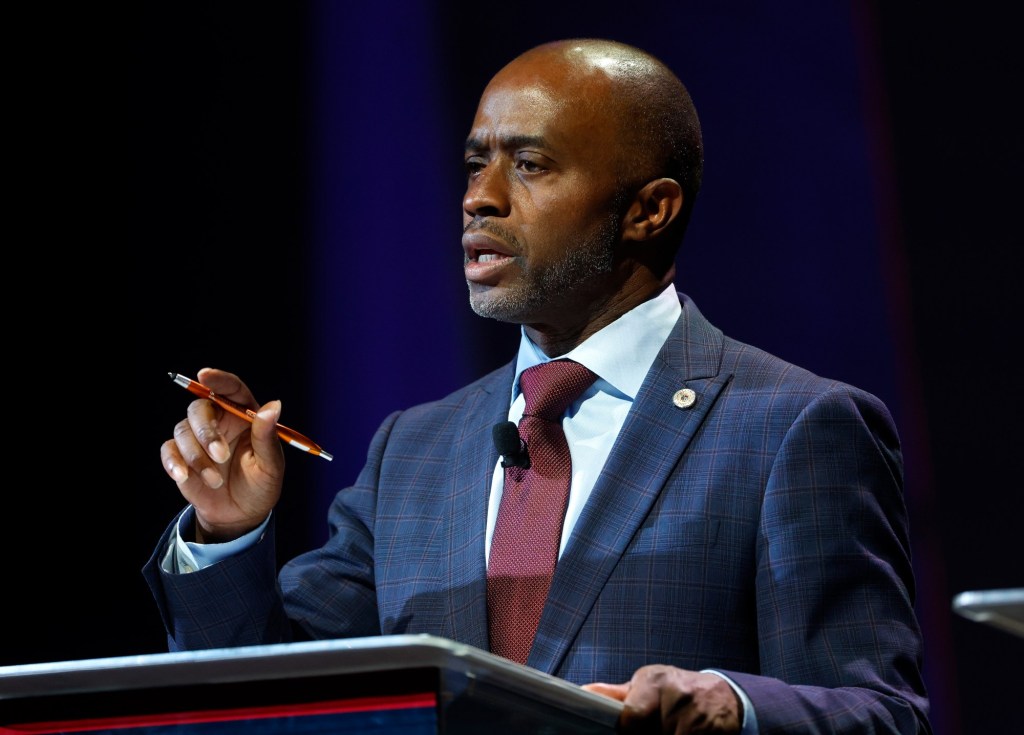
Ahead of the June primary election, the Southern California News Group compiled a list of questions to pose to the candidates who wish to represent you. You can find the full questionnaire below. Questionnaires may have been edited for spelling, grammar, length and, in some instances, to remove hate speech and offensive language.
Name: Tony Thurmond
Current job title: State Superintendent of Public Instruction
Age: 56
Political party affiliation: Democratic
Incumbent: No
Other political positions held: State Assembly, Richmond City Council, West Contra Costa Unified School Board Member
City where you reside: Chino
Campaign website or social media: www.tonythurmond.com
What is your top economic development priority for the state? How will you work with cities to achieve this? (Please answer in 250 words or less.)
The single biggest priority for our next governor should be building more housing. That’s why I have a plan to build up to 2 million housing units for working Californians in our state. This plan is premised on helping school districts build housing on the 75,000 acres of surplus land they currently own, and I’m helping them plan, finance and develop housing across the state. This housing will primarily help teachers and classified staff secure affordable housing for educators, but I am building on these efforts to ensure these housing units can be made available for others in our workforce, including caregivers, nurses, firefighters, police officers and the families served by the school districts that are building the housing.
Also, I am working to get a $10 billion bond passed in 2026 to support the development of more affordable housing in our state because affording a home is the top economic priority for most Californians, but for many, it remains out of reach.
Affordability continues to be top of mind for Californians. What is one specific area where the state could bring about immediate relief for residents? (Please answer in 250 words or less.)
As governor, I would re-initiate programs like redevelopment agencies that allow cities and counties to access up to $1 billion to invest in affordable housing and economic development.
Additionally, our small businesses are the backbone of our communities, and as governor, I will invest in low-cost loans to help small businesses that need help making improvements at their shops and stores, and grow programs to help California get into good-paying jobs in fields like STEM, BioTech and health care. I’ll also fight to provide a tax credit to working and middle-class families to help with the rising costs of living, housing, groceries and gas.
Legislative Republicans this year called for a one-year suspension of the state’s gas tax. Meanwhile, another legislative proposal would consider charging drivers based on how much they use the roads as opposed to the fuel consumed. As governor, would you support any of these proposals? How else would you hope to alleviate prices at the pump for California drivers? (Please answer in 250 words or less.)
While I do not support a suspension of the state’s gas tax, I am committed to delivering a middle-class tax credit to working-class California taxpayers to help alleviate their gas costs, particularly in the midst of Donald Trump’s war of choice that is skyrocketing prices. Lower-income folks who may have to travel further to get to work will end up paying the taxes if road use is taxed instead of gas taxes.
Long-term, we need to build much more housing so people can work closer to where they live and enhance mass transit networks so Californians can reasonably take public transportation to work. But in the short term, I will also provide a tax credit to working and middle-class families to help with the rising costs of living, including gas.
How do you propose to manage the state’s budget to ensure long-term fiscal stability? What areas would you consider for spending cuts, and, similarly, where would you like to see increased investment and why? (Please answer in 250 words or less.)
Due to a down economy and looming federal cuts, California faces years of overwhelming budget deficits in the future. While we can and must identify and cut wasteful spending, that won’t be enough — we need bold measures to improve the long-term fiscal health of state revenues or else countless police officers, educators, health care workers and more will be laid off across the state.
That’s why I proposed a tax on Californians with over $100 million in assets — the billionaires and ultra-millionaires — who are benefiting tremendously from California’s robust economy and Trump’s tax cuts and can afford to pay their fair share. An extension of Proposition 30 is a critical way to ensure these additional revenues, as well as Proposition 13 split roll reform, and raising taxes for “water’s-edge” filers, multinational companies that do business in California.
One of the main concerns cited by opponents of a proposed billionaire tax is that it would push the state’s wealthiest residents to move elsewhere. Should this tax proposal qualify for the ballot and be approved by voters, what would you do as governor to ensure California remains a place where entrepreneurs and innovators want to live, so that the Golden State can continue to benefit as one of the world’s largest economies? And if it doesn’t pass, how would you propose the state pay for health care amid the Trump administration’s funding cuts? (Please answer in 250 words or less.)
Families are sadly leaving California, and that’s a devastating policy failure, but if you look at who is leaving, it’s not the ultra-wealthy; it’s working and middle-class families. The tax applies only to the assets of the wealthiest, and the reality is that the best way to make California’s business climate better is to make it more affordable — more housing, affordable health care and cheaper energy — so entrepreneurs can start and maintain a business in California.
If we don’t implement a wealth tax, these families will bear the brunt of devastating state funding cuts that would be imminent, losing access to critical education, health care, public safety and more resources. Also, the data shows that while some major companies have moved their headquarters over the past 5-10 years, California businesses are thriving. Despite some issues we need to address, California remains one of the top destinations to start a business. If the billionaire tax fails, then the next governor will have to pursue alternative revenue sources to pay for the Trump administration’s health care cuts.
As governor, I will work with Congress to pass a national wealth tax and will work with innovators and entrepreneurs to explore incentives that help future entrepreneurs launch new businesses that will provide innovative products for the world. I will also work with our universities and colleges to help them expand research that will lead to the establishment of new technologies and businesses to serve Californians and the world.
Speaking of health care, should the state provide free or subsidized health care, such as Medi-Cal, to undocumented immigrants? Should there be any conditions placed on their eligibility? (Please answer in 250 words or less.)
I have long been a strong believer that health care is a human right for everyone, and California should absolutely continue to provide Medi-Cal to undocumented immigrants. Because of our incredibly broken federal immigration system, California continues to have millions of undocumented residents, and it’s both the moral decision and most cost-effective to integrate these Californians into Medi-Cal.
Additionally, the notion that this community is a drain on our resources is completely unfounded. Undocumented immigrants in California pay an estimated $8.5 billion in state and local taxes annually, according to a 2024 analysis by the Institute on Taxation and Economic Policy based on 2022 data. Providing universal health care to undocumented immigrants will bring down health care costs in our state by preventing people from seeking out basic care in emergency rooms, which is much more costly.
Would you continue to implement CARE Court, which is meant to help get people with severe mental illnesses off the streets? What changes, if any, would you make to the program? (Please answer in 200 words or less.)
As governor, I would support the implementation of CARE Courts to be able to help those whose mental health conditions are so severe that they pose a threat to themselves and others, and who are not able to care for themselves. I will also expand mental health and substance abuse participation requirements for those who participate in homeless programs. Research shows that those who are in homelessness programs with requirements to participate in mental health and substance abuse programs have a record of success at more than 90%.
As part of combating homelessness, elected officials often talk about the need to prevent people from losing their homes in the first place. What policies or programs should the state adopt to make housing more affordable for renters and homeowners? What do you propose the state do to incentivize housing development and expedite such projects? (Please answer in 250 words or less.)
Most Californians are being priced out of housing markets and are unable to buy or rent a home. Throughout my career in public service, including as an Assemblymember, I passed legislation to streamline the process for cities to permit new units of housing, and while I respect the principle of local control, I support efforts to restrict the ability of local governments to deny housing proposals, so we can spur the much-needed development of affordable housing across the state.
I welcome the recently passed reforms from the past year that streamlined the development of housing, but it’s clear we need an all-hands-on-deck approach. That’s why I recently launched a new plan to build up to 2 million housing units for working Californians in our state. This plan is premised on helping school districts build housing on the 75,000 acres of surplus land that they currently own, and I’m helping school districts plan, finance and develop housing all across the state. This housing will primarily help teachers and classified staff secure affordable housing for educators, but I am building on these efforts to ensure these housing units can be made available for others in our workforce, including nurses, firefighters, police officers and the families served by the school districts that are building the housing. Ultimately, we need a comprehensive plan that helps California build all types of housing, including home ownership, rental and housing for low-income residents.
What is a policy or project from the Newsom administration that you’d like to expand or continue? Is there something you’d change about the approach? (Please answer in 250 words or less.)
The governor has led a significant investment in early education and preschool programs, but I would advance it a step further to fill holes that exist and to make care more affordable for Californians. For starters, I would invest in a universal childcare program that brings down the high costs of childcare. I would also increase rates for small child care business operators who are small business owners and are essentially making minimum wage because rates are so low. By establishing universal childcare, we can ensure that parents can afford childcare, that our children will have quality child care and that we will be able to invest more than $20 billion into the California economy.
Conversely, name a policy or program from the Newsom administration that you’d want to eliminate or make major revisions to and explain the changes. (Please answer in 250 words or less.)
One thing I would do differently from the governor is to approach support for homeowners and response to disasters differently. The governor is promoting a state-run agency for providing homeowners’ insurance called the FAIR Plan. However, the FAIR Plan is very limited, and as governor, I plan to push the commercial homeowners insurance industry to write more policies and to honor the policies during times of need after they withheld support for homeowners in fire-impacted communities like the Palisades, Pasadena and Altadena after collecting premiums from the residents for years. After that, the homeowners’ insurance industry was granted a wage increase. As governor, I will be insistent that the industry write more policies for Californians and that they not receive a rate increase unless they write more policies.
Artificial intelligence has become a ubiquitous part of our lives. Yet public concerns remain that there aren’t enough regulations governing when or how AI should be used, and that the technology would replace jobs and leave too many Californians unemployed. How specifically would you balance such concerns with the desire to foster innovation and have California remain a leader in this space? (Please answer in 250 words or less.)
The governor’s call for age restrictions on social media is certainly admirable, and the guidelines passed in AB 53 are a good start to AI regulation, but he also vetoed AB 316 in 2023, a critical safety bill that would have required human drivers in AVs over 10,000 pounds. As Superintendent of Public Instruction, I’ve worked to effectively implement AI guidelines in our schools so that AI is a tool that complements the education of our students, not replaces workers. This problem is only going to intensify in the future, which is why we need a governor who isn’t afraid to take on “Big Tech” when needed, but is also committed to ensuring California remains on the edge of technological advancements.
Last summer, President Donald Trump not only deployed federal immigration agents to California to carry out his mass deportation policy; he also federalized the National Guard and sent them to Los Angeles. How would you respond as governor should the president deploy more federal agents or troops to California again? (Please answer in 250 words or less.)
While the governor will have to work with Trump in some aspects, there are others where we must be as firm as possible in standing up for our values and California residents. The Trump administration is attacking the very fabric of American society and the “California dream,” of being a multicultural place that embraces immigrants and tells people across the globe that they can make it here. I’ve always stood up for immigrant communities throughout my life, including supporting AB 49 this past year to protect immigrant families from ICE in California schools, and I’ll continue to do that as governor. I have been a longtime supporter of California’s sanctuary state laws, and will work to strengthen them as governor.
What’s a hidden talent you have? (Please answer in 250 words or less.)
My hidden talent may be my ability to find solutions to complex problems that others have not considered before, bringing in diverse perspectives on issues to get people on both sides of the aisle together to solve problems.
Sonia Kacker, CA-26 candidate, 2026 primary election questionnaire
Jacqui Irwin, CA-26 candidate, 2026 primary election questionnaire
Liam Andres O’Neill Hernandez, CA-26 candidate, 2026 primary election questionnaire
Sam Gallucci, CA-26 candidate, 2026 primary election questionnaire
Chris Espinosa, CA-26 candidate, 2026 primary election questionnaire