
Despite a dry winter and forecasts of another hot summer on the horizon, California energy officials said Monday that they are cautiously optimistic the state’s electric grid can handle whatever comes its way.
“As we enter summer 2026, the reliability outlook is generally positive and compared to previous years, the state is better positioned to meet peak demand,” California Energy Commission vice chair Siva Gunda said.
Utility customers across the Golden State experienced rotating power outages in mid-August 2020 — and narrowly avoided repeats in 2021 and 2022. The 2020 outages saw some areas of the state blacked out up to 2 1/2 hours.
But during Monday’s briefing, representatives with the energy commission, the California Public Utilities Commission and the California Independent System Operator said the state’s power system has added about 31,000 megawatts of capacity in the past six years, providing a much-needed cushion for grid managers.
“These are resources that will help support reliability needs for all Californians in all hours of the day,” said John Reynolds, president of the utilities commission, “not just to meet expected growing demand, but also to cover contingencies like extreme weather and unexpected power plant outages.”
Of those 31,000 megawatts of new resources since 2020, about 17,000 megawatts come from the rapid deployment of battery energy storage systems.
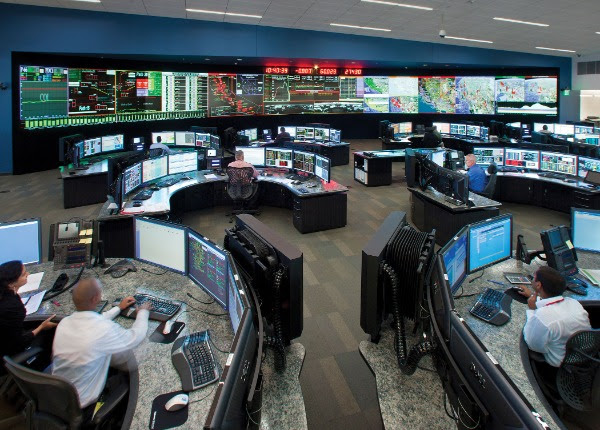
The California Independent System Operator, or CAISO, manages the flow of electricity across high-voltage, long-distance power lines that make up 80% of California’s and a small part of Nevada’s grid.
Grid managers at the CAISO have to constantly balance the supply of power coming into the system with demand. In the early evening hours, megawatts produced by solar dwindle as the sun sets. Operators must replace that with power from other energy sources in real time to keep the lights on.
The balancing act becomes more difficult in the summertime, when people keep their air conditioners running at the same time that solar production plummets. Prolonged heatwaves can put extra stress on the grid and increase the chances of power outages.
“Into the evening, as the solar energy comes off the system, the batteries release that energy back into the grid, helping to support reliability and keep the lights on,” said CAISO President and CEO Elliot Mainzer.
On March 29, batteries on the grid provided 12,300 megawatts of power — the rough equivalent of six Hoover dams, Mainzer said, or around 43% of the total demand on the grid.
“The battery storage resources have been a true game-changer for reliability in California and have really become a critical part of our operation,” Mainzer said.
But adding extra capacity costs money, and utility ratepayers across California are shouldering an ever-larger financial burden on their monthly power bills.
Reynolds of the CPUC acknowledged the tradeoffs between higher costs and maintaining grid reliability, while also keeping the state’s clean energy mandates on track. California has committed to derive 100% of the state’s electricity from carbon-free sources by 2045.
“We have more extreme weather in the West that has led to higher demand and puts greater strain on the grid,” Reynolds said, adding that focusing on long-term planning and “being smart about the investments that are necessary for a safe and reliable system is what’s going to drive us towards better affordability in the future.”
The CAISO’s most recent weather outlook indicates another hot summer may be in store for California, as well as neighboring states in the West that import and export energy to each other as needed.
Warmer sea surface temperatures also increase the likelihood of hotter-than-usual conditions along the coast, too.
All that raises the specter of potential wildfires posing a threat to grid stability.
In July 2021, the Bootleg fire in Oregon tripped a major transmission line called the California-Oregon Intertie that carries imported electricity from the Pacific Northwest into California.
More generally, smoke from large wildfires can obscure the sky, leading to reductions in solar production.
In addition, a lack of snow over the winter wiped out the snowpack in the Sierra Nevada, with some areas reporting record lows. Water levels at major reservoirs are currently at or above historical averages, but limited snowmelt will likely reduce the ability to sustain those levels throughout the summer.
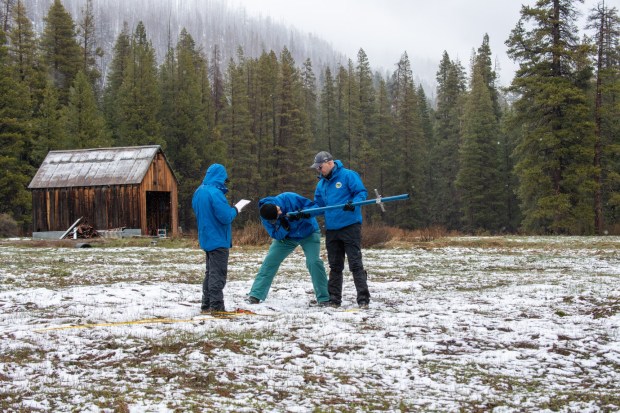 Managers and engineers from the California Department of Water Resources collect meager amounts of snowpack from the Phillips Station in the Sierra Nevada in Eldorado County on April 1. (Melissa Sanchez Robinson / California Department of Water Resources)
Mainzer said it’s been a dry year for states across the West.
“What this means is that as we get further and further into the summer, the ability to import power into California, particularly during stressed grid events, could be strained and this is something we’re going to have to watch very carefully,” he said.
The California Energy Commission expects total demand this summer to come to 46,546 megawatts, with 66,625 megawatts of total resources available to meet it — not counting up to 4,500 MW of contingency resources on hand in case things get tricky.
“While the outlook is positive, weather and transmission conditions still matter,” Gunda said. “Extreme heat blanketing the West, combined with wildfire-related transmission disruptions, could still create tight grid conditions.”
When the system gets overly stressed, the CAISO sometimes issues statewide flex alerts — asking utility customers to voluntarily reduce consumption, typically in the late afternoon and early evening hours.
In 2022, a “heat dome” that blanketed California and neighboring states in late August through early September prompted the system operator to issue a record 10 consecutive days of flex alerts. On Sept. 6 of that year, demand in the Cal ISO system reached its highest mark ever at 52,061 megawatts as utility customers tried to stay cool.
But the past three summers — in 2023, 2024 and 2025 — the CAISO has not had to issue any flex alerts.