
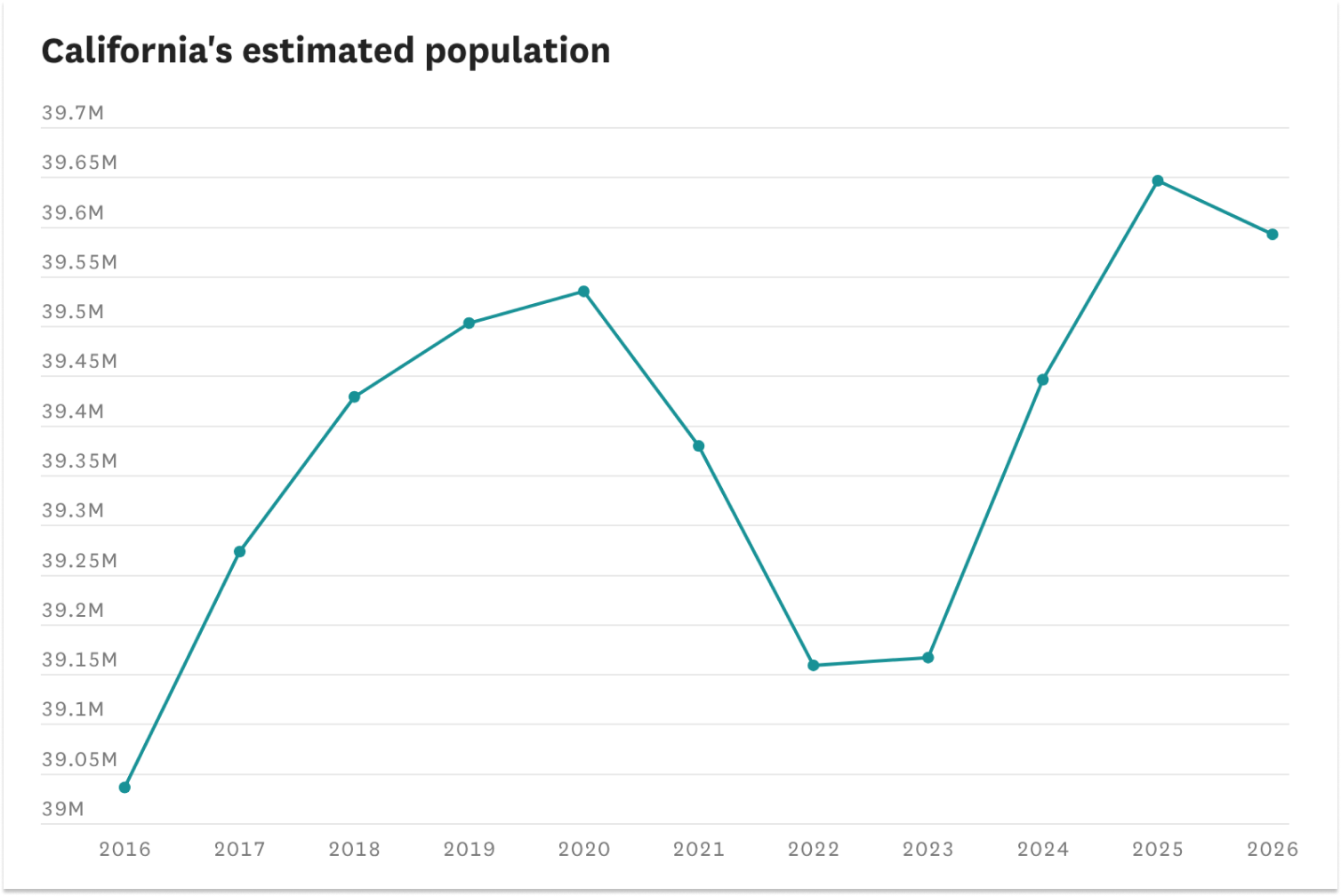
After two years of strong post-pandemic recovery, California’s population dipped last year, new state estimates show.
The decline was marginal — roughly 54,000 people from January 2025 to January 2026, putting the state population at just under 39.6 million — but still notable for a state whose population had only recently bounced back from the pandemic.
San Francisco was one of the few California counties with a higher number of residents at the start of the year — about 846,000, up from 844,000.
The California Department of Finance, which publishes the annual estimates, said that federal cuts to legal immigration hamstrung the state’s population growth. U.S. Census Bureau data released late last year also indicated that immigration restrictions made California the slowest-growing state in the country, which also saw an overall decrease in population growth. (The Department of Finance and the Census Bureau use different methodologies to reach their estimates, but rely on similar data sources).
President Donald Trump’s administration has slashed legal immigration pathways, including by revoking refugees’ protections and restricting employment-based programs. Those changes have helped cut net legal immigration to California — the number of people coming from a foreign country versus the number leaving — in half, from 248,000 in 2024 to 126,000 in 2025, according to the Department of Finance.
The agency says its estimates mostly include immigrants connected with school systems, immigration courts or other government entities.
A minority of California counties, including San Francisco, experienced population growth. Gains were mostly concentrated in the Central Valley, where birth rates and housing production are among the highest in the state. Placer County, which has built homes at some of the fastest rates in California this decade, saw the most population growth at 1.4%.
The inverse of the housing growth and population correlation was also true for several counties. Marin County, where housing production has been especially sluggish, saw its population drop again, from about 253,000 in 2025 to 251,000 in 2026.
San Francisco, which had the sharpest pandemic-era population drop in the Bay Area, continued a marginal recovery. The county’s population at the start of this year was less than 97% of its 2020 mark.