
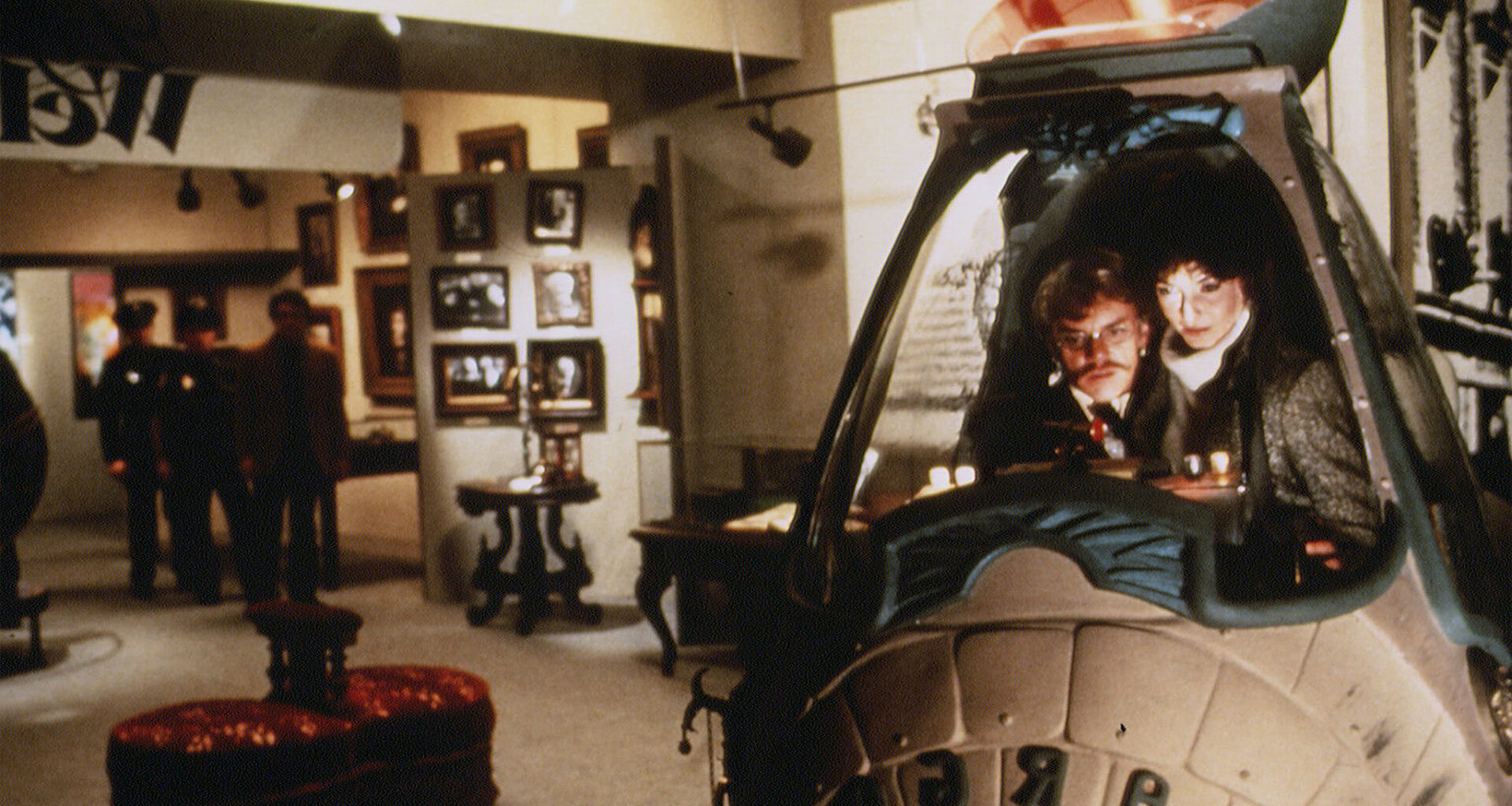
The sci-fi classic “Time After Time” begins in 1893 with Scientist H.G. Wells, played by Macolm McDowell, bringing a group of dapper Brits into his basement to show off his newly constructed time machine. A few minutes later, Wells is stepping out of the machine into the streets of 1970s San Francisco, where he embarks on one of the best romps through the city that’s ever been committed to film.

For a movie that’s nearly 50 years old, “Time After Time” has aged shockingly well — aside from a few outdated special effects, it’s a testament to San Francisco’s cinematic character and the timeless power of a good plot. The 1979 film was written and directed by Nicholas Meyer, who later went on to write another San Francisco-set classic, “Star Trek IV: The Voyage Home.” At the time, it won three Saturn Awards — the Oscars of science fiction — for writing, music and best actress for Mary Steenburgen. It currently possesses an impressive 88% score on the critics Tomatometer, and on release earned a gushing review from movie review legends Siskel and Ebert.
“It’s light-footed and quick-thinking,” said critic Roger Ebert. “And it treats its material just seriously enough to make us care. And then it kids its characters just enough to seem playful.”
Article continues below this ad
“Old-time, classy Hollywood filmmaking,” replied his partner Gene Siskel.
Shortly after showing off his time machine, Wells (Malcolm McDowell) brings his well-heeled friends upstairs for a friendly chess match. While playing against surgeon John Leslie Stevenson (David Warner), Wells waxes poetic about the future, claiming that within three generations a social utopia will come to pass, with perfect equality between races and sexes. The chess match comes to an end just as police from Scotland Yard arrive at the door in search of the infamous serial killer Jack the Ripper.
Make SFGATE a preferred source so your search results prioritize writing by actual people, not AI.
Add Preferred Source
Stevenson turns out to be the killer in question, but before the police can apprehend him, he takes advantage of Wells’ time machine. His destination is 1970s San Francisco, where he continues his campaign of terror, and where that utopia of course hasn’t quite come to pass. Wells quickly follows suit, landing on Nov. 5, 1979, in a museum exhibit dedicated to his work. He exits the California Academy of Sciences into a brave new world.
Article continues below this ad
“Such a scrambling of fact, fiction and imagination in itself deserves back-patting and, for the most part, the rendering is as delightful as the basic idea,” wrote the Hollywood Reporter at the time.
‘Bowled over by the city’
San Francisco was a special place for writer and director Nicholas Meyer. In the summer of 1971, he made a long road trip to visit his aunt in an apartment on Cherry Street near the Presidio. When he approached San Francisco via the Bay Bridge in his Pontiac Tempest, he was crying due to a tense conversation he had just had with his agent, but San Francisco brought him some much needed perspective.
Traffic crossing the Golden Gate Bridge from San Francisco toward Marin County, Calif., in 1972.
NNehring/Getty Images
“It says something about San Francisco that by the time I got to the other end of the Bay Bridge, I’d forgotten the man’s name. I was just so completely bowled over by the city and I fell in love with it instantly,” Meyer told SFGATE.
Article continues below this ad
Meyer then spent a month in San Francisco, incorporating his experiences into the film.
“I explored the city and later, when it came time to write the movie, I simply put in all the things I loved into the script. Because I was like Wells, I was like a tourist,” he said.
Given San Francisco’s historic Victorian architecture, there were plenty of locales in the city that could’ve made the character of H.G. Wells feel right at home. However, Meyer chose to go in the opposite direction, with filming locations that emphasized the future. It was a conceit that allowed him to create a science fiction film that felt grand in scope but was easy on its financiers.
Article continues below this ad
“The idea of two people in Victorian outfits running around San Francisco in modern times was not only a visual idea,” said Meyer. “It was an inexpensive visual idea, since all the sci-fi would be in the head of the audience watching these two Victorians take in everything that they bumped into.”
The film cost $3.5 million to produce, which was considered cheap for a studio film at the time. But it barely broke even after advertising, with a box office take of $5 million. One item Burbank Studios didn’t skimp on was the time machine itself, a 12-foot-long steampunk fiberglass creation that reportedly cost its prop department $70,000 to build.
British actor Malcolm McDowell on the set of “Time After Time,” directed by Nicholas Meyer.
Sunset Boulevard/Sunset Boulevard/Corbis/Getty Images
Back to the future
From the California Academy of Sciences, Wells makes his way to Fulton Street and Sixth Avenue, gawking at an airplane flying overhead, then causing a car crash by ignoring a “don’t walk” sign. Wells exchanges money at a brutalist building at 350 California St., then hits up a McDonald’s where he orders a Big Mac, fries and … tea. According to Reel SF, which exhaustively documented the film’s locations, the exterior of the McDonald’s was located in Daly City, but the interior shots were taken in a McDonald’s in the lobby of Two Embarcadero Center.
Article continues below this ad
Wells assumes that Stevenson would also need to exchange money, so he continues a tour of San Francisco banks, ending up at the Merchants Exchange Building, where he meets a bank teller named Amy Robbins (Steenburgen) who becomes his love interest.
“You want them to get together but know that since they come from two different times, they really can’t in some way,” said Siskel in his review.
Little did he know that after the filming, the pair would actually become a real-life couple and have two children together.
British actor Malcolm McDowell and American actor Mary Steenburgen on the set of “Time After Time,” directed by Nicholas Meyer.
Sunset Boulevard/Corbis/Getty Images
“That slow-drip voice comes to your ears like honey arriving on a moonbeam. Who couldn’t fall for her?” wrote Charles Taylor of Steenburgen in the film’s New York Times review.
Article continues below this ad
Robbins gives Wells a tip that he might find Stevenson at the Hyatt Regency on Drumm Street in the Financial District, a hotel chosen for its spinning rooftop restaurant and a glass atrium so Space Age that San Francisco Chronicle architecture critic John King dubbed it a “sci-fi hotel.”
“I wanted to go for presenting Wells as a complete fish out of water. In fact, once you’re inside the Hyatt on Drumm, you could argue that it’s a giant fish tank,” Meyer said.
After a confrontation in his hotel room, Wells gives chase to Stevenson in a sprint through Embarcadero Center, complete with sight gags, like Wells trying to run the wrong way down an escalator. Stevenson escapes, but the pair become further entangled as he continues his murder spree — with eyes on Amy as a potential victim.
Street of San Francisco, overlooking the bay in the 1970s.
Gamma-Keystone/Getty Images
Other notable locations include the legendary discotheque Trocadero Transfer (which closed in the late ’90s), the Marina Green, Vaillancourt Fountain and an apartment overlooking the Palace of Fine Arts. However, one of the locations that most excited Meyer had to be cut from the script after a mishap.
Article continues below this ad
“I’d been to Muir Woods during that month at my aunt’s, and I just thought, ‘Oh God, we’ve got to have Muir Woods,’” Meyer said. “I thought that would be a cool thing for a time traveler like Wells, to confront these different dates on the tree rings and realize where he’s from.”
They were told that under no circumstances could they leave the path near the biggest redwoods during shooting, and after someone from the crew violated the order, the entire production was shut down, according to Meyer.
‘Time’ marches on
In Meyer’s autobiography “The View From the Bridge,” he refers to the filming of “Time After Time” as “the most fun I’ve ever had in the daytime.” But it wasn’t without its challenges.
Article continues below this ad
As a first-time director, Meyer learned his skills on the job, relying on a patient crew.
British actor Malcolm McDowell and American actor Mary Steenburgen on the set of “Time After Time,” directed by Nicholas Meyer.
Sunset Boulevard/Sunset Boulevard/Corbis/Getty Images
“I made the same speech to everybody that was going to be on my crew. I said, ‘Look, No. 1, I know nothing, so No. 2, you’re going to have to teach me. No. 3, you’re going to have to not mind teaching me. And No. 4, if I still want to do it my way, you can’t go away mad,’” he told SFGATE.
Despite the naivete of its director, “Time After Time” deserves to be on the short list of the best San Francisco-set films. Although it’s been forgotten by many, the film will be returning to the big screen in June for a special screening at the Vogue Theater, with Meyer in attendance.
Article continues below this ad
As far as the film’s legacy is concerned, its most obvious connection to pop culture is the eternal Cyndi Lauper slow jam anthem by the same name, which was inspired after Lauper saw the film’s title in a TV Guide.
In a broader sense, Meyer said he thinks the value of the movie today is that it makes viewers feel intelligent while watching it, because it’s such a melting pot of genres: science fiction, comedy, crime thriller, social commentary and, ultimately, a love story.
“Wells says at the end of the movie, ‘Every age is the same. It’s only love that makes any of them bearable.’ You know, I don’t know if I was 30 when I wrote that, and I marvel at the profundity and the accuracy of that line, it just seems to me truer than ever,” he said.
Article continues below this ad