
Berkeley teachers a century ago were making an appeal to the public in May 1926 to “aid them in the effort to obtain more pay,” according to the Berkeley Daily Gazette.
The city’s school district was planning a May 17, 1926, vote of its board of directors on teacher salaries, and apparently a 10% increase had been offered. That wasn’t enough, said the teachers. Their arguments included the statistic that Berkeley spent only 67% of its budget for teacher salaries as compared to more than 80% in Oakland and 70% in the city of Alameda.
“Salaries of Berkeley teachers have not kept pace with increased costs of living nor with salary increase in other occupations and professions,” the Berkeley Teachers Association said. “No teacher in Berkeley now receives or can receive more than $200 a month,” and only one elementary school teacher made that much.
“There are 61 teachers who have taught in schools of Berkeley more than 10 years who are earning only $162.50 per month” plus 49 paid less than $150 a month, the teachers group said. The minimum teacher salary in Berkeley was $108 per month, equivalent to less than $2,000 a month in today’s dollars. The maximum teachers made was less than $50,000 in today’s money.
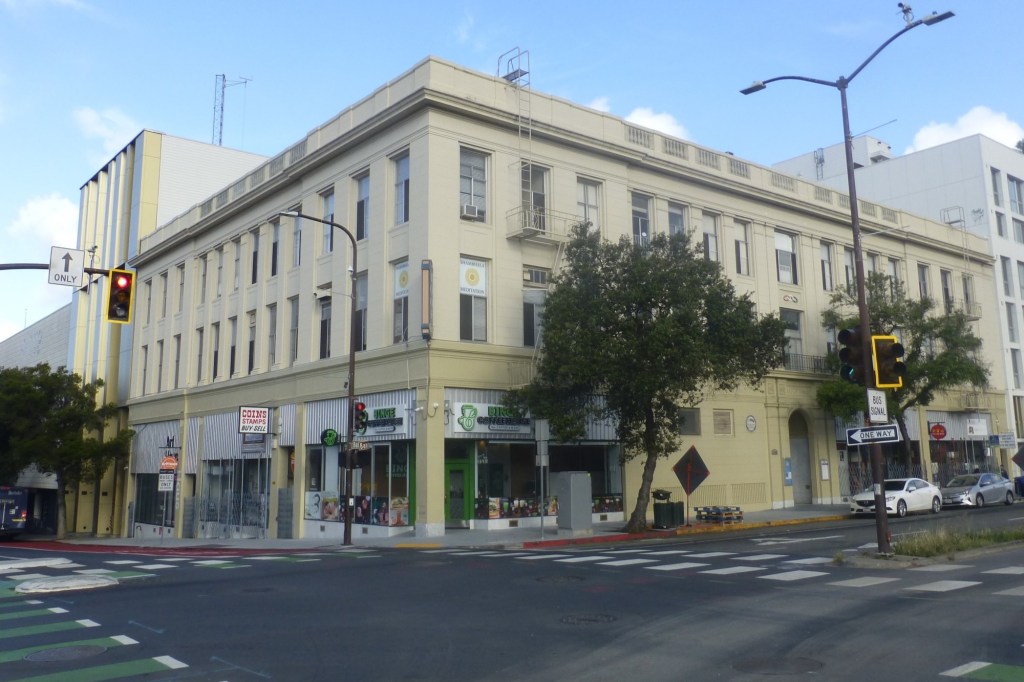
Odd Fellows hall: Ground was broken May 5, 1926, for Berkeley’s new Odd Fellows Temple with excavation beginning on the 100-by-135-foot lot at the northwest corner of Bancroft Way and Fulton Street (where the building still stands today), the Gazette reported. The three-story building would cost $150,000 and “be built in such a fashion as to withstand possible earthquake shocks.”
“The ground floor will be given over to stores,” with at least six shopfronts projected. Two large lodge meeting rooms would be provided upstairs, one with an organ loft plus “a ballroom and banquet room, a large cloakroom, kitchen, storerooms and armory” and a women’s parlor, lockers, clubroom and telephone room.
Public works: Berkeley’s bid to purchase a large underwater portion of the Berkeley waterfront to expand the city dump took a turn on May 4, 1926, when the Cragmont Land Co. offered the city 22.5 acres of offshore land at $1,000 an acre, a lower price than a parallel land offer from the San Francisco Chemical Co.
The council asked for further review before committing to a purchase. City Manager John Edy mentioned that he had previously asked Cragmont for offers of land to sell and had not received a response. The city awarded a contract to construct a “deep sewer” along Center and Milvia streets. Edy ”explained that the sewer would be necessary because of the construction of the new Hearst Gymnasium at the university.”
Berkeley stories: Also on May 4, 1926, Berkeley Realty Board members held a dinner for their “salesman’s division” at which “old timers” told stories of real estate deals in very early Berkeley. C.C. Emslie described “his family’s first induction into the real estate business” when his uncle traded a saddle for 10 acres of what would become the city’s Northbrae district, only to discover the seller had no title to the property.
“Will May, of a title company … declared that when he was a boy his chief duty was to drive the coyotes from the chicken ranch of his family located then at Euclid and Hilgard avenues.”
W.J. Mortimer described racing in one of Berkeley’s first automobiles to beat a train and make a sale of a property at Telegraph Avenue and Bancroft Way.
Police alarms: On May 6, 1926, the Gazette reported on an upgraded police alarm system. The city would have 57 police call boxes connected to headquarters, and 35 red lights throughout the city to signal nearby patrol officers to call in.
Bay Area native and Berkeley community historian Steven Finacom holds this column’s copyright.