
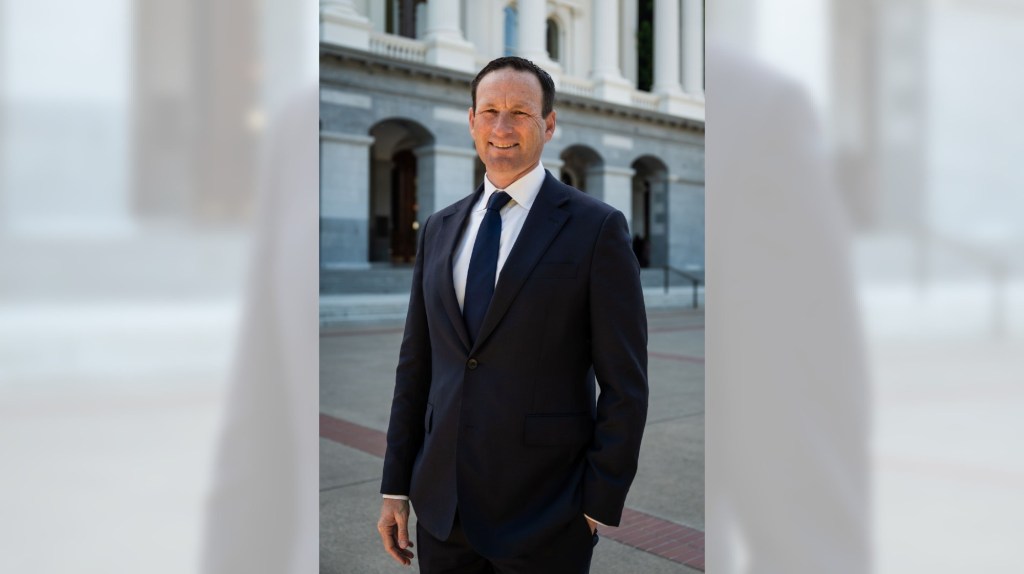
For California’s lieutenant governor’s race, so far I’ve spoken to and written about Republican Gloria Romero, and Democrats Michael Tubbs and Fiona Ma. Unfortunately, these candidates left a lot to be desired. All hope is not lost though – I recently spoke to Josh Fryday, another Democrat in the race.
Josh Fryday is a Navy veteran and currently serves in Governor Gavin Newsom’s cabinet as Chief Service Officer, overseeing the state’s volunteer programs including College Corps, which provides financial aid to students in exchange for community service. He also previously served as mayor of Novato, California.
So how did our fair Fryday fare?
Just as Tubbs and Ma, Fryday promised to use his membership in UC, Cal State, and community college governing boards to motivate housing construction on school-owned lands and use his office to advocate for streamlining building regulations.
I noted to Fryday that the UC Board of Regents and the Cal State Board of Trustees have approved student housing projects but that they’ve often been stalled for years by regulations and lawsuits. I asked him about how he could make a difference given these realities.
“I don’t believe, based on my conversations with leadership at the UC system, at the CSU system, that we have really pushed as hard as we need to on housing. And I’ll just give an example, which is the CSU system, which is the largest institution of higher education, or one of them in the country, only houses 13% of their students. And when I have conversations about why that is, it’s because just culturally, they haven’t seen housing as being something that needs to be provided.”
On the housing front, given the limitations of the office of lieutenant governor and existing regulatory hurdles, it’s difficult to expect much more from our candidates than promises of advocacy.
It is however promising that, even as a Democrat, Fryday acknowledges that many of the problems that California is currently facing are self-inflicted wounds created by his party.
“We’ve put in a bunch of barriers that have made it impossible to build and you know I often refer to our party, and I’m running as a proud Democrat, as we too often become the party of good intentions. And we put in a bunch of rules and regulations and processes with good intentions for largely the right reasons that have resulted in essentially strangling us and making it nearly impossible to build the infrastructure we need, which is housing and clean energy.”
A conspicuously odd feature of Fryday’s platform is that he’s running on addressing problems with the Pre-K-12 system and increasing teacher pay – the lieutenant governor has no authority over grade school matters and teacher salaries are largely determined by negotiations between local school boards and teacher’s unions.
According to Fryday, the extent of his aspirations is, “being a champion, by talking about why we need to do it.” Increased funding for education is not exactly the most radical position we’ve encountered in our search for a worthy lieutenant governor. For what it’s worth, Fryday didn’t stop at just calling for more funding and paired it with a desire to see structural reform in schools, stating that currently, schools are not sufficiently sensitive to the diversity of student needs.
We moved on to other matters that may inform our beliefs about Fryday’s ability to lead. A report by the nonpartisan Legislative Analyst’s Office found that under Fryday’s leadership, College Corps spends about half of its budget on administrative costs, which compares poorly to entities like the California Student Aid Commission (CSAC). I asked him why his department appears to be so wasteful.
“Well, so I think the LAO report is deeply flawed to begin with. So what they refer to as admin costs is actually programmatic costs. It’s training, supervising and support of students. So it’s the terminology that they got wrong.”
According to the report though, “Under the Governor’s proposal, California Volunteers would have about one-third the amount of staff as CSAC, despite College Corps equating to less than 3 percent of the state financial aid that CSAC administers.”
The crux of the issue is that we already have existing student aid and community service programs and creating new and separate bureaucracies only leads to the inefficient use of state funds. I asked Fryday why it wouldn’t be a better use of our resources to just increase funding for existing programs rather than feeding additional administrative bodies.
“Yeah, so let me be clear. We’re not a financial aid program. So what we do is provide service opportunities and job training and the opportunity for people to be engaged in their community. It’s a totally different mission.” Fryday continued, “And these are programs, by the way, it’s the first program in the country for Dreamers. So we’re creating opportunities for Dreamers that never existed before.”
A requirement to volunteer for College Corps is being a full-time undergraduate student who can demonstrate that they need to work to pay for school. As the LAO report stated, there’s also already a community service option for Dreamers to get financial aid via the Dream Act Service Incentive Grant (DSIG). The point is not that College Corps isn’t helping people, it’s that if the aim is to provide more financial aid and service opportunities to students, we should increase funds to existing programs, not create whole new bureaucracies that use those funds less efficiently.
Fryday may be pinning his argument on qualitative differences between College Corps services and extant programs (the extent and quality of their mentorship and jobs training for example) but such differences do not justify the existence of College Corps when CSAC and community service programs can be modified while limiting the administrative bloat of a separate agency.
While Fryday must defend the value of his seemingly inefficient work, his most valuable quality is that he is not Tubbs, or Romero, or Ma. He’s not as smitten with ludicrous progressive policies as Tubbs. As far as I know, his reasoning abilities are not compromised enough to believe conspiracy theories like Romero. The details of his platform are slightly more grounded and focused than Ma’s and unlike Ma, the state didn’t pay $350,000 to settle a sexual harassment lawsuit against him.
Fryday is far from a perfect candidate, but he’s better than the alternatives.
Rafael Perez is a columnist for the Southern California News Group. He is a doctoral candidate in philosophy at the University of Rochester. You can reach him at rafaelperezocregister@gmail.com.