
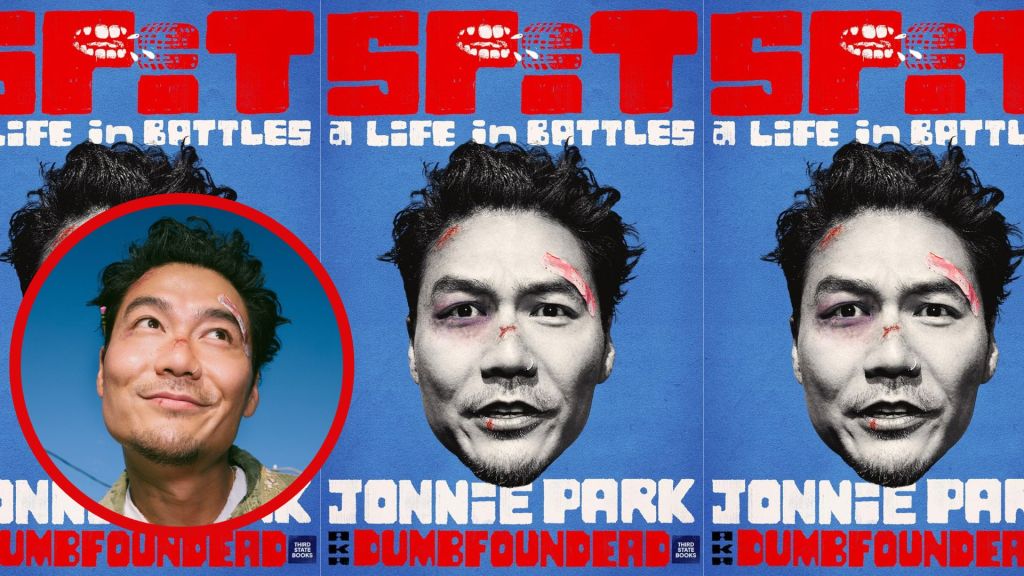
Spring feels different for rapper, comedian, and writer Jonnie Park this season.
As a Los Angeles resident, he typically would have immersed himself in the communal rush of last month’s Coachella Valley Music & Arts Festival. But instead, he found himself in the middle of a book tour in support of his memoir, “SPIT: A Life in Battles.”
“I performed at Coachella in 2022 with the 88rising collective on the main stage,” Park said during a recent phone interview. “I got to check that off my list before I moved on to other things. Not that I stopped making music, but the chances of me performing at Coachella now are less that I’m on the older side of my career.”
Sign up for our free newsletter about books, authors, reading and more
Park recently posted a throwback photo on Instagram of himself at Coachella that year, alongside a snapshot of him at his own Bookchella, posing with a stack of hard copies of the memoir at a signing.
Vastly different experiences, but equally exciting, he added.
While he missed out on the music festival weekends, so far, the “SPIT” book tour has been a rewarding run.
“It feels great now that the book is out,” he said. “It’s a lifetime of experiences to share, but I’ve had a lifetime of workshopping these stories through interviews I’ve done and different mediums I’ve performed in, whether it’s through my music or through my podcast.”
“SPIT: A Life in Battles,” co-written with Donnie Kwak, is a deep dive into Park’s life, and the title takes on several meanings. While he details his early days joining in rap battles, it also refers to the battles he faced as his family fell apart, experiencing racist stereotypes, addiction, and how he’s battled the pressures of fame.
Park is an Argentina-born, South Korean immigrant who was raised in the Koreatown neighborhood of Los Angeles. He became a U.S. citizen at the age of 19, but he was smuggled across the U.S.-Mexico border with his mother and sister when he was a young child. His father had already come to the U.S. for work, setting up shop in Koreatown.
“I was so young, so that was really my mother’s experience,” he said, adding that he spoke with his mother also using a translator to fully understand the details. “It was a two-week trek, and I learned how scary that was for her and the little things she remembered, like me making a birthday cake out of sand to keep my sister from crying.”
Park is still close with his mother, but not so much with his father. In the book, he describes the implosion of his family unit as a result of his father’s infidelity, abuse and addictions. By writing about it, Park said he’s been able to look back at these tumultuous moments with a bit more compassion.
“Not just for my mother, but for my father too, who I don’t speak highly of in the first chapter,” he said. Park still hasn’t spoken to his father since the book was published. “I always had this rebellious kind of teenage attitude when I was younger, and I was never one to fall into the things of what my parents wanted for me. That teenage rebelliousness always overpowered the cultural strictness of the Asian household.
“But as I grew older, I grew more empathetic toward my father’s experience as an immigrant Korean American man coming here and trying to set up shop for his family, but also falling for the vices that came along with that in the chase of the American dream. It’s a tough thing to analyze the sacrifices our parents made, but realizing you also sacrifice a lot of family life in that pursuit.”
Map: 90 independent bookstores in Southern California
As a teenager, Park learned the true power of language. A fan of ‘90s hip-hop, Park would rap for friends in the high school cafeteria, but it wasn’t until this novice entertainer stepped up in front of a crew at Project Blowed, an open-mic workshop in Leimert Park, that he realized his words could become weapons. Despite experiencing pangs of self-doubt, he was enthusiastic about sharpening that sword.
It was during these rap battles, or cyphers, he joined at Project Blowed that he took on the moniker Dumbfoundead. Though his nerves got the better of him the first few times he tried to jump into battle, once he got in, he was hooked.
“I think I saw a generation above me who wasn’t really speaking up for themselves all of the time, and that includes my parents coming to a new country and not being able to communicate,” Park said. “Knowing that I do have the language down and an opportunity, I wanted to be as loud as possible.”
When he stepped into those early rap battles, he got an adrenaline rush like no other when he landed his first punchline and the crowd reacted positively.
“I got treated differently after that,” he said. “As soon as I experienced that, I ran with it. I was as loud and as clever as possible, knowing that was going to be important in the culture and how I moved through it. And it got me through some stuff. It got me through dropping out of high school and surviving. I’m not advising that everyone drop out of high school, but I did have the gift of gab and a way of talking myself out of things … and sometimes into trouble, too. But I understood that power.”
Park parlayed his love of hip-hop and language into a multi-faceted career. Some fans know him for the early rap battle videos on YouTube, others for his numerous hip-hop albums and EPs, or for starring in films like “Quiz Lady” or TV shows like “Awkwafina Is Nora From Queens.” He also does stand-up and has hosted several podcasts, including “Fun With Dumb,” the “Baby Goat” alongside Andrea Jin, and “Home Room” with Steffie Baik and Rick Lee.
He can now add author to his resume. Park frequents a few local bookstores, including Chevalier’s Books on Larchmont Boulevard in Los Angeles and Skylight Books in Los Feliz. As a kid, he read “A Confederacy of Dunces” by John Kennedy Toole, and he says author Hua Hsu’s “Stay True” inspired him to write his own memoir.
“He told the story through the lens of his best friend who passed away, and he questioned a lot of things about their relationship, but with that, told a lot of his own story,” he said of Hsu’s memoir. “I think a bit of my story was about people’s perceptions because when I’m battle-rapping, I’m hearing a lot of people’s perceptions against me in that arena. It’s taught me a lot about myself and the average perception of what an Asian person is.”
Park said he had to develop a thick skin when entering rap battles, as well as hitting the comedy clubs, as every Asian stereotype was hurled at him.
“A thick skin, but also a little empathy,” he said. “You have to understand that everyone gets hit with something. I got the Asian jokes, the Latino kid got the Latino jokes, and the fat kid gets the fat jokes — like everyone has something. When you go in thinking that way, it’s a sport, and you break it into what’s the best lyrics versus what’s the most offensive or racial joke.”
He is proud to see more Asian representation in mainstream cinema, music, and other media.
“We’re living in a completely different time than when I was coming up,” he said. “Like post-‘Crazy Rich Asians,’ but we all know there was more of a foundation laid before that, but that was a big move for the community. Young people have just changed on how we see division, and a lot of non-Asians love Asian culture as well, with the rise of K-pop and anime.”
“We do still have stereotypes and kids called racial slurs,” he said. “My last rap battle was three years ago, and I heard all the same tired Asian stereotypes. I was less disappointed in my opponent than I was in the audience of 300-400 people who still reacted to those punchlines. They still work, but on the opposite end of all of that, you get to hear Korean lyrics when you turn on the radio now. There’s been a drastic change in the last 10 years.”
Most recently, Park served as a writer on the Lee Sung Jin Netflix series, “Beef.”
“Lee Sung Jin found me through my podcast and just liked my perspectives on Asian American and Korean American stuff, and I did an interview and got the job,” he said. “It was such a masterclass in writing being in that room because I was in there with seasoned writers from ‘Severance’ and ‘Succession.’ It almost felt like being in a cypher when I just had to know when to jump in and when to read the room. I applied my freestyle and rap battle roots into that system.”
In what spare time he has, Park is ducking into comedy shows at local clubs or even backyard parties. He’s also a foodie and has some solid food recommendations.
“Check out Seong Buk Dong in Koreatown,” he said. “I think a lot of these places aren’t as popular because they’re hard to pronounce, but it’s absolutely a gem – like Korean home cooking. I love that spot.
“Oh, and Saffy’s. It’s one of my favorites now,” he said of the Middle Eastern eatery. “I go there frequently and just get chicken skewers. It’s some of the best chicken I’ve ever had, so I’d recommend getting that with some hummus.”