
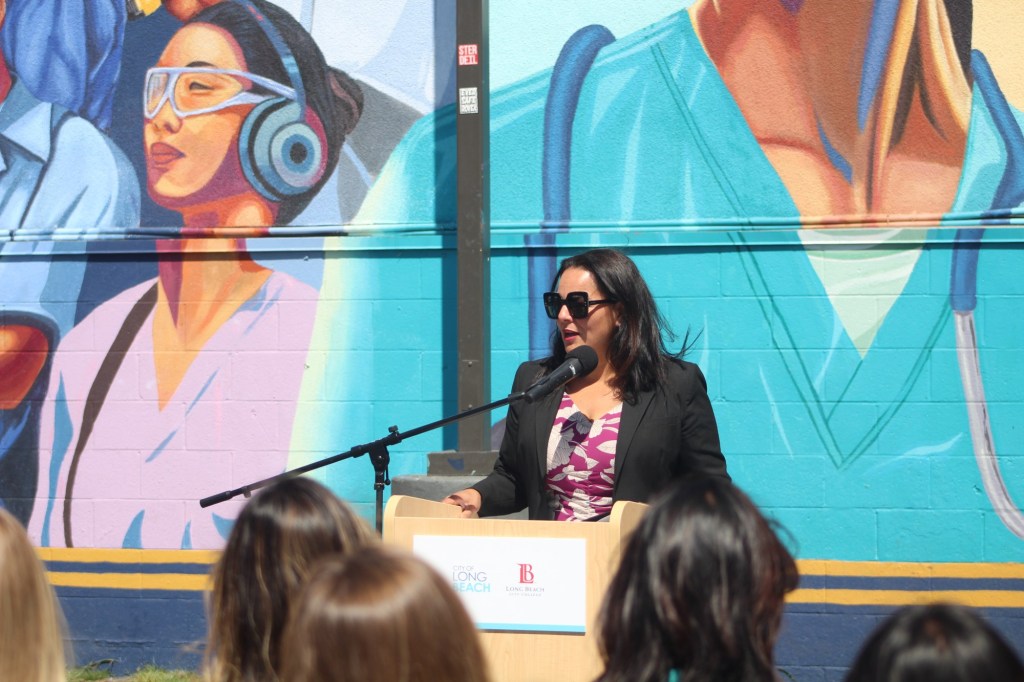
Ahead of the June primary election, the Southern California News Group compiled a list of questions to pose to the candidates who wish to represent you. You can find the full questionnaire below. Questionnaires may have been edited for spelling, grammar, length and, in some instances, to remove hate speech and offensive language.
Name: Vivian Malauulu
Current job title: ILWU Longshore Worker and Long Beach City College Trustee
Age: 52
Incumbent: No
Other political positions held: Long Beach City College Trustee
City where you reside: Long Beach
Campaign website or social media: vivianforlongbeach.com/
One of the main issues local leaders are grappling with is Long Beach’s current and long-term fiscal position. With major budgetary concerns on the horizon, explain your top priorities for Long Beach’s financial future and plans to achieve them. (Please answer in 200 words or less.)
Long Beach is at a critical point, and we need to be honest about the challenges ahead while staying focused on long-term stability. My top priority is ensuring a structurally balanced budget that protects core city services — public safety, infrastructure and neighborhood quality of life — without placing additional burdens on working families.
We must improve fiscal discipline by aligning ongoing expenditures with reliable, recurring revenues and reducing our reliance on one-time funds. That includes strengthening oversight, increasing transparency and holding departments accountable for measurable outcomes.
At the same time, we need to grow our revenue base strategically. As a port-adjacent city, Long Beach plays a critical role in the global supply chain. We should leverage that position by supporting responsible economic development, investing in small businesses and ensuring that goods movement and related industries contribute fairly to the communities most impacted.
I also believe we need to prioritize workforce development and job pipelines tied to emerging industries, including clean energy and logistics technology, so that local residents can access quality, good-paying jobs.
Fiscal stability is not just about balancing numbers — it’s about making smart, sustainable decisions that strengthen our economy and protect our neighborhoods for the long term.
Long Beach residents have been sounding the alarm about the presence of federal immigration enforcement agents and operations in the city. Where do you stand on ICE/CBP actions, and how to plan to address residents’ concerns about this issue? (Please answer in 200 words or less.)
Long Beach residents are right to be sounding the alarm. I want to be clear — I do not support the way ICE operates in our communities. Tactics that instill fear, separate families and disrupt the lives of working people who are contributing to our city are harmful and unacceptable.
Long Beach is a diverse, immigrant city and our residents deserve to feel safe in their own neighborhoods. When federal enforcement actions create fear and discourage people from reporting crimes, seeking help or participating in community life, it makes all of us less safe.
While immigration enforcement is a federal responsibility, the city has a duty to stand on the side of its residents. I support strengthening and enforcing policies that ensure local resources are not used to assist ICE operations and that our police department remains focused on public safety — not immigration status.
We must also expand legal support, increase community education around rights and demand transparency when federal agencies operate in our city.
This is about more than policy — it’s about who we are. I will always stand with our communities and fight to ensure that every resident is treated with dignity, respect and basic human rights.
Homelessness and affordable housing continue to be a top issue for Long Beach residents. What is your position on the city’s current efforts to reduce homelessness and increase affordable housing availability, and how do you plan to improve these efforts? (Please answer in 200 words or less.)
Homelessness in Long Beach is a humanitarian crisis and a systems failure, and residents are right to expect better results. While the city has made investments in outreach, interim housing and services, outcomes have not kept pace with the scale of the problem. We need a more coordinated, accountable and results-driven approach.
My priority is to strengthen what works and fix what doesn’t. That means expanding mental health and substance use treatment, improving coordination between the city, county and service providers, and ensuring that resources are tied to measurable outcomes — not just good intentions.
We must increase the supply of affordable housing at every level, but specifically for our neighbors who are currently unhoused. That includes streamlining permitting, incentivizing the development of workforce and middle-income housing and requiring that new development contributes meaningfully to affordability.
We also need to focus on prevention — protecting tenants from displacement, supporting seniors and working families at risk of falling into homelessness and addressing the rising cost of living.
This issue requires both compassion and accountability. We must get people off the streets and into stable housing while ensuring that our neighborhoods are safe, clean and livable for everyone.
What is the biggest issue your district specifically faces, and how do you plan to address it, if elected? (Please answer in 200 words or less.)
District 7 sits at the intersection of industry, infrastructure and residential life — and our biggest issue is the cumulative impact of that reality on our neighborhoods.
Our residents deal with the daily effects of port-related truck congestion on the 710 freeway, which causes traffic, pollution and noise. That creates safety concerns and aging infrastructure — all concentrated in working-class communities that have carried this burden for decades.
My priority is to make sure District 7 is no longer treated as a pass-through corridor, but as a community worthy of investment and protection.
That starts with fighting for cleaner air and stronger mitigation strategies tied to goods movement, including definitive accountability from industry partners. It also means investing in street repairs, traffic calming and green space improvements that directly impact quality of life.
It is critical that we identify and secure resources for our neighborhoods — support for small businesses, workforce development tied to port and logistics jobs and real investment in parks and public spaces.
District 7 deserves balance, and we deserve better. If we are going to host the infrastructure that drives the regional economy, then our residents should share in the benefits — not just the impacts.
What experience do you bring to the table for this role? (Please limit your answer to 200 words or less.)
I bring real, results-driven experience at the intersection of education, labor and public service — not theory, not talking points, but work that has delivered for our community. I am capable of leading on day one.
I’ve served three terms as an elected trustee at Long Beach City College, where I’ve helped guide policy, budgets and workforce development initiatives that directly impact students and working families. I come from the port industry, so I understand firsthand the realities of goods movement, economic drivers and the challenges facing working-class communities.
I’ve spent years teaching, working in journalism and building partnerships across sectors — experience that allows me to communicate clearly, bring people together and get things done collaboratively.
I’ve been elected, reelected and trusted to lead my community and within my union. I understand how government works, why tough decisions must be made, and which complex systems to navigate when.
Most importantly, I know District 7 because I’ve lived there. I’ve raised my family here, worked here and served here. Together with our four children, my husband and I have made West Long Beach our home for the past 26 years because we believe in our community.
I’m not running to get the job — I’m running to do the job.
Tom Umberg, California Board of Equalization District 4, 2026 primary election questionnaire
Karen Leigh Matthews, CA-23 candidate, 2026 primary election questionnaire
Raul Ruiz, CA-25 candidate, 2026 primary election questionnaire
Armen Kurdian, CA-49 candidate, 2026 primary election questionnaire
Mike Levin, CA-49 candidate, 2026 primary election questionnaire