
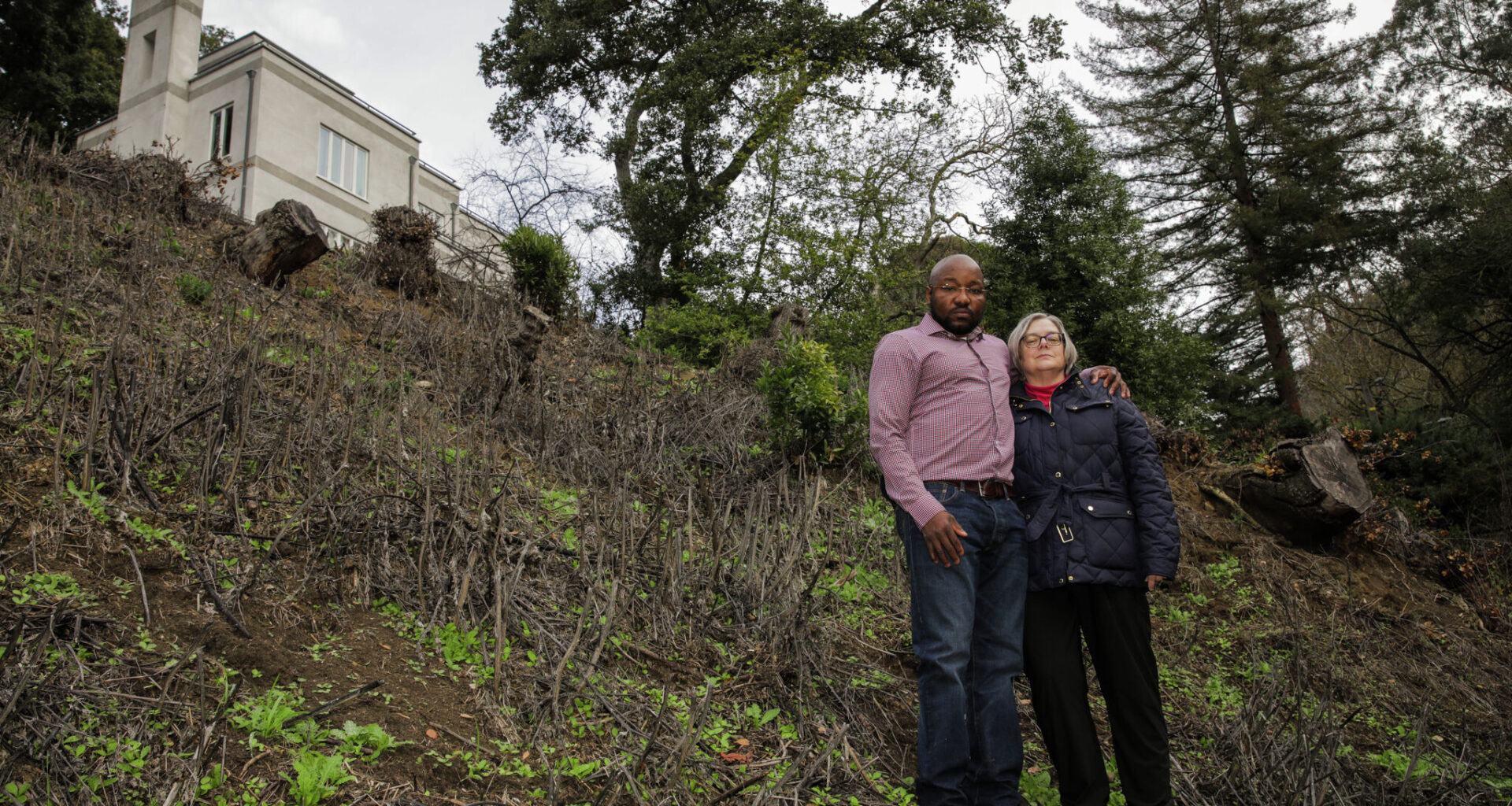
The Oakland City Council on Tuesday voted to enforce a nearly $1 million fine against Matthew Bernard and his domestic partner Lynn Warner, who are pictured above on their Claremont Avenue property.
Yalonda M. James/S.F. Chronicle
After months of debate and visible frustration, the Oakland City Council voted Tuesday to enforce a $1 million fine against a couple who cut down 38 mature trees across their property, a neighbor’s lot and an adjacent city lot on Claremont Avenue.
For some, the vote was about more than a single hillside property. It became a test of whether Oakland, which has gained a reputation for permissiveness and lax enforcement, would stand behind its own laws.
“We have to decide as a council if the laws mean something, or if they’re just ink on a piece of paper,” Council President Kevin Jenkins said during the meeting. “We have to decide whether Oakland will continue to have the reputation that people can do whatever they want without consequences.”
Article continues below this ad
Emeryville residents Matthew Bernard and Lynn Warner bought their tree-covered lot in 2019, and planned to build a family home there. City staff say that in 2021 and 2022, Bernard and crews he hired cut down 38 mature trees, including oaks, without permits.
Even when city arborists appeared on site and asked him to stop, Bernard continued cutting, according to city officials. One city arborist called the case “the most egregious illegal tree removal case” the city had seen in three decades.
San Francisco Chronicle Logo
Make us a Preferred Source to get more of our news when you search.
Add Preferred Source
Bernard and Warner, who were both at the meeting on Tuesday, declined to comment.
The issue has riled swaths of the Oakland community, garnering public comment from environmental advocates who spoke at Tuesday’s hearing, as well as written comment from elementary and high school students. But even after discussing the issue at two previous meetings, the council still remained divided.
Article continues below this ad
Some council members said that imposing the full fine would go too far, and could make it impossible for the couple to ever build on the property. Others argued that anything less than the full $915,000 fine would undermine the city’s credibility. Council Members Janani Ramachandran, Zac Unger, Charlene Wang, Noel Gallo and Jenkins voted to levy the full fine, while Carroll Fife, Rowena Brown and Ken Houston voted against it.
“By holding accountable those who knowingly violate those laws, we are sending a clear message that Oakland is serious about enforcement and will hold accountable those who flagrantly disregard our laws and trash our land,” Ramachandran, whose district includes the Oakland hills, said in a press release.
Brown argued the city likely would have given the couple permission to remove several trees on the property, had they gone through the standard building permit process before deciding to cut down the trees themselves. She said that applying the full fine of $915,000 would amount to “hyper-enforcement,” and instead advanced a proposal to fine Bernard and Warner around $600,000, accounting for the 28 trees beyond the footprint of their home plans.
“We must ask ourselves a fundamental question of justice,” Brown said during the meeting. “Why are we fining a property owner the full replacement value of the trees the city would have likely authorized him to remove during the standard building permit process?”
Other council members saw the issue through a distinctly racial equity lens. Fife said that it was unjust of the city to levy one of the largest fines in the city’s history against a Black man and his partner, in an area that historically barred non-white homeowners.
Article continues below this ad
“We’re talking about land that has been colonized,” Fife said. “Who is the authority that gives permission on stolen land?”
To some Oakland residents who spoke on Tuesday, the fact that the issue had been elevated to a hearing before the council at all demonstrated an uneven application of the city’s laws.
“If I park my car illegally, I’m required to pay a fine,” said Kevin Mulvey, co-chair of Oakland Urban Forestry. “I don’t get to come before the city council three times to make an appeal directly to our political leaders.”
“When citizens break the law, they must pay the price — the full price — not a slap on the wrist, otherwise we further jeopardizes our constantly shrinking urban forest,” he said.
Article continues below this ad
It’s unclear what will become of the property now. Since 2022, the lot has been barren — just some stumps and spiky thickets remain. If the owners don’t pay the fine, Oakland can place a lien on the property, which could eventually lead to foreclosure and a forced sale of the land if it remains unpaid.
Bernard previously told the Chronicle that he paid $175,000 in cash for the 12,000-square-foot property in 2019, and estimates that it is worth close to $250,000 now.