
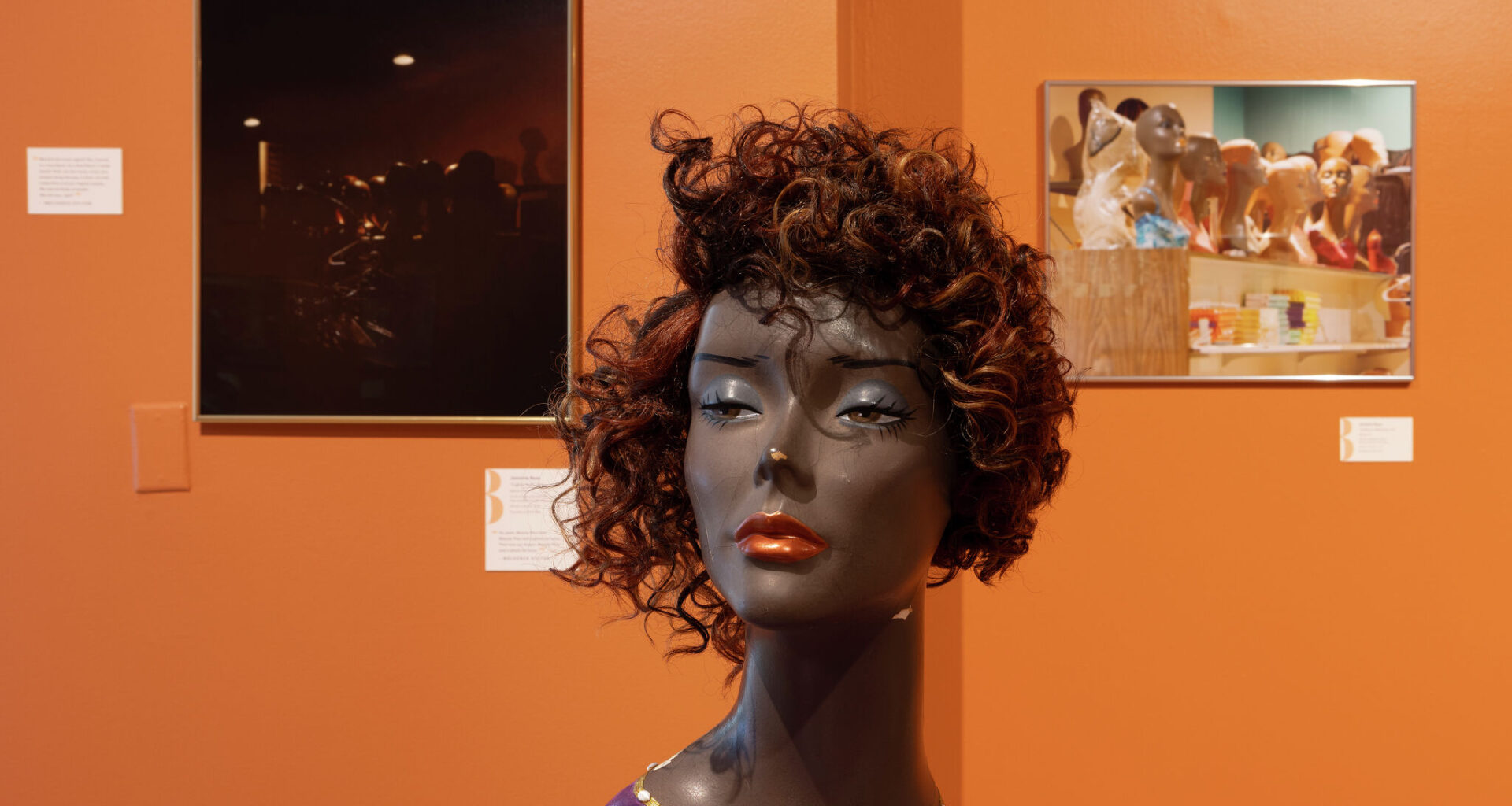
“Jasmine Ross: Beauty Plus” on view through May 31 at the Museum of the African Diaspora.
Francis Baker/MoAD
“What’s Left” by Jasmine Ross.
Jasmine Ross
“Jasmine Ross: Beauty Plus”
Francis Baker/MoAD
“Jasmine Ross: Beauty Plus”
Francis Baker/MoAD
“Jasmine Ross: Beauty Plus” on view through May 31 at the Museum of the African Diaspora.
Francis Baker/MoAD
At 22 years old, Jasmine Ross is the youngest person to ever be selected for the Museum of the African Diaspora’s Emerging Artist Program. But that’s not the main reason to see her show.
“Jasmine Ross: Beauty Plus” at MoAD accomplishes two impressive feats, both establishing Ross as an artist of precocious sensitivity and intimately presenting the bittersweet closure of a beloved Black-owned beauty supply store.
“Jasmine Ross: Beauty Plus”: Multimedia. 11 a.m.-5 p.m. Tuesday-Wednesday and Friday-Saturday; noon-8 p.m. Thursday. Through May 31. $7-$15; free admission for ages 5-12 and those with a valid military I.D. Museum of the African Diaspora, 685 Mission St., S.F. 415-358-7200. www.moadsf.org
With “Beauty Plus,” Ross documents the last two and a half months of the eponymous beauty supply store in New Haven, Conn. prior to its closure after 31 years in business. One photograph shows owner Melvenia Hylton standing proudly in front of rows of mannequin heads still sporting wigs for sale. In another image, empty plastic hangers clack together on a metal rack denuded of products that will not be restocked.
Article continues below this ad
“It’s fine art documentary photography,” Key Jo Lee, MoAD’s chief of curatorial affairs, explained. “There’s this way in which those images are very evocative. Yes, they’re about the closing of the shop, but they’re also about shape, about light and dark.”
Jasmine Ross, the youngest person to ever be selected for the Museum of the African Diaspora’s Emerging Artist Program.
Maiyio Taylor-Jackson
“Beauty Plus,” which formed Ross’s senior thesis at Yale University, began when Ross presented Hylton with a photo of the owner standing inside the shop window. Instead of the finished image, the photograph appears as twin images on film, bringing the viewer into the artist’s process.
San Francisco Chronicle Logo
Make us a Preferred Source to get more of our news when you search.
Add Preferred Source
“I took that image without her consent, which is very much against my collaborative basic image making practice now,” Ross admitted during a phone call with the Chronicle speaking from her home in Berkeley. “I scurried away out of fear that she would disapprove and so it wasn’t until about three months later when my friend told me that they were closing that I actually, I finally went back.”
Article continues below this ad
While a student at Yale, where she earned a B.A. in ethics, politics and economics as well as art in 2025, Ross visited Beauty Plus both for her personal needs (braiding hair, gel) and artistic (2,000 bobby pins to fashion a crown for a photographic model). Then, in her final semester, Ross became Beauty Plus’s elegist, its final loving witness.
“Jasmine Ross: Beauty Plus” on view through May 31 at the Museum of the African Diaspora.
Francis Baker/MoAD
Among the more documentary images, such as Hylton holding a photograph of the Obamas or a shot of ceiling water stains above merchandise shelves, are photographs straight out of the fine arts tradition. Turned three quarters towards the viewer, an elegant mannequin head known as “Lady #5” poses like a Renaissance portrait. Her beauty was enhanced by Lisa Harrell, who worked at Beauty Plus all 31 years. Harrell gave each mannequin a necklace and painted lipstick.
As lovely as the mannequins are, Ross said they “still have dainty Eurocentric noses and long necks.” Harrell tried to make them more reflective of Black culture,but the skin tones were still “grayed out.” So Ross took time to “make it seem more chocolaty to represent the Black community a little bit more accurately,” continuing Harrell’s efforts.
Ross spent the spring of 2025 lugging a suitcase containing her 4×5 camera, a 10- to 20-pound apparatus complete with old-timey bellows requiring hand-loaded film, to Beauty Plus. Each shot made with the camera required up to 30 minutes of set-up. Ross sees that time as a way of avoiding the “extractive process,” the exploitative non-consensual practices unfortunately common in the history of photography.
Article continues below this ad
“The time that Jasmine is taking to produce those films actually mimics the time-based nature of community building,” said Lee. “It also mimics the intimacy required to sustain Black life under pressure.”
The 4×5 camera Jasmine Ross used for “Beauty Plus.”
Jasmine Ross
Lee’s observation echoes Ross’ own articulation of her practice.
“My goal will never be to simply document what something looked like, but what it felt like to be there, moving through that space, and inhabiting that identity,” Ross explained. “Especially when thinking about Black life, where lived experience has historically been dismissed or distorted, I see this more holistic approach and understanding of what truth can be as a way to reclaim narrative authority.”
That ethos is embodied in Hylton, who Ross describes as“one of those neighborhood aunties who you could go to the beauty supply store and just talk to for hours. … She was very much a community builder.”
Article continues below this ad
“No Returns/Life’s Work” by Jasmine Ross
Jasmine Ross
The 2020 census counted the Black population of San Francisco at 5.1%. Last month the Castro Theatre hosted a sold-out screening of the 2019 film “The Last Black Man in San Francisco,” but Black businesses continue to face pressure. In recent years prominent Black-owned businesses including 1300 Fillmore, All Good Bakery, Brown Sugar Kitchen and Red Bay Coffee’s flagship café have closed.
“We have to have these microcosms of care if we’re ever going to be able to face the larger systems of exclusion,” said Lee.
When Ross graduated, Hylton and her husband Rudolph, aka Rudy, whom Ross calls “fictive kin,” gave her a card with $100. They later shipped the blue boombox that appears in “Ms. Purple” to MoAD.
Article continues below this ad
In the gallery, photographs of Hylton in her shop listening to the radio — antenna still wrapped with tin foil — are displayed. They appear among the mannequin heads decorated by Harrell’s paintbrush and worn at the crowns from people removing and replacing wigs for 31 years. Here, the gift of Beauty Plus lives on.
Letha Ch’ien is a freelance writer.