
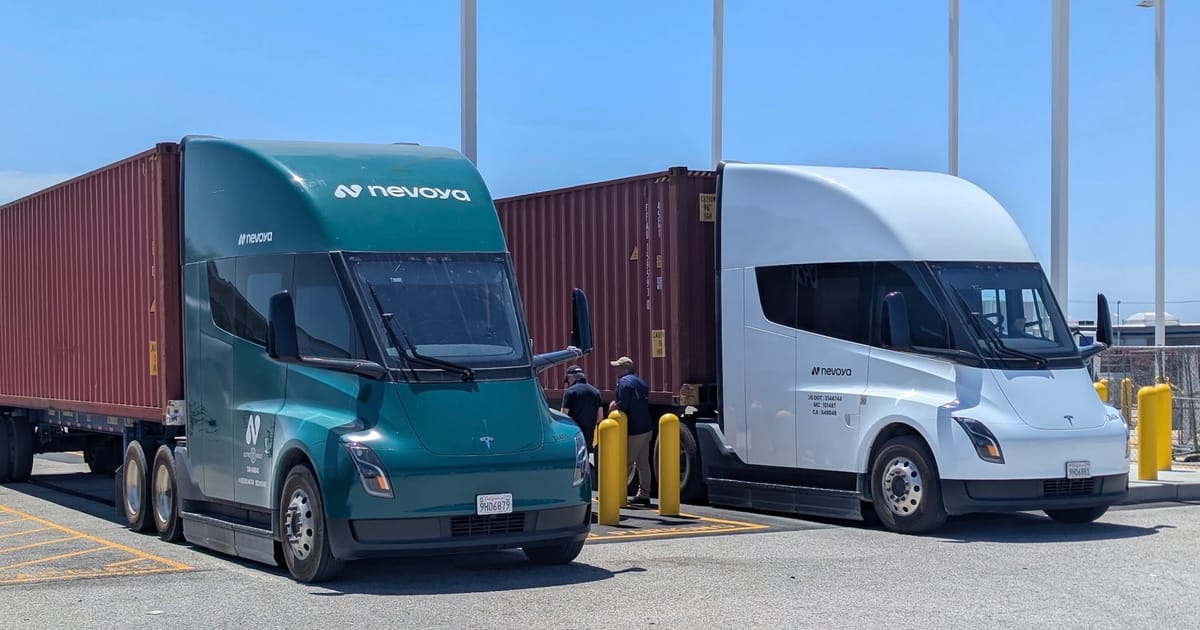
Back in 2017, Tesla promised to bring an all-electric semitruck to market that would have a longer range and lower cost than its competitors. Then, the trucking industry waited — and waited. The initial production target of 2019 came and went, as did each newly announced date over the next three years.
But in 2022, Tesla finally unveiled its Tesla Semi and started to get pilot versions on the road for testing. The Class 8 battery-electric truck hit performance targets well beyond what Daimler, Volvo, Kenworth, Peterbilt, and other companies were delivering with their all-electric models. As of April 29, Tesla says it has finally started high-volume Semi production at its factory in Sparks, Nevada.
Now, the Semi’s combination of mileage and price appears set to transform an industry hungry for an affordable way to move freight without burning diesel — especially in California, the country’s top market for electric trucks.
Of the 1,067 requests for vouchers submitted during the latest application window, which launched in December 2025, 965 were for Tesla Semis, he said. That’s far more applications than for any other model of truck, he added — and more than the total number of HVIP applications for all heavy-duty trucks since 2021.
And if all those Tesla Semis are actually delivered by the end of this year, that could make up about a third of heavy-duty truck sales in the state, Minjares said. That’s far above the 10% target for zero-emissions Class 8 vehicles set under California’s Advanced Clean Trucks regulation, he noted.
This would be an important environmental accomplishment. Heavy-duty trucks emit more than half the transportation sector’s harmful air pollution, with disproportionate health impacts for lower-income areas and communities of color.
Considering the policy headwinds, “states that have severe air quality challenges and climate goals need to find alternative pathways to enable this transition,” Minjares said. And one of the most important ways to do that is “putting downward pressure on the price that fleets are paying for the vehicles.”
The median price for a Tesla Semi capable of driving about 500 miles on a single charge is just under $300,000, according to HVIP data. That’s about $138,000 to $224,000 less than competing Class 8 battery-electric vehicles with roughly half the range, he said.
And while Tesla has tested the patience of buyers with its delays, the early models it put on the road got high marks from trucking companies and drivers.
As of today, Tesla has boosted the range of its Semi to up to 350 miles for the standard model and up to 500 miles for the long-range model. It has also launched its Megacharger, capable of delivering up to 1.2 megawatts of power — enough to replenish about 60% of a Semi battery in 30 minutes — available both for truck depots and at an expanding set of public charging sites.
“The Tesla Semi is twice the range, and half the charging time, of trucks from traditional manufacturers,” Roeth said. “And early data is showing it’s a third less expensive to purchase.”
What truckers want from their electric trucks
These are all appealing characteristics to Jennie Abarca, founder and CEO of King Fio Trucking in Long Beach, California. She already has 11 electric trucks in her 35-truck fleet serving the ports of Long Beach and Los Angeles, including models from Volvo, a major manufacturer, and Nikola, a startup that went bankrupt last year.
“Both trucks have been exceptional,” she said. “But now you have something like the Tesla coming in: 500-mile range, 30-minute recharge, and $150,000 less than the current option out there — wow.”
Buyers must still pay sales and excise taxes on the full sticker price of the vehicle and cover registration fees. But with the full stack of incentives, the cost of a Tesla Semi “will look more like a really nice used diesel [truck], which is what I would normally buy,” Abarca said.