
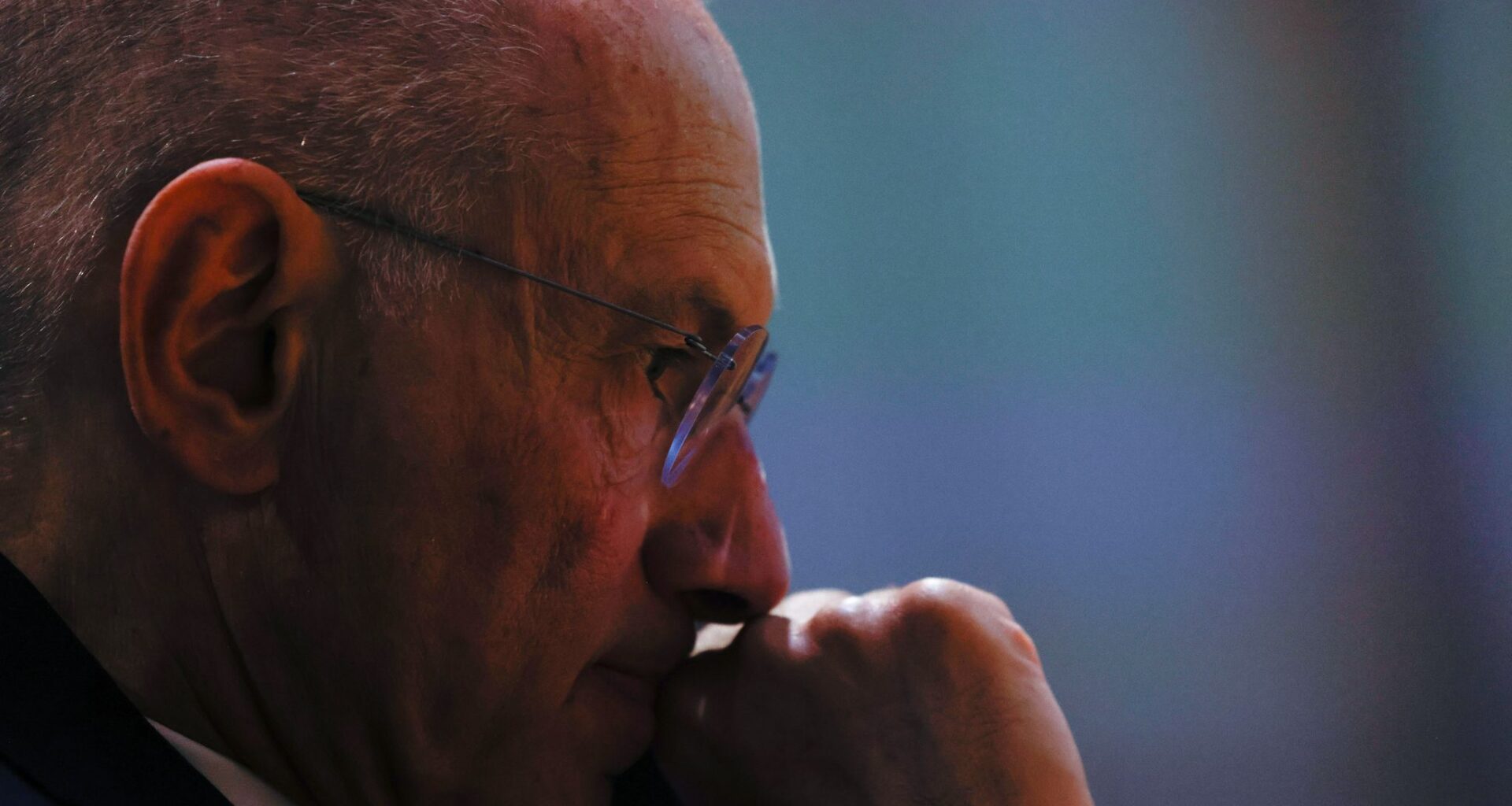
San Francisco billionaire Michael Moritz, shown in 2025, said he has given hundreds of scholarships to students. The gifts stem from how a scholarship saved his own family.
Lea Suzuki/S.F. Chronicle
It was just a typical scholarship so one student could attend a school his family otherwise couldn’t afford, nothing noteworthy at the time.
But over 80 years the legacy of that scholarship rippled across countries and continents, to California and the Bay Area, shaping Silicon Valley and changing the lives of thousands.
Specifically, Michael Moritz is alive because of that scholarship.
Article continues below this ad
The financial gift saved his father from the Holocaust while Moritz’s grandparents and other relatives, unable to leave, perished.
“The only way that my father got out of Nazi Germany was, as a 14-year-old, to win a scholarship at a school in London,” he said. “That was his ticket out of the terror.”
San Francisco Chronicle Logo
Make us a Preferred Source to get more of our news when you search.
Add Preferred Source
So, the father lived and his son became one of the 500 richest men in the world.
And now Moritz — a journalist turned venture capitalist who helped launch Google, Yahoo, Apple, Zoom, PayPal and Cisco — is buying the next generation of young people tickets to their own futures.
Article continues below this ad
San Francisco billionaire Michael Moritz, shown in 2025, said his family foundation’s scholarships to students aren’t the reason for their achievements. The students must still find success on their own.
Lea Suzuki/S.F. Chronicle
This week, as the second round of San Francisco Crankstart scholars readied for their celebratory bash, first year recipient Denys Kovalenko thought about his freshman year at college and the strangers doling out scholarships who helped him get there.
“If not for them,” he said, “I wouldn’t be here.”
Philanthropy-funded scholarships are not noteworthy. Nor are billionaires who dabble in education. But Moritz is something of a standout among his peers in both the level of spending and the lack of limelight he seeks. His donations for college aid, going back to at least 2008, reach well into the hundreds of millions and he doesn’t want his name on any buildings.
More recently, his family’s Crankstart Foundation has pushed college aid into San Francisco and is set to launch its second class of San Francisco college scholarship recipients this fall, 223 public high school seniors who will receive up to $15,000 per year for their undergraduate degrees.
Article continues below this ad
An official celebratory “send-off” Wednesday will feature top City Hall and education officials at an invite-only event at The California Academy of Sciences.
The first cohort, the class of 2025, included 200 students from city high schools, whose scholarships totaled $1.33 million for year one, with a budgeted $18 million for up to six years of undergraduate education. Of the group, 83% are the first in their family to go to college while 91% qualify for the highest levels of financial need.
Denys was a San Francisco among the San Francisco senior, but with a backstory thousands of miles away. A few years earlier, his family had fled the war in Ukraine, the fighting less than an hour’s drive from his home. He ended up in San Francisco at age 15, a refugee whose English was limited to a few phrases like, “Hello, I’m Denys, I’m from Ukraine.”
Denys Kovalenko, third from left in yellow, stands with his Cal Poly San Luis Obispo club soccer teammates after a tournament win.
Courtesy of Denys Kovalenko
He started school at Balboa High his sophomore year. The food, the culture, the people — all different from his home.
Article continues below this ad
Two years later, his English was nearly fluent, he had fallen in love with burritos, he was playing soccer — his passion — and he was applying to colleges, although he had no idea how his family would pay for it.
The Crankstart scholarship shifted the math. Denys is finishing his first year at Cal Poly San Luis Obispo where he is studying Business Administration. He has also found a community on the men’s club soccer team, with the Ukrainian teen named an All-American goalkeeper.
The displaced college student from a war-torn country could see the bittersweet irony in the title, describing the experience as “magical.”
“Back in Ukraine four years ago, I could not even imagine going to America, let alone going to such a university and winning all the championships and nationals and regionals, I guess that’s the beauty of life,” he said. “It comes at a cost.”
While Moritz’s father survived the war, his grandparents and other family died in the Holocaust. His parents eventually settled in Wales and Moritz would later attend the University of Pennsylvania — with a scholarship paying his way.
Article continues below this ad
His subsequent fortune funds the Crankstart Foundation, which gives out more than $200 million in grants annually, most in San Francisco to address a range of issues from health, to housing, jobs and civil rights.
But education has long been a big part of Moritz’s philanthropic push.
“It began with the obvious idea that education is a pathway for people,” he said, “and an essential part of being able to clamber up economic mobility matter, irrespective of where you were born.”
He not only funds scholarships in San Francisco, but also at the University of Chicago, where his wife Harriet Heyman attended, at The Juilliard School in New York and more significantly at Oxford University in England, where his father received financial assistance.
About 14% of undergraduates at Oxford are on a Crankstart scholarship, Moritz said.
“It’s very easy to give a scholarship. It’s very hard to make the most out of it,” he said. “I think it’s what they do for themselves, it’s not what we do for them. Yes, they may obtain a scholarship or financial support, but then it’s up to them to make the most of it.”
Moritz, who also funds the for-profit news site, the San Francisco Standard, doesn’t get sappy about the recipients, even as his father’s legacy moves through them, including the displaced Ukrainian goalkeeper gripping a trophy.
Denys was just fortunate, Moritz said.
“Imagine all the people who weren’t able, people of his age who had his abilities, who weren’t able to get out of their countries or come (here),” he said. “So he’s a very lucky fellow.”
Denys knows that. He sometimes catches himself remembering a street back home or a place he hung out with friends, a realization he can’t go back to something that’s no longer there.
“That’s when I understand there are things that I can do something about and there are things that I cannot do anything about,” he said. “I cannot go back. I cannot stop the war myself. But what I can do is stay here, adapt and try to, for now, to do as good as I can: learn, play soccer, build some plans for the future.”