
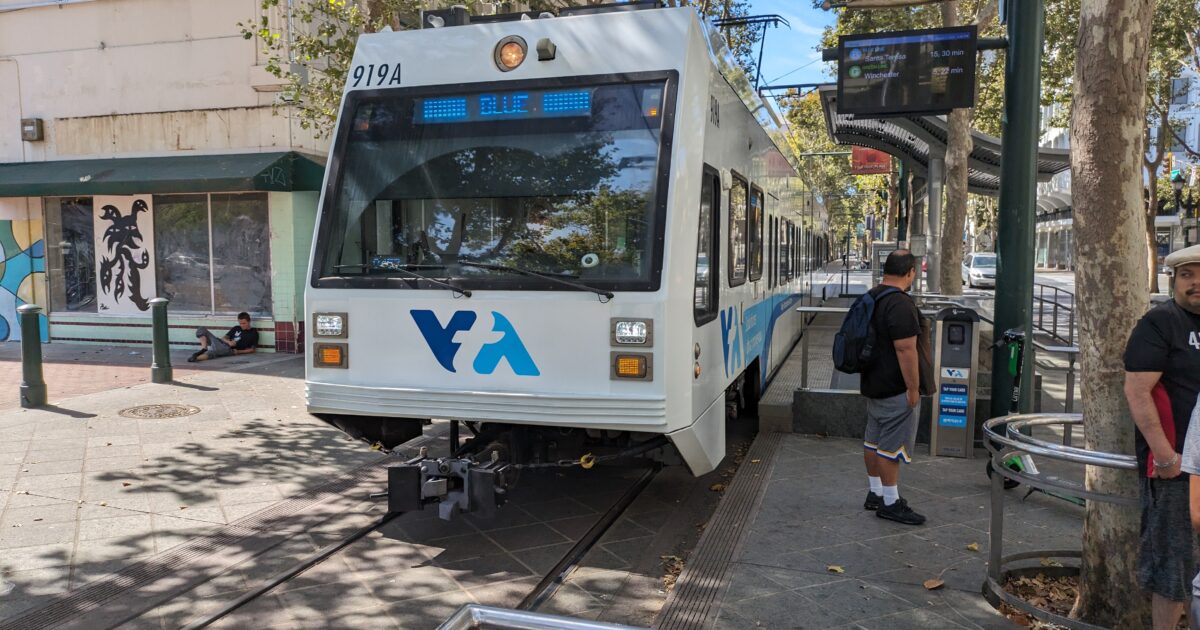
Advocates are gearing up for a regional outreach effort now that the door is open for a Bay Area public transit funding measure on the November 2026 ballot.
Gov. Gavin Newsom signed Senate Bill 63, also known as the Connect Bay Area Transit Act, on Oct. 13 — clearing the way for a voter initiative to put a 14-year sales tax measure supporting Bay Area transit agencies on next year’s ballot. A coalition of transit supporters across advocacy, labor and business groups formed soon after to spearhead outreach and signature gathering efforts.
The coalition — Connect Bay Area Transit Committee — has to gather more than 186,000 signatures across Santa Clara, San Mateo, San Francisco, Alameda and Contra Costa counties by June 3, 2026, to coalition spokesperson Jeff Cretan said. Signature gathering can’t start until next year, so he said these first few months are focused on fundraising and building support from other organizations.
“This is a huge effort, it’s five counties,” Cretan told San José Spotlight. “We have an advocacy council that’s working to build up support amongst their membership, but also go out into their communities and talk about why this matters.”
If approved, the measure is expected to bring a roughly $264 million annual boost to VTA by 2031 ahead of multimillion-dollar deficits. Not only would it close the gap, but extra funds could go toward service expansions and improvements.
While most counties including Santa Clara face a half-cent tax, it could be as high as one cent in San Francisco. The money will be distributed proportionally to the transit agencies serving each county where the tax is collected, so VTA will receive the majority of taxes from Santa Clara County.
For other regional transportation agencies, the proposed sales tax is about survival. BART’s emergency funds are expected to run out in 2026, and slashing service frequency, closing nine stations and ending service three hours early would not be enough to bridge the deficit. An estimate expenditure plan from the Metropolitan Transportation Commission (MTC) shows BART would receive $330 million annually by 2031 from the proposed sales tax.
Advocates say funds from SB 63 are essential to maintain public transportation and the Bay Area’s overall quality of life.
“Without this regional measure, BART and Caltrain and all the other agencies are looking at massive cuts to service, which means 101, 280, 680 and 880, they become parking lots,” Transbay Coalition co-founder Carter Lavin told San José Spotlight. “Can you imagine how terrible traffic would be if there was no Caltrain, if thousands of people on BART going from Berryessa North had to get in a car and drive?”
Transbay Coalition is part of the committee’s advocacy council, and Lavin was one of dozens of supporters urging VTA to opt-in to the measure in July. Lavin said polling has been positive so far, as a January MTC poll of a truncated version of the measure without Santa Clara County found a majority of voters would support the tax to stave off transit cuts. May polling from VTA also found a majority of voters would approve a transit sales tax measure.
Cretan said MTC is conducting another poll of the finalized SB 63 measure, with results expected to be posted soon. As a voter initiative, the measure would need a simple majority to pass.
While VTA’s board of directors voted to join the effort, the agency is only legally allowed to publicize facts about the proposed measure, according to a VTA spokesperson. But elected officials can show their support, so VTA Board Chair and Campbell Mayor Sergio Lopez said he plans to endorse the measure.
VTA board members previously voiced worries about encouraging voters to pass a tax given the current economic climate and competing measures, but advocates said the positive polling numbers prove residents know the necessity of good transportation.
“People don’t want to see the status quo, people want to see that the transit system is getting more convenient and easier to use,” Seamless Bay Area Executive Director Adina Levin told San José Spotlight. Lopez said the measure would allow VTA to enhance public transit by increasing service frequency, coverage and connectivity throughout the county and beyond. An MTC estimate expenditure plan shows about $46 million would be allocated toward rider quality of life improvements, such as free and reduced fee transfers between agency lines.
“We want the opportunity to think, how can we use these resources to transform our system, to make it a more seamless, interconnected system, to make it easier to get around, whether it’s within the county or across the region,” Lopez told San José Spotlight.
B. Sakura Cannestra is a freelance reporter who previously worked at San José Spotlight through the California Local News Fellowship. Contact her at [email protected] or @SakuCannestra on X.