
Councilmember Ken Houston wants to dramatically scale back the independence and power of Oakland’s police oversight board.
His proposal, made public last week, would eliminate a volunteer selection panel that currently picks police commissioners. In place of that, each councilmember and the mayor would pick a commissioner. The District 7 representative’s plan would also take away the commission’s ability to appoint the inspector general — a person responsible for auditing OPD’s practices and policies and recommending improvements. And he wants to take away one of the commission’s most important jobs: helping hire police chiefs. Under the current system, the police commission selects finalists and the mayor hires the chief from that batch.
Houston told The Oaklandside he is still working on his ballot measure’s language, and that he accidentally left out a key provision in his legislation: eliminating the commission’s power to fire the police chief.
“I missed it because I was trying to get [the proposal] in really fast,” Houston said.
His plan to weaken civilian oversight of OPD caps years of criticism aimed at the police commission by the Oakland Police Officers Association, pro-police activists, and their allies in city government. Critics claim the commission is to blame for restraining officers’ abilities to fight crime, demoralizing the department, driving away police chiefs, OPD’s understaffing, and other problems.
Supporters of Oakland’s civilian oversight system say these claims are misguided and that the police commission is needed to ensure OPD continues to hold problem officers accountable and that the department keeps advancing meaningful reforms.
The Coalition for Police Accountability, a community group that helped establish the police commission in 2016, called Houston’s plan an “attack against police oversight” in a recent email to its supporters and alleged that the councilmember’s proposal was really drafted by the police union.
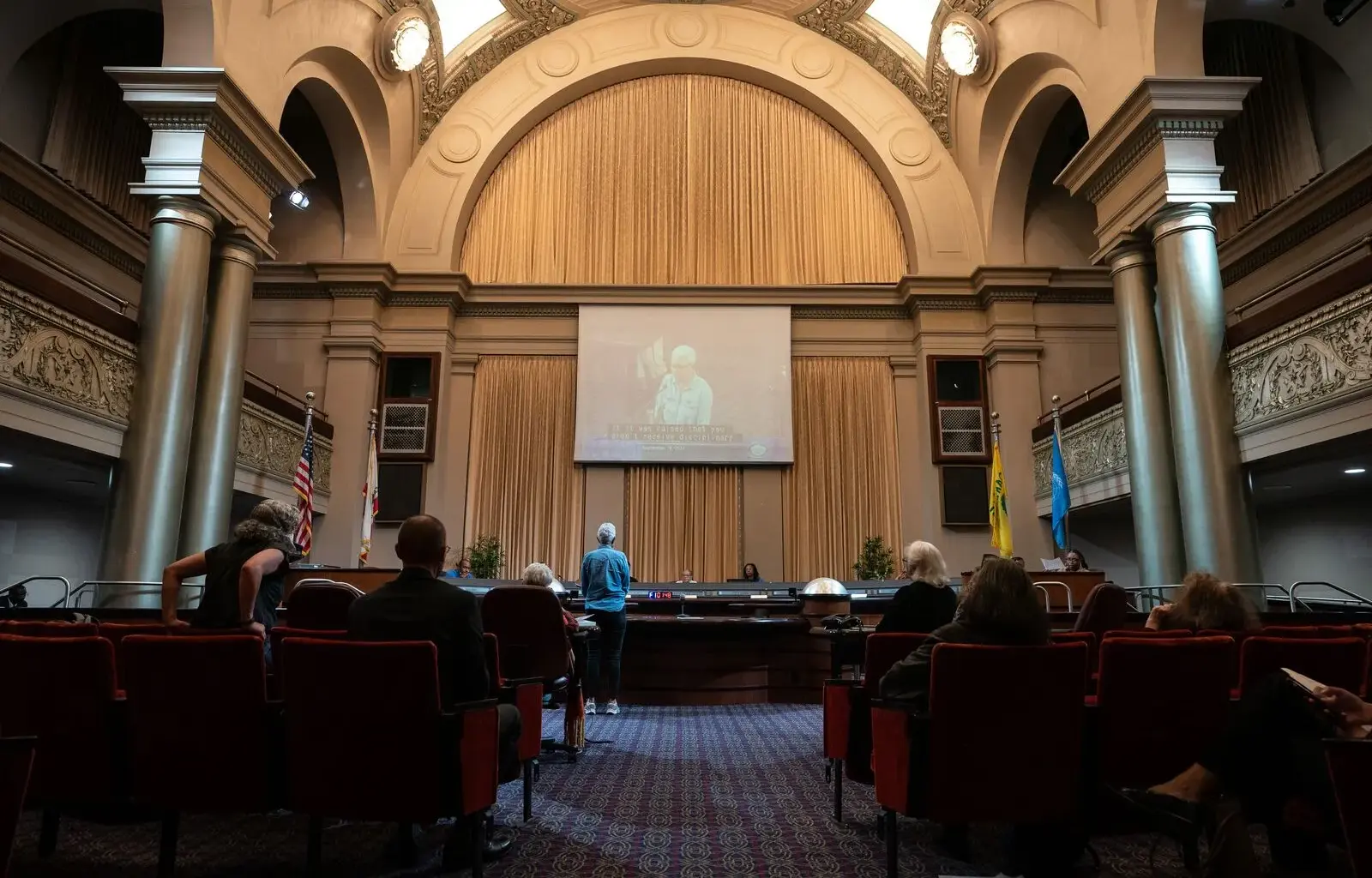
Supporters and opponents of the commission are rallying their sides to show up to the May 7 City Council Rules and Legislation Committee meeting to weigh in on Houston’s plan.
Any changes to the police commission’s powers, whether it’s Houston’s proposal or some other offering, would have to be put before voters as a ballot measure because the commission is a branch of Oakland’s government established in the City Charter.
10 years ago, voters overwhelmingly chose to create a strong police commission
It’s unclear whether Oaklanders will agree to civilian oversight of the police department. More than 83% of voters passed Measure LL in 2016 to create the commission. In 2020, 81% of voters approved Measure S1, which gave the commission more authority and independence.
Voters made those choices in the aftermath of a disastrous scandal where multiple OPD officers were found to have sex trafficked a teenager and the police chief at the time was implicated in an effort to bury the abuse case and prevent the department’s federal monitor and others from ever learning about it. Since then other police misconduct cases have rocked the department, including the 2018 fatal shooting of a homeless man, a police sergeant’s string of misconduct that was mishandled by department leaders, a detective’s alleged perjury and bribery of a witness and other wrongdoing that has overturned several convictions, including for murder, and again the mishandling of the detective’s internal affairs case by the former chief of police and other high-ranking officials.
However, in recent years, the commission has been beset by internal power struggles and clashes with the City Council. At the same time, new public safety advocates and groups have emerged, criticizing civilian oversight of the police and attempting to portray the police commission as a board that pushes “excessive disciplinary measures” on officers, discouraging police from doing their jobs.
Houston acknowledged that his plan might be “a pretty heavy lift” for his colleagues, especially during a year when three are up for reelection, and when voters could be asked to weigh in on major overhauls to the City Charter.
But Houston said he’s received feedback from residents who are concerned about the commission. He also said Empower Oakland, a political advocacy organization, recently surveyed residents, finding support for his measure. Empower published its survey on Tuesday.
Conducted by Change Research, the poll of 1,200 likely Oakland voters in March found that 60% of respondents want to keep the commission but “make significant changes to its structure and powers.” The poll also found a strong plurality of respondents supported this idea across all council districts.
According to Empower’s poll, respondents favored removing the police commission’s ability to hire and fire police chiefs “by a very wide margin,” and expanding eligibility rules so that former law enforcement officers can serve on the commission.
According to Empower Oakland, respondents also supported removing the commission’s “final say” over OPD policies. However, the commission doesn’t have final say over all of OPD’s policies. Most of the department’s policies are determined by the police chief. The commission can only provide advice about most of OPD’s policies, and the chief isn’t obligated to go along with the commission’s recommendations. The commission’s ability to reject or approve policy changes, described in the City Charter, is limited to those “which govern use of force, use of force review boards, profiling based on any of the protected characteristics identified by Federal, State, or local law, or First Amendment assemblies,” and matters having to do with federal court oversight. When the commission does reject a proposed policy, the Oakland City Council gets to approve or reject that decision.
Houston wants the police commission to be an “advisory” body
Before the police commission was established in 2017, Oakland had a Citizens’ Police Review Board, which had the power to investigate complaints of police misconduct, but it could not impose discipline on officers. It could only make a recommendation to the city administrator, and its advice was often ignored. Houston’s plan would make the police commission more like the old review board.
He appeared to first float his proposal on April 5 in a social media post where he asked, “should the Oakland Police Commission have Advisory or Authority over the Oakland Police Department ‘OPD’?”
Some commenters supported the idea of the commission being more of an advisory body. One of the people who responded wrote that they believed the commission shouldn’t have authority. Houston replied, “I 100% agree!”
At a council committee meeting in late April, Houston announced his intent to “bring some charter changes forward” based on a new city audit of the police commission, according to the Oakland Observer, which has closely followed the police commission and City Council.
Houston has had a contentious relationship with the commission. Much of this has had to do with a conflict over reappointments to the commission that have been vigorously opposed by pro-police activists.
Last October, the City Council unanimously declined to renew the appointments of two commissioners, Ricardo Garcia Acosta and Omar Farmer, who had been recommended by the selection panel. After a heated meeting, Houston upbraided the commissioners in a social media post.
“The Disrespectful behavior and the total sense of false power by volunteers acting like they are elected or employees of the City of Oakland was shown to us yesterday!” Houston wrote. “Now this phase is OVER!”
In speaking with The Oaklandside, Houston repeatedly argued that commissioners are not sworn officials like law enforcement officers, and that “they shouldn’t have the authority to do what elected and sworn people do.”
While the commission has some unique powers, Oakland’s city laws do not give authority to police commissioners to do what police officers or the City Council do.
Like elected officials, members of the Oakland Police Commission are required to take an oath of office administered by the City Clerk before they can assume their roles. Similarly, they also have to file forms that disclose their economic interests and complete ethics training. As public officials, they are required to follow the same city laws as elected representatives, as well as state transparency laws, including the Brown Act and the California Public Records Act. Their official powers are also enumerated in the City Charter, similar to the City Council’s.
Houston also said he is concerned that commissioners don’t represent every council district. He characterized the selection panel as “disorganized.” And he said it takes Oakland too long to hire police chiefs.
He also told The Oaklandside that the commission shouldn’t have the power to hire or fire the police chief because none of the members are elected officials.
Throughout most of Oakland’s modern history, sworn officers and elected officials have not held the power to hire or fire police chiefs. That power was the city administrator’s, an appointed bureaucrat chosen by the mayor. This changed in 2016 with the establishment of the police commission which actually handed the power of hiring and firing police chiefs to the elected mayor and police commission.
The exact wording of Houston’s plan says the appointment of police chiefs should follow “the same processes used to appoint other department heads.” All other department heads are currently hired and fired by the non-elected city administrator.
“It’s a feud”
Rashidah Grinage, a member of the Coalition for Police Accountability who was involved in the creation of the police commission, said she believes Houston’s proposal is essentially an extension of his fight with members of the police commission.
“It’s a feud,” Grinage said. “We’re seeing a personal feud turn into a policy proposal for changing the charter of this city. That does not make any sense.”
Grinage noted that Houston’s proposal could affect OPD’s ability to exit federal oversight. The commission is supposed to take over oversight duties after the monitorship ends, so weakening the commission could send “a really unfortunate signal to the court” that Oakland is turning away from oversight.
Grinage also expressed confusion about how removing the commission from hiring the chief will speed up that process. She pointed out that Oakland typically hires an executive recruitment firm to do the headhunting, and that this takes many months. One role the commission does play in this process is soliciting input from the community, which Grinage said is important.
Grinage said she and other members of her organization are currently working with councilmembers Carroll Fife and Noel Gallo to craft legislation that would make some changes to the police commission’s enabling ordinance that were previously introduced in 2024. The goal is to bring this legislation to the council in early June, which she hopes the council will embrace.
Other changes Houston wants to make
Houston’s proposal would have the commission’s inspector general appointed by the city auditor, an elected position. In a report accompanying his proposal, Houston argues this would “improve impartiality and institutional independence” of the position. Houston said the Inspector General may be “fearful” to push back against the commission on certain issues, and he wants this office to operate under an elected official.
A recent report from the auditor, Michael Houston (no relation to the councilmember), found conflicting language in the city’s rules that “have significant implications on the independence of the Inspector General” and the head of another agency that works under the commission. But the auditor didn’t recommend placing the Inspector General under a different agency.
Instead, the report observed that the City Council’s failure to adequately fund the police commission and other oversight offices has prevented them from fully carrying out their duties. The auditor found that granting the commission and the OIG greater structural independence would help ensure that they have the resources to do their jobs. The auditor also noted that many of the inconsistencies in city rules could be addressed through revisions to the municipal code.
A major gripe for Houston is the selection panel committee, which his measure would do away with. Under Houston’s proposal, each councilmember and the mayor would select a commissioner, with no alternates. The proposal doesn’t address how the commission would operate in the event that there are multiple vacancies.
Houston also appeared unconcerned about how this structure would make each commissioner beholden to the councilmember who appointed them, undermining the independence of the body.
“If I don’t do what my constituents say, who put me in place, they give me the boot — what’s the difference?” Houston said.
“*” indicates required fields