
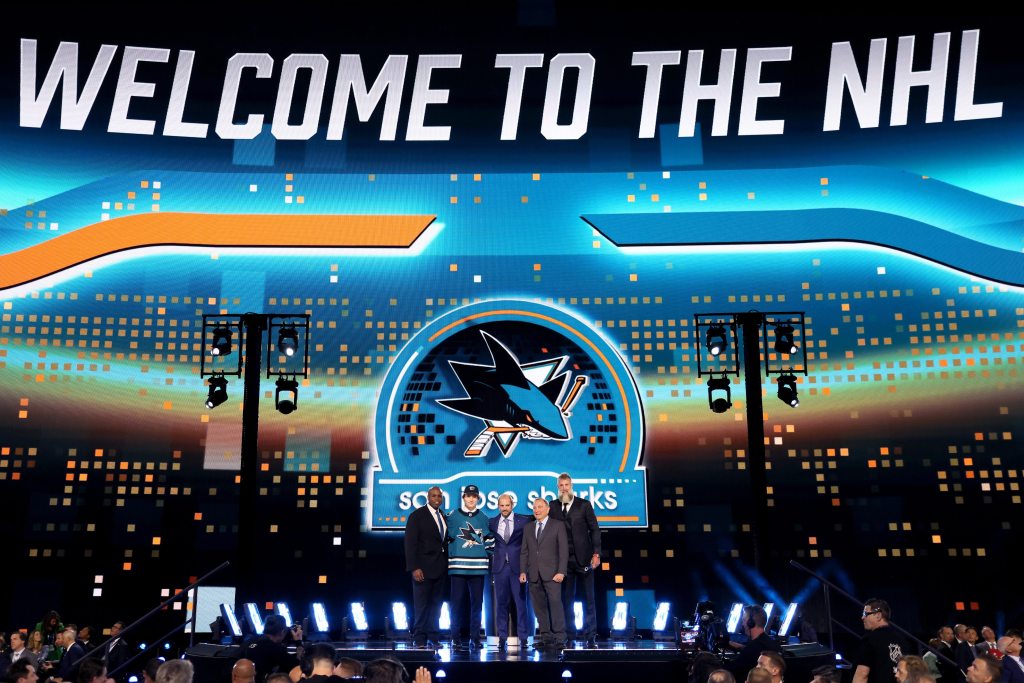
SAN JOSE – San Jose Sharks general manager Mike Grier has kept the same philosophy of taking the best player available when it came to deciding who he was going to select early in the first round of the past three NHL drafts.
It hasn’t usually been a difficult decision for Grier. But this year, there might be some intrigue.
Armed with the second overall pick they won during Tuesday’s NHL draft lottery, Grier, sensibly, doesn’t want to reach for a player just to fill an organizational need. But what if addressing that organizational need, which in this case is a big right-shot defenseman with high offensive upside, isn’t a big reach at all?
That’s why the Sharks should seriously consider taking Michigan-born defenseman Chase Reid at No. 2, Sportsnet draft analyst Sam Cosentino said, instead of a top-rated forward like Gavin McKenna or Ivar Stenberg.
“I wouldn’t consider it a drop off,” between Stenberg and Reid, Cosentino told Bay Area News Group. “But I think in the position that (Grier’s) in, you can lean a little bit towards positional need.”
The Sharks have drafted forwards Will Smith, Macklin Celebrini, and Michael Misa with their last three early first-round picks, and also have wingers Collin Graf, Igor Chernyshov, and William Eklund, and center Zack Ostapchuk as part of their 23-and-under crowd up front. Winger Kiefer Sherwood, 31, is signed for five more years.
Either the gifted McKenna or the all-around skillset of Stenberg, both 18, would no doubt be valuable additions to the Sharks’ roster, and at least one will be available at the NHL draft in June after the Toronto Maple Leafs select first.
But the only young right-shot defensemen the Sharks have signed for next season in their organization are Mattias Havelid and newly signed Eric Pohlkamp, both 22-year-olds. The Sharks might not get another chance in the coming years to draft a defenseman this high.
The 6-foot-2, 195-pound Reid had 48 points in 45 games for the OHL’s Soo Greyhounds this past regular season. His development path has been an unusual one, having played in the Tier II NAHL just two years ago before he became, per The Athletic, junior hockey’s top draft-eligible defenseman this season.
“I think Chase Reid is a top-five player all day, every day,” Cosentino said. “When I look at what he brings to the table as a 6-foot-2 defenseman who skates extremely well, who has a little bit of bump to his game, who’s faced some adversity coming up through the system.
“When I look at Chase Reid, I guess I see more runway for him.”
Grier, too, admires Reid, who had six points in 10 OHL playoff games. He also had four points in five games for Team USA at the World Junior Championship in December and January, playing a lead role after Washington Capitals prospect defenseman Cole Hutson was injured.
“Dynamic skater, eats minutes, plays a ton every night for the Soo,” Grier said of Reid after Tuesday’s lottery. “He’s a good two-way defenseman, impacts the game on both ends of the rink. Can create offense through skating and stick skills, and can shoot the puck.
“He’s a talented, talented player. When you watch World Juniors, when Cole Hutson went down, he was tapped to kind of take over the power play and some of those offensive responsibilities, and he answered the call.”
Grier has also watched a lot of McKenna and Stenberg the last two years, saying, “They’re very talented, gifted players. Dynamic with the puck. They’re both shoot-pass threats, which is not always the case with young players, but there’s playmaking and vision on both of them. They think the game well and at a high level, and are a threat to score and create scoring chances every shift.”
Reid, too, isn’t the only top defenseman available.
Keaton Verhoeff, listed at 6-4 and 215 pounds, had 20 points in 36 games for North Dakota this past season as one of the NCAA’s youngest players at just 17, and the Sharks have scouted him extensively. Carson Carels had a strong offensive season with Prince George of the WHL with 73 points in 58 regular-season games, and 10 points in 10 playoff games.
Still, Cosentino believes Reid is a cut above in this draft class.
“I’m a huge, huge fan of (Carels),” he said. “Where I think he might be different is I don’t know if he has — you’re seeing him produce offense (in the WHL) — I don’t know if he’s going to be able to produce it the same way at the next level. Whereas when I look at Reid, I look at him as a future power play quarterback.”
While McKenna or Stenberg might be ready to play in the NHL next season, Reid has committed to Michigan State. Playing at one of the NCAA’s elite programs makes sense for Reid’s development.
“He’s going to need a full year of college hockey, for sure,” Cosentino said of Reid.
Perhaps for the Sharks, it’ll end up being a simple decision on who to take at No. 2. If the Leafs take Stenberg, then the Sharks might go with Reid. If the Leafs take McKenna, then Grier likely takes Stenberg.
If the Leafs take Stenberg, and the Sharks want a defenseman and are confident that the Vancouver Canucks will select McKenna, maybe the two Pacific Division teams can arrange a trade.
It all depends on how the Sharks’ list takes shape between now and the first night of the draft on June 26 in Buffalo, N.Y.
“There’s another (seven) weeks before the draft, so we’ll dig into it,” Grier said. “When you’re picking at the top of the draft, we always try to go with the best player available, really. If there’s a big gap between two players at two positions, we’re not going to take a player just for need in that situation.
“We’ve got to do our homework. We’ve got to dig into it, and most likely we’ll take who we feel is the best fit and the best player available.”