
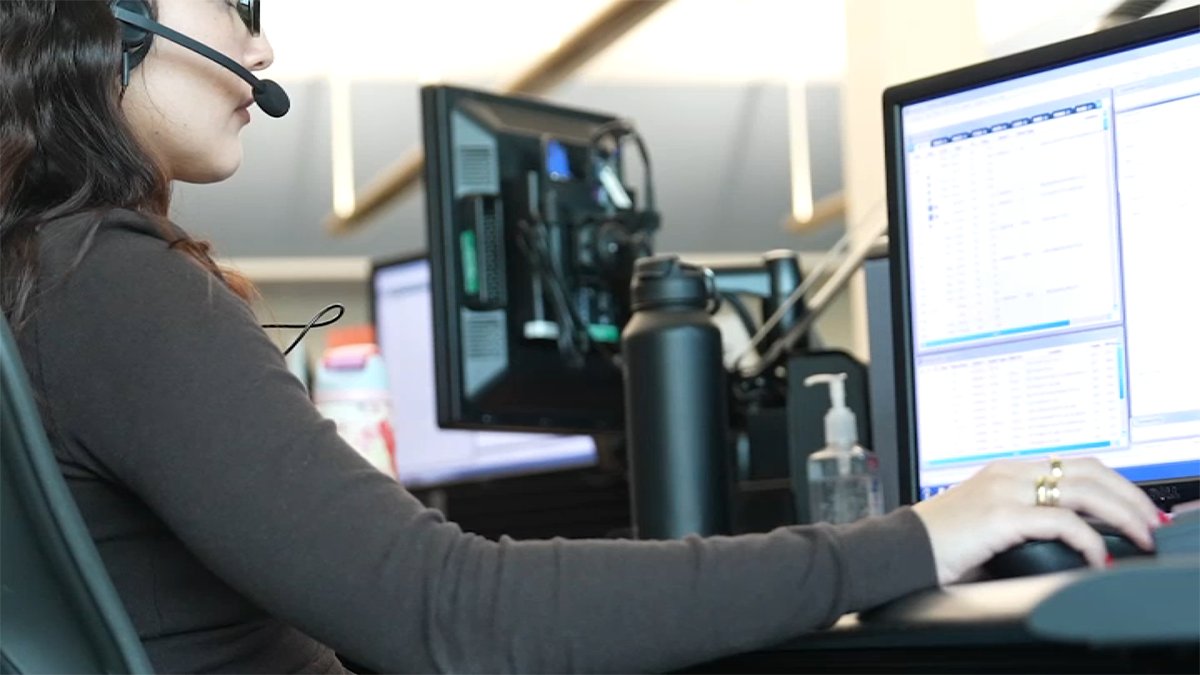
On a Tuesday morning in mid-April, a loud beeping noise repeatedly bounced off the walls of the San Diego County Sheriff’s Office 911 Communications Center. It’s a sound that’s bad news for both dispatchers and the people calling about emergencies.
Those beeps meant at least one 911 caller was on hold, potentially waiting for life-saving help. The county said delays can largely be blamed on a shortage of dispatchers.
NBC 7NBC 7
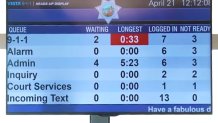
A monitor inside the San Diego County Sheriff’s Office 911 Communication Center is constantly updated to show how many 911 calls are on hold and for how long.
That staffing problem wasn’t just a snapshot of that particular day but an ongoing issue. It’s held the county back from hitting national standards about how quickly 911 callers should wait before they’re connected to a person.
The National Emergency Number Association (NENA) sets those standards, which state that dispatcher centers should answer 90% of calls within 15 seconds.
When NBC 7 Investigates reported on this problem previously, county data from 2024 revealed the comms center was only meeting the 15-second mark 76.1% of the time. There was little improvement during 2025, with data revealing that benchmark was achieved only 76.5% of the time.

NBC 7NBC 7
This graphic shows the standard that 911 dispatch centers should reach for, compared with the performance of the San Diego County Sheriff’s Office.
Tamra Samuels has been with the sheriff’s office for 20 years and is one of the five communication coordinators managing dispatchers.
“It is not where we want to be,” Samuels said. “We don’t want people to wait any amount of time on 911. Staffing is a huge part of it. If you don’t have enough people, then you need people to answer the phones and to dispatch the calls.”
Hiring dispatchers is a challenge for the entire industry, and the sheriff’s office is no exception. Since at least 2019, about two dozen or more of its dispatcher positions have been vacant, out of about 125 total.
“Kids don’t grow up and think, ‘I want to be a public safety dispatcher,’ ” Samuels told NBC 7. “So we have to work hard to even introduce this career as a possibility to people.”
Retaining dispatchers can also be a tricky proposition. It’s a stressful job, often with difficult hours, with pay starting at $37 an hour.
Budgeted dispatcher positions eliminated
The newest hurdle to achieving NENA’s standard could be the elimination of 13 budgeted dispatcher positions. The sheriff’s office said it reclassified those jobs.
Some of that funding stayed at the communications center, spent on two new communications supervisors and a supervising dispatcher. The rest went to other sheriff’s office divisions.
The crime lab got six new positions, including forensic evidence technicians. The human resources department got a couple of HR assistants.
The sheriff’s office said the money for those empty positions was better spent elsewhere instead of sitting idle.
“The unfortunate part is our positions are ‘hard-to-recruit positions,’ ” Samuels said. “That’s kind of how they’re defined. So, when positions sit vacant for a period of time, and we cannot fill them, typically they get reallocated elsewhere.”
Technically, a total of 16 dispatcher positions aren’t in the mix this year. Three of those budgeted jobs were frozen, with the money turned into surplus funding for the entire sheriff’s office.
Some of the money gained by eliminating dispatcher positions is being used to incentivize current dispatchers to train new hires. The bonus pay that training officers get is being increased by 10%.
Solutions beyond staffing
The sheriff’s office said one new program is showing some promise to help the division hit national standards. In March, it launched Hyper, an artificial intelligence system to answer non-emergency calls.
The AI asks a short series of questions to transfer callers to the correct sheriff’s resource, provide callers with the information they are seeking or connect them with a dispatcher.
Each call to 858-868-3200 is answered by one less human dispatcher, who can then focus on an emergency call. It’s possible that the system is responsible for some performance gains in 2026.
Data from the first four months of the year shows the comms center answered nearly 80% of 911 calls within 15 seconds or less. An improvement, but still under the 90% goal.
The sheriff’s office will also soon roll out a program that could allow as many as 10 dispatchers to work from home, answering non-emergency calls. That could happen as early as August, but only after new computer-aided dispatch software gets launched.
Looking to the next generation
The county said it hopes to fill its open dispatcher positions by convincing teens to make this their future career. Later this year, the sheriff’s office will run a youth training academy every Saturday for about two months.
Called Responder Ready, sessions will put students in the role of a dispatcher. They’ll take mock 911 calls and learn how to make quick decisions.