
There are plays that endure because they ask difficult questions, questions to which we keep changing the answers.
William Shakespeare’s “The Merchant of Venice” sits squarely in this category. Written somewhere between 1596 and 1598, it has long been labeled a comedy, though generations of audiences have wrestled with the darker truth beneath its wit. It is a story of debt, prejudice, mercy, and the uneasy bargain between justice and forgiveness — and it has survived precisely because it refuses to resolve cleanly.
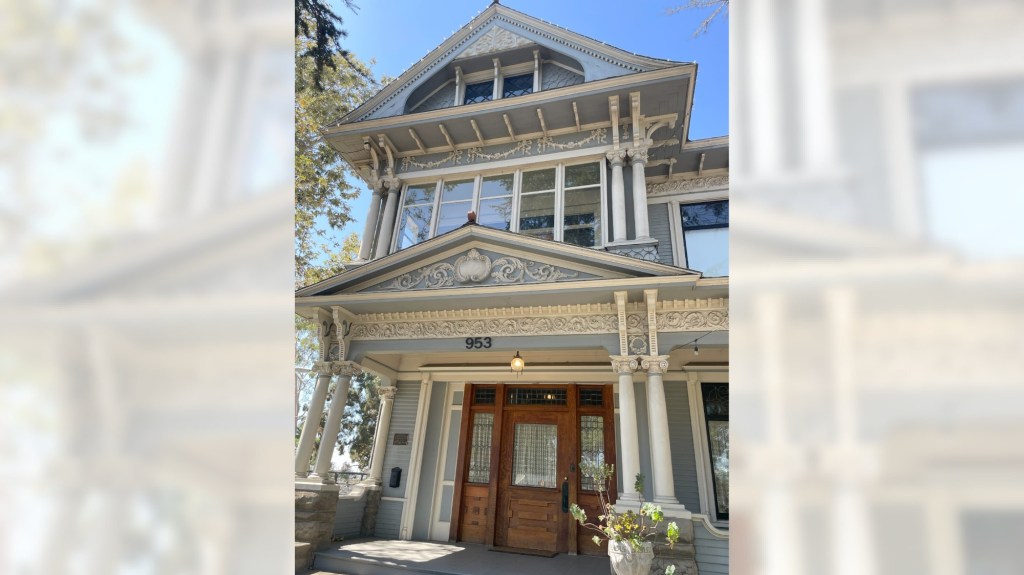
That tension finds an unexpectedly intimate home at the Bembridge House, where “Tea with Shakespeare” has mounted a 90-minute, site-specific rendering under the guidance of Michael Taber. Here, the audience does not observe the play so much as drift through it, beginning in the garden, teacup in hand, before being ushered into the house itself, and then finally to the rear porch.
The conceit could easily collapse under its own charm. Tea service and Shakespeare risk becoming novelty rather than necessity.
But what Taber understands is that proximity sharpens the play’s moral edge. When Shylock speaks of loss and grievance, he is not projecting to a balcony, he is speaking to you across a parlour. When Portia delivers her famous appeal to mercy, the room is small enough that you feel implicated in the outcome.
And that is where the production quietly and beautifully succeeds.
The genteel ritual of tea, delicate sandwiches, polite conversation, the choreography of pouring, sits in direct contrast to the play’s harsher questions. We are, quite literally, consuming comfort while the text asks whether mercy is ever freely given or merely performed.
Across town, the question of forgiveness arrives without ceremony and without tea.
At International City Theatre, inside the Beverly O’Neill Theater, the world premiere of “Warsaw” begins not with language, but with absence.
A woman lies in a hospital bed, unconscious after a devastating accident. Around her gather four individuals, each carrying a different version of her, each waiting for something that may never come.
Playwright Paul Webb, best known for his work on the film “Selma,” trades historical sweep for emotional excavation. Under the careful direction of caryn desai, the play unfolds with a deliberate patience that at times borders on stillness, and then boom, the quiet fuse that had been cracking away out of sight explodes in a flurry of stunningly crafted grief.
Secrets are not revealed so much as uncovered, slowly, reluctantly, as if each character is unsure whether the truth will offer relief or further decimate what remains.
The performances are grounded and, at their best, deeply affecting. Anna Van Valin masterfully guides us through a landscape of emotional devastation. Suzanne Ford brings a gravity to the proceedings, while Bruce Nozick navigates the uneasy terrain between regret and self-preservation.
The script occasionally leans heavily on coincidence, the idea that one woman could serve as the missing piece for so many lives, but the emotional logic holds. We recognize the impulse: to seek forgiveness from someone who may never to grant it.
Where “Merchant” debates mercy in public, “Warsaw” examines forgiveness in private. One is structured around contracts and consequences; the other around memory and loss. Yet both arrive at the same unsettling realization: forgiveness, when it comes is complicated.
If you go: ‘The Merchant of Venice’
Where: Bembridge House, 953 N. Park Circle.
When: Thursday, May 7, at 7 p.m. Saturday, May 9 shows are sold out.
Cost: Tickets start at $33.
Info: thebembridgehouse.org.
If you go: ‘Warsaw’
Where: International City Theatre, 330 E. Seaside Way.
When: Runs through May 17.
Cost: Thursday, Friday, and Saturday showings start at $56; Sunday showings start at $59.
Info: ictlongbeach.org.