

And last year, U.S. Immigration and Customs Enforcement signed a contract to obtain Cellebrite’s tools.
“I just don’t want Oakland to be part of that list of bad actors who continuously violate human rights,” Fife said. Zhou said that Oakland’s data is stored locally through evidence.com, and that Cellebrite does not “touch” it.
According to the police department’s 2024 annual report, “OPD has not shared any Cellebrite extraction data with U.S. Immigration and Customs Enforcement, the Department of Homeland Security or U.S. Customs and Border Protection.”
During Wednesday’s meeting, more than 20 people spoke in opposition to the contract, many echoing Fife’s and CAIR’s concerns about human rights violations.
“The tools provide access to phones, messages, location data, photos, deleted files and obviously that’s immensely intrusive,” said Musa Tariq, CAIR-SFBA’s policy coordinator. “This company is kind of part of a broader ecosystem of surveillance where these tools that are developed in militarized or occupation contexts are being exported globally. That’s raising concerns about the normalization of these practices, both abroad and then over here at home.”
 Councilmember Carroll Fife speaks during a press conference at Oakland City Hall in Oakland on Aug. 14, 2025, condemning President Trump’s recent remarks about Oakland. (Beth LaBerge/KQED)
Zhou said the department “does understand the optics of this company,” but hasn’t been able to identify a comparable alternative for extracting data from Android devices.
“We are tied to it because of necessity,” he told the councilmembers. “If there is a viable replacement, just because of cost alone, I think most of us would switch over.” He said the department has tested alternative technologies, including one in the midst of a 30-day trial.
So far, Zhou told the council, the alternative tool has been used to try to unlock eight phones, and failed each test. By contrast, he said, Cellebrite has worked to access seven of the eight.
Councilmember Charlene Wang, who chairs the public safety committee, said it was “undeniable” that Cellebrite had been used by authoritarian regimes to surveil people without consent, but that it’s also used in democratic nations to investigate violent organized crime and human trafficking.
She said not approving the contract would hurt OPD’s ability to solve violent crimes.
“We do have trade-offs to make,” she said. “We have an obligation to protect our citizens, and to use this technology wisely here in the city of Oakland.”
Wang said next year, she would like to see a competitive bidding process for the phone-extraction contract — a usual process for city contracts that was waived in this case.
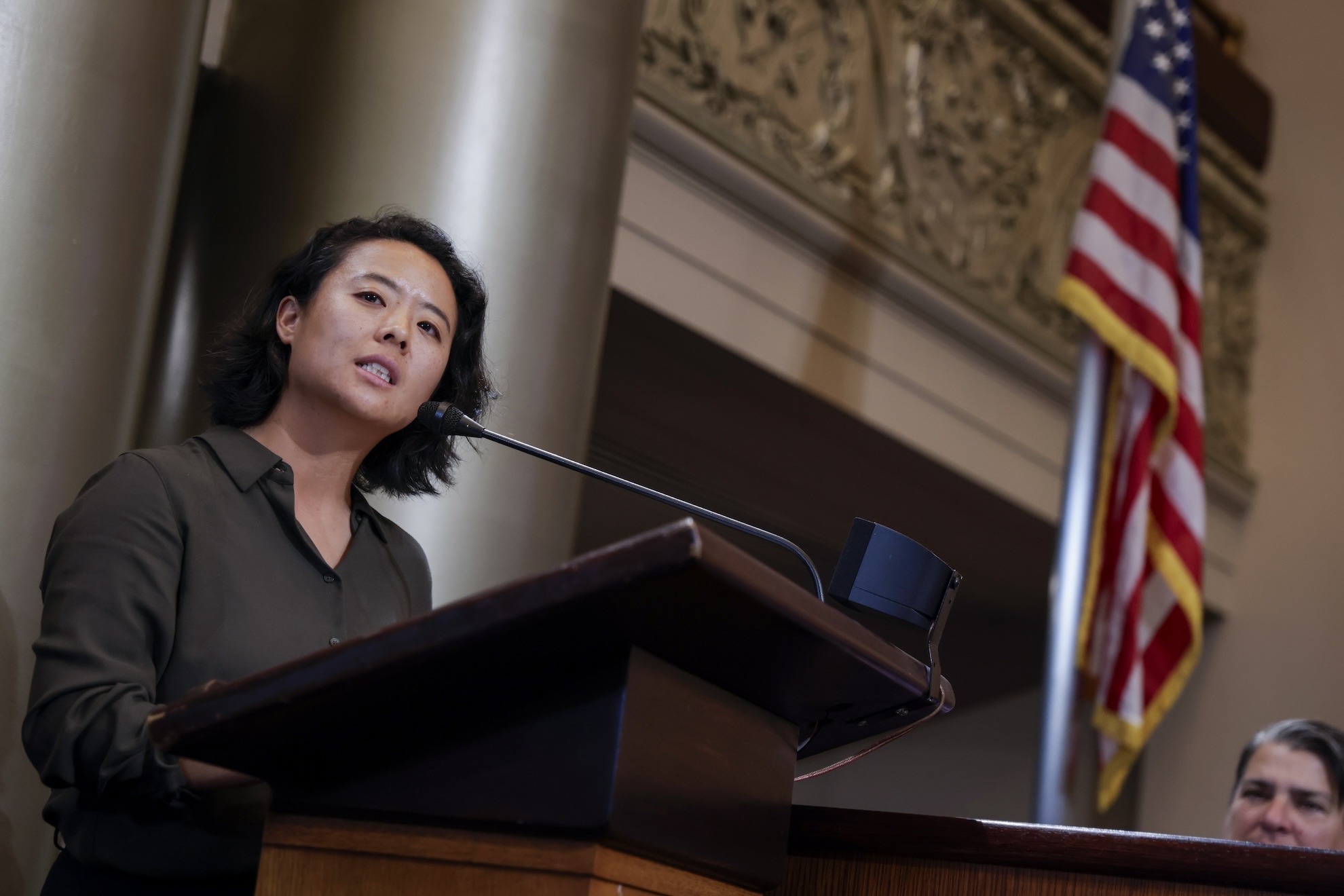 Charlene Wang speaks after being sworn in as city council member for District 2 at City Hall in Oakland, California on May 20, 2025. (Brontë Wittpenn/San Francisco Chronicle via Getty Images)
Fife asked the department to conduct a review of other vendors that might be available to offer similar technology, as well as an independent legal analysis assessing Cellebrite’s access to the city’s data.
She also asked that the department publicly report concrete statistics of how the data extraction technology is leading to a decrease in crimes.
“We keep having to approve contracts that have been shown around the world to have proven violations of people’s human rights,” Fife said. “I don’t support the use of this vendor. Israel is a genocide state. They are utilizing their power and their control and their monopolies in the public safety sector to monopolize law enforcement agencies around the world.”