
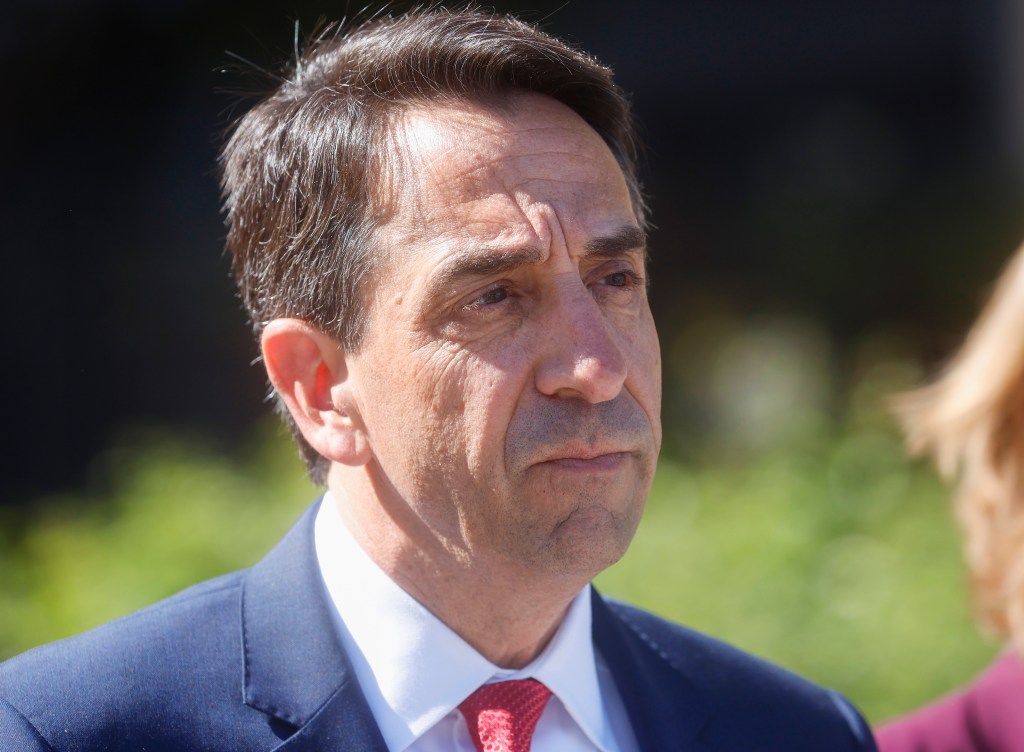
SAN JOSE — A Santa Clara County judge removed District Attorney Jeff Rosen’s office Thursday from the retrial of five pro-Palestinian activists accused of vandalizing Stanford University’s executive offices, ruling that Rosen’s campaign fundraising and public comments had created too grave a conflict for his office to continue prosecuting the politically charged case.
The ruling came after defense lawyers sought to disqualify Rosen and his staff from retrying felony vandalism and conspiracy charges, after the first trial ended in February with a jury deadlocked 9-3 and 8-4 in favor of conviction for the respective counts.
As a result of the ruling, the state Attorney General’s Office, which represented the DA’s office for the recusal motion, will for the time being become the prosecuting agency for any retrial. But Paul said her recusal order would be stayed while the parties sort out downstream issues including whether the AG’s office will appeal her decision.
The ruling represents an extraordinary rebuke of the county’s elected prosecutor in one of the Bay Area’s most closely watched criminal cases stemming from campus protests over Gaza.
In a recusal petition reviewed by Superior Court Judge Kelley Paul, attorneys for German Gonzalez, Maya Burke, Taylor McCann, Hunter Taylor Black and Amy Zhai, co-signed an argument asserting that Rosen was conflicted by his “monetizing” of the case by highlighting it in his fundraising efforts for a fifth term in office. Paul sided with them Thursday.
“The conflict is so grave as to render it unlikely that the defendants will receive fair treatment,” Paul said. The judge said Rosen’s fundraising and public comments improperly tied the Stanford prosecution to combating antisemitism, even though the defendants were not charged with hate crimes.
Rosen’s office had a brief response to Paul’s decision: “While we disagree with the judge’s ruling, we respect it.”
The first Stanford trial was closely watched as it represented one of the most high-profile criminal prosecutions to result from a wave of civil disobedience and unrest at college campuses across the country over the Gaza conflict. Rosen has repeatedly asserted that he is pursuing a second trial strictly to secure accountability for the estimated hundreds of thousands of dollars in property damage reported after the protest.
“To walk away from the case at this point … would be me giving in to a small number of loud voices,” he said in a March interview. “I’m not looking to send somebody to prison … what you should do is accept responsibility for what you did, apologize for it, and make restitution.”
Deputy Public Defender Avi Singh, who spearheaded the recusal petition, could be heard telling defendants’ supporters after the hearing that Paul’s decision demonstrated a “tremendous amount of care put into the due process rights of each of the individuals who are on trial from the Stanford protest case.”
He later told reporters that while he does not know if the AG’s office will appeal, he respects the legal process, and added that the “case law suggests a strong foundation and real rigor in the analysis.”
German Gonzalez, one of the defendants facing retrial, who was seen raising his arms in triumph after the February mistrial declaration, was more reserved Thursday, saying he was battling nerves that gave way to relief after the ruling.
“I’m grateful that it’s in the hands of the Attorney General now, and I hope that the Attorney General makes some correct decisions regarding this case and makes a correct charging decision to not bring charges,” Gonzalez said.
The defense petition argued that Rosen’s office demonstrated bias and politicized the trial in instances like when it interrogated the political beliefs of witnesses, and through his announcement immediately after the mistrial declaration that they would be retrying the case.
The Stanford recusal motion cited a 2020 San Luis Obispo County court granting of a recusal — later upheld in appellate court — involving felony vandalism charges against Black Lives Matter protesters. The defense argued the DA there demonstrated bias in media appearances disparaging the BLM movement and by fundraising on the notoriety of the vandalism charges and positioning himself as “leading the fight” against similar causes. A judge ruled that he “sought political and professional benefit and campaign contributions in conjunction with the prosecution” of the protesters.
That ruling, known as the Lastra decision after one of the protesters, was cited repeatedly by Paul in the context of fundraising emails and public comments Rosen made to supporters and prospective donors, which she concluded linked his office’s prosecution of the Stanford defendants with combating antisemitism. She said that “runs afoul of Lastra” in part because the defendants were not charged with a hate crime.
“Caution and care need to be taken when utilizing an active prosecution in campaign fundraising efforts,” Paul said. “The DA still has the right to freedom of speech and association, but exercise of those rights cannot deprive those he prosecutes to the right to a fundamentally fair trial.”
In an April interview with the Bay Area News Group editorial board, Rosen expressed pointed resentment toward the recusal effort, calling it selective and saying it targeted his identity since recusals have not been pursued when he promotes his office’s work in areas like domestic violence.
“In this case, because it’s about antisemitism, and it’s because I’m a Jew, it’s the oldest f—— antisemitic trope. And that’s exactly what the defense attorney is doing in this case,” Rosen said to the editorial board.
Judge Paul quoted that exchange, which was reported in a Bay Area News Group story last month about the recusal motion, in contending that “themes of antisemitism” continue to inappropriately “permeate” the case.
“This is not a disinterested prosecution,” Paul said Thursday.
The reported Stanford office takeover and barricading occurred June 5, 2024, and involved a dozen people, consisting mostly of Stanford students and alumni, entering Stanford’s Building 10, which houses the president’s office, by breaking a window and using ladders, furniture and other items to block doorways. It occurred as campus protests called on the school to divest its holdings from companies linked to Israel over the war in Gaza.
They disseminated their political demands on social media, and were arrested about 90 minutes after entering the building. Authorities contend that the activists ransacked the interior of the building while carrying tools including an electric grinder, hammers, crowbars and chisels, and alleged that they inflicted between $360,000 and $1 million in property damage.
Defense attorneys countered with evidence that the protesters had planned to keep in contact with police and intended to leave the building voluntarily, arguing the demonstration was meant to be peaceful. They also showed video of law enforcement cursing at protesters.
Seven of those arrested settled their cases prior to trial; three pleaded to misdemeanors, three agreed to pretrial diversion arrangements, and one opted for a youth diversion resolution. The remaining five proceeded to trial, with prosecutors asserting that they were strictly seeking accountability for the damage, and the defense calling the case an attack on political expression.
The last high-profile forced recusal — a rarity — for this DA’s office occurred five years ago, involving one of four men indicted in an alleged pay-to-play scheme trading political donations and favors for concealed-carry weapons permits from the Santa Clara County Sheriff’s Office. The defendant claimed Rosen and his office were conflicted because the defendant had fundraised for and was friends with Rosen.
A trial court denied the recusal motion, but an appellate court reversed that decision. The AG’s office, which took over, later opted to drop his charges.