
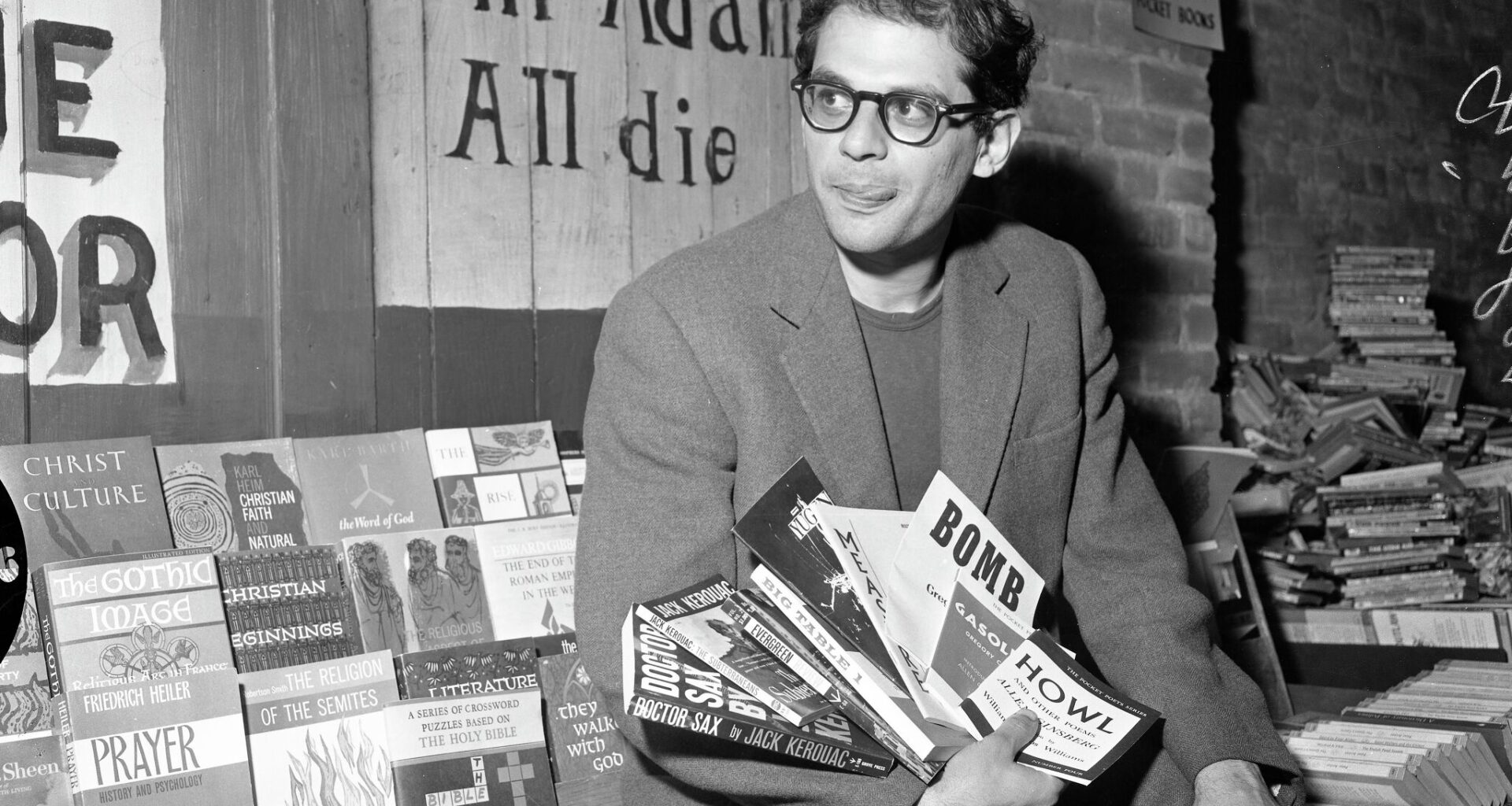
American poet Allen Ginsberg poses in a bookstore on June 2, 1959.
Joe Rosenthal/S.F. Chronicle
Since the moment Allen Ginsberg read “Howl” at San Francisco’s Six Gallery in 1955, the city and the poet’s work have been synonymous. For Peter Hale, director and manager of the Allen Ginsberg Estate, the distinction is warranted — even if it is a touch misleading.
“San Francisco will always feel his spiritual home,” Hale told the Chronicle, “which is funny, because he actually only lived there for, like, a year-and-a-half. But that’s where he wrote ‘Howl’ and his archive is at Stanford, so it makes sense. It’s like Bob Dylan being forever associated with Greenwich Village.”
Poet Allen Ginsberg seen in San Francisco on Sept. 18, 1974.
Dave Randolph/S.F. Chronicle
Allen Ginsberg, left, and his father Louis seen speaking at an event at San Francisco State University in San Francisco on May 9, 1974.
Stephanie Maze/S.F. Chronicle
Ginsberg helped define the Beat Generation through poetry that openly confronted drugs, queer love and American alienation. Few can offer insights as pertinent as Hale, given that he was among those who took care of Ginsberg in the years leading up to his death in 1997 at age 70 from liver cancer. Following that loss to the literary community, Hale has turned his energy to preserving and promoting Ginsberg’s immense and invaluable estate.
Article continues below this ad
To commemorate what would be Ginsberg’s 100th birthday on June 3, as well as the 70th anniversary of Lawrence Ferlinghetti’s City Lights publishing “Howl” under his City Lights Book imprint, Hale and associate Jesse Goodman have curated a robust calendar of events set to take place across the country, appropriately kicking off in San Francisco with a special event at the Chapel on Monday, May 11.
Merrill Garbus of Tune-Yards
Jim Bennett/Getty Images
Among the musicians interpreting Ginsberg’s work at the local event include the Kronos Quartet, Vetiver’s Andy Cabic, the legendary Ramblin’ Jack Elliott and Merrill Garbus of Oakland band Tune-Yards.
Garbus, whose band scored Oakland filmmaker Boots Riley’s latest feature, “I Love Boosters (in theaters May 22), took a break from promoting the film to detail how Ginsberg has inspired her.
Article continues below this ad
San Francisco Chronicle Logo
Make us a Preferred Source to get more of our news when you search.
Add Preferred Source
“We need Ginsberg now, more than ever,” Garbus said, “and I’m thrilled that as performers, we’ll get to lift the words from the page and sound-sculpt them into three- and, perhaps, four-dimensional forms in that room, with an audience, to tap into the energy and spiritual needs of 2026.”
Featured speakers on Monday also include former San Francisco Poet Laureate Tongo-Eisen Martin, activist Dominique di Prima, author Kim Stanley Robinson and Oakland artist Brontez Purnell.
“As our society moves away from believing in canon, I think (Ginsberg’s) presence and his work still sit really heavy in the middle of a lot of American literature as we know it,” said Purnell, who first read “Howl” as a 14-year-old in Alabama and recalls once being allowed to touch a mentor’s first printing of the poem.
“Howl” book cover by Allen Ginsberg
City Lights Book
Poet Eleni Sikelianos, who studied under Ginsberg at Naropa Institute (now Naropa University) in Boulder, Colo., and now lives in the East Coast, will also read Monday.
Article continues below this ad
Reflecting back on her mentor’s vast output, she said she still finds Ginsberg’s work “very pertinent and fresh” even decades later.
“I think the way his work calls out political and social abuses while also rejoicing in detail and sensory engagement and beauty remains such a potent combo,” she said.
Sikelianos’ San Francisco visit coincides with the launch of her new poetry collection, “Memory Rehearsal,” at City Lights on Thursday, May 14.
Beyond organizing these anniversary events, Hale and Goodman see keeping Ginsberg’s legacy alive in an ever-shifting culture as a core part of their work with his estate.
In 2002, they started what they believe to be the first website for a literary estate to ever appear online. In the intervening years, they’ve continued to adapt, adding a blog and eventually an Instagram account. They’ve also pursued works of archival significance and curated a musical tribute album to commemorate the 50th anniversary of “The Fall of America,” another seminal Ginsberg poetry collection that would go on to net its author the 1974 National Book Award.
Article continues below this ad
“Musical and visual collaborations are a great gateway drug to poetry itself,” Hale said of their efforts. “If we accomplish anything with this show, maybe we’ve gotten a few more people to read poetry in general.
“But obviously,” he added, “we want Ginsberg to be a big focus of this, so if people only know his name but not his poetry, this is an amazing opportunity to finally experience that work.”
Zack Ruskin is a freelance writer.