
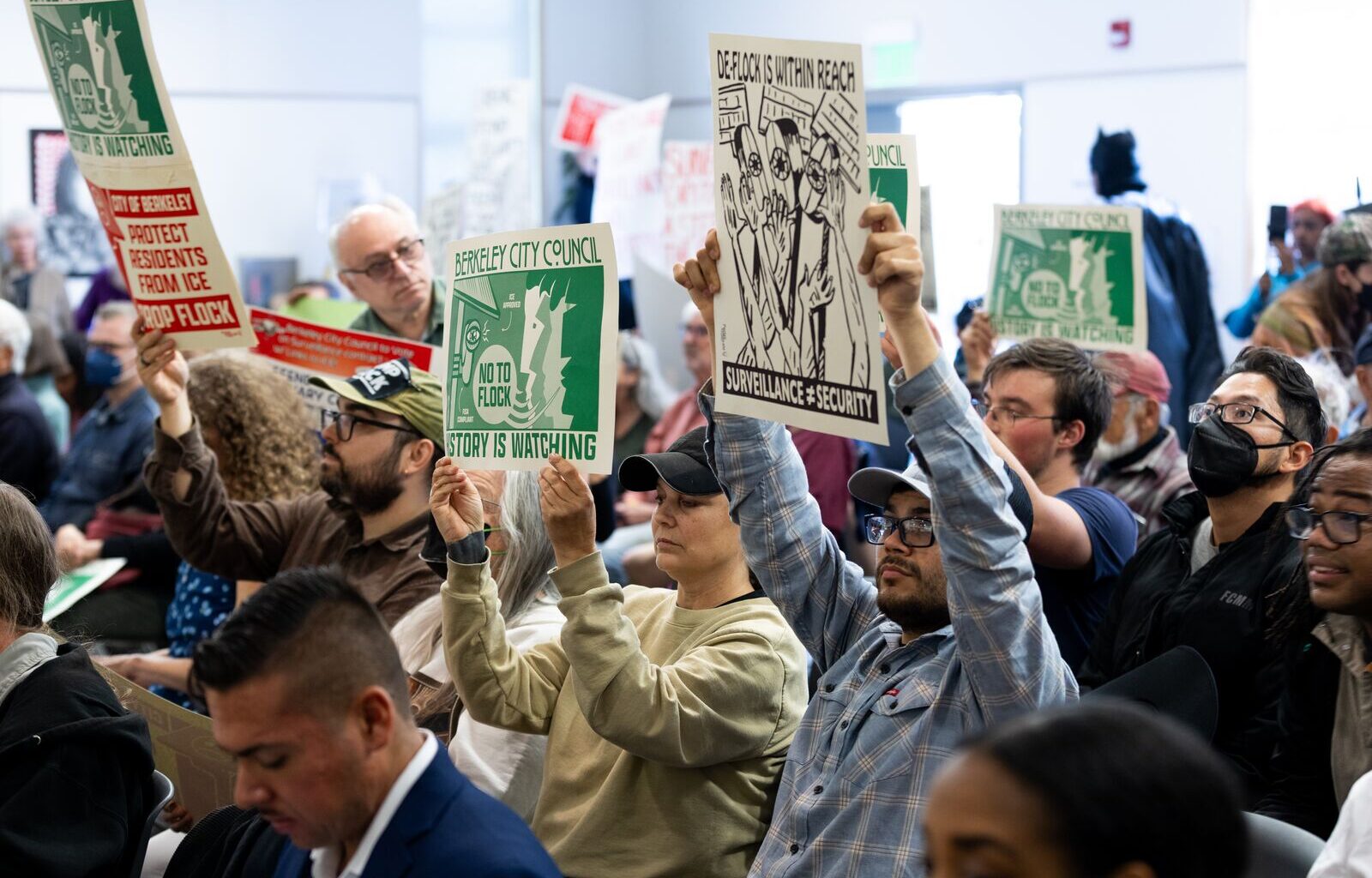
 Protesters hold signs against the use of Flock technology during a Berkeley City Council meeting Thursday. Credit: Estefany Gonzalez for Berkeleyside
Berkeley has abandoned — at least temporarily — a plan to bulk up its police surveillance network with new video cameras, drones and software supplied by the firm Flock Safety.
The City Council voted 8-1 Thursday to pull the plug on a proposed $2 million surveillance network expansion sought by police, though it did not close the door on contracting with Flock for the technology in the future. In the short term, the council narrowly renewed Berkeley’s lease of 52 of the tech giant’s automated license plate readers for up to another year, at a cost of up to $200,000. The plate readers have been active since 2024, and police say they have led to scores of arrests since then, including at least one alleged instance of attempted murder.
About 100 residents, activists, current and former council and Police Accountability Board members, and advocates from the Council on American Islamic Relations, ACLU of Northern California and immigration-focused nonprofits staged a rally before the council vote, demanding the city drop any contracts with Flock. Among other concerns, Flock has faced scrutiny nationwide after law enforcement officers elsewhere have used data from its networks to investigate people who have had abortions, monitor protesters and locate undocumented people for deportation.
“Although Flock says that they’ve addressed these issues, their reactive approach is insufficient and simply just can’t be trusted,” Mayor Adena Ishii said at the rally. “When the public trust is broken and when there are legitimate fears that data could be used to target our community members, we need to listen and say ‘no’ for these reasons.”
Police officials and business leaders have said new surveillance tech is a crucial force multiplier for a perpetually understaffed police department and, at least until recently, most council members seemed convinced by Flock’s assurances that Berkeley’s data could be kept secure.
Critics say Flock isn’t worth the money or the risk
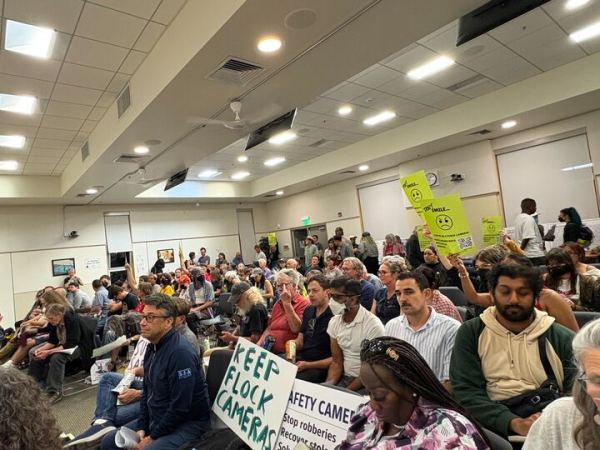
The council meeting was packed to the corners of the room, with many more people tuning in remotely. Nearly everyone who spoke during three hours of public comment opposed surveillance technology generally and Flock Safety specifically. Speakers questioned why the council would approve a $2 million wish list for any city agency while trying to plug a nearly $30 million budget deficit, and pointed to declining crime rates, in Berkeley and nationwide, as reason enough to pause on investing in new surveillance tech.
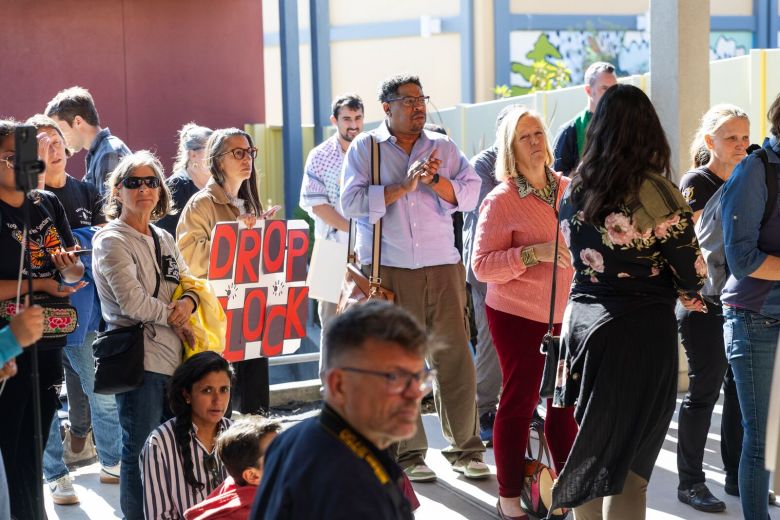 Former PAB Chair John “Chip” Moore III (center, with shoulder bag) and former Councilmember Kate Harrison (to his left, in pink sweater) spoke out against Georgia-based Flock Safety at a rally outside the council chambers. Credit: Estefany Gonzalez for Berkeleyside
Jocelyn De Sena, a city health work specialist and organizer with Service Employees International Union Local 1021, said contracting with Flock and risking the lawsuits that could go along with it “would be an irresponsible financial decision when the jobs of essential city workers are in your hands.”
“Police overtime is already eating up millions of dollars while critical safety net services are under threat,” De Sena said. (Police officials have said they hoped new tech could reduce overtime, but it is not yet explicitly clear how that might work.)
A few supporters did speak favorably of the proposal, however.
“Employees, customers and visitors need to feel safe in our commercial districts and public spaces, and tools that improve emergency response and investigations can provide real public benefit,” Beth Roessner, CEO of the Berkeley Chamber of Commerce, said over Zoom.
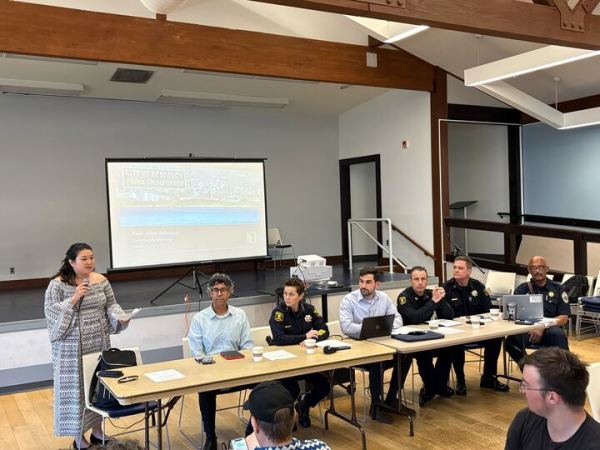
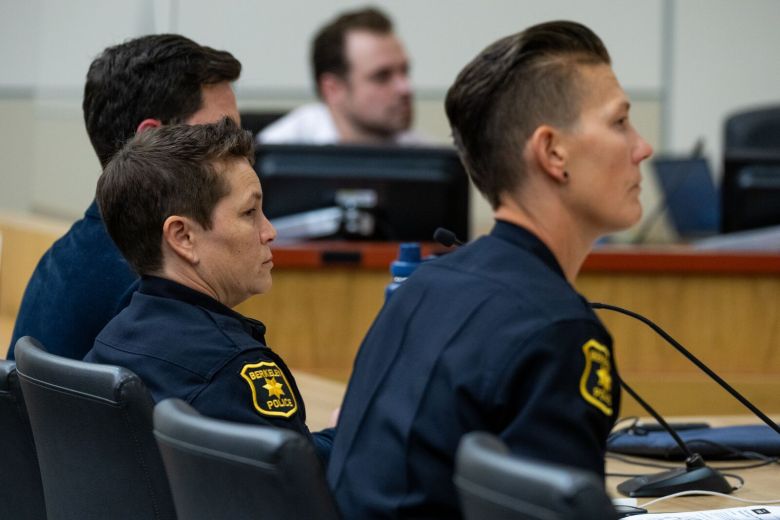 Arlo Malmberg, BPD Chief Jen Louis and Deputy Chief Jen Tate answer questions on a proposal to expand BPD’s surveillance network on May 7, 2026. Credit: Estefany Gonzalez for Berkeleyside
Trevor Chandler, a San Francisco-based spokesperson for Flock, also sought to allay fears of data from Berkeley winding up in the hands of federal authorities. A “national lookup” feature, which some police agencies kept activated without realizing how many out-of-state agencies could use it to see their data, had been deactivated throughout California, Chandler said. (Berkeley’s attorneys have warned that Flock has, unilaterally and without permission, reactivated the feature in several California jurisdictions that had shut it off.)
Nor would the hardware in Berkeley be equipped for facial recognition or machine learning, he said, though the network would be able to differentiate people from animals or specify identifying characteristics like articles of clothing, Chandler said.
Councilmembers who backed contract shift
Until the day of the vote, it appeared a bare majority of five council members were leaning in Flock’s favor.
Four council members — Mark Humbert, Rashi Kesarwani, Shoshana O’Keefe and Terry Taplin — co-authored an op-ed in The Berkeley Scanner, citing the 52 arrests last year BPD said were thanks to Flock plate readers and seeking to allay the fears of immigrants and their neighbors. (The same four council members also proposed a series of tweaks to the proposed contract in March, hiking penalties for unauthorized data sharing and tightening restrictions on what Flock could do with Berkeley’s data.)
Councilmember Brent Blackaby, meanwhile, lauded arrests tied to plate readers and of drones and technology generally in a recent newsletter. Modernizing BPD’s infrastructure, Blackaby wrote, “is part of how we recruit and retain” officers, something with which the agency has struggled.
But at Thursday’s meeting, Blackaby proposed the council scrap the proposal on the table and instead direct the City Manager’s Office, BPD and the PAB to start soliciting competitive proposals for the technology from other potential vendors, while renewing the contract for plate readers “so that we don’t go dark in that period.” That leaves open the possibility Flock could emerge as the vendor with the most attractive bid to sell Berkeley the hardware.
“This technology is important for Berkeley, but equally important is making sure that we get this decision right and build the public trust that we need in our decision-making process,” Blackaby said. “I have full confidence in Chief Louis and the professionalism of our officers in uniform and the BPD staff. We should be equally sure that the tools that we license meet these same superior standards of performance. I believe tonight it’s more important to get it right than to get it fast.”
Everyone on the council save Councilmember Ben Bartlett, who said residents in his South Berkeley district uniformly told him they opposed any contract with Flock, voted for Blackaby’s compromise. The vote to renew the plate reader contract took place separately and passed by a 5-4 margin, with Bartlett, Ishii, Cecilia Lunaparra and Igor Tregub opposing and Blackaby, Humbert, Kesarwani, O’Keefe and Taplin in favor.
O’Keefe and Taplin said it was the renewal of the plate reader contract that made the compromise workable for them, but none of the four authors of the op-ed directly addressed the decision to launch a new bidding process in their comments Thursday.
The council also adopted use policies for the types of technology at issue, something city ordinance requires before an actual purchase. And the council agreed to a proposal from Lunaparra barring BPD from deploying drones over mass gatherings except for extreme circumstances like felony investigations, and to analyze the plate reader network for efficacy and compliance.
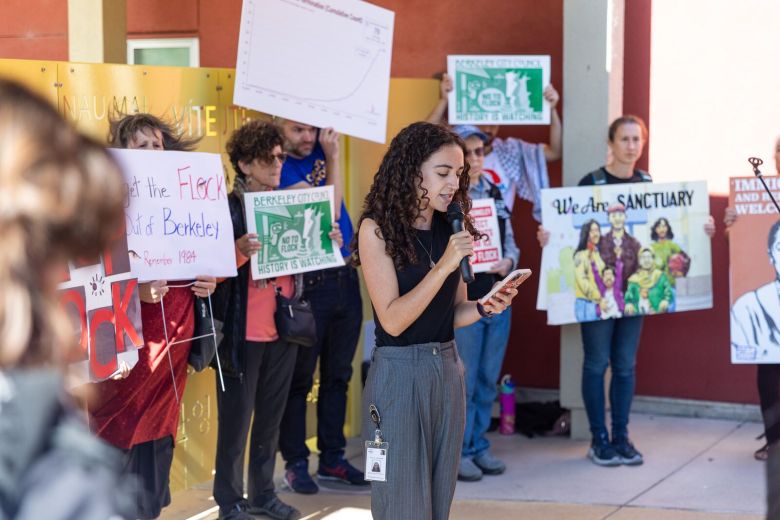 Councilmember Cecilia Lunaparra speaks during a rally against the use of Flock ahead of the Berkeley City Council vote on contracts with the company. Credit: Estefany Gonzalez for Berkeleyside
Leaked legal memo outlined legal risks
The op-ed from supporters of the technology package came out May 5, after attorneys for the city had warned the council, the PAB and city administration in a confidential memo that the proposal could lay the city open to any number of lawsuits based on federal and state laws and Berkeley’s own ordinances. The memo, which leaked to the press this week, also cautioned that while Flock would likely agree to any security measures Berkeley could demand, “we cannot ensure Flock will abide by its contractual obligations,” and may not even be capable of doing so if they wanted.
Council members have not spoken openly about the memo, so it is unclear whether it weighed on their decisions.
The PAB had issued warnings of its own earlier this week, saying BPD’s selection of Flock appeared to belie Berkeley’s competitive bidding process. The PAB had previously advised that picking a single vendor would put the surveillance network at greater risk of catastrophic failure, and would give the vendor far too much leverage.
During the protest ahead of the City Council meeting, John “Chip” Moore III, a former PAB chair, tied the debate over the Flock contract to “an escalating conflict over transparency and accountability” in Berkeley, citing the protest resignations of two veteran PAB members and firing of Director of Police Accountability Hansel Aguilar last year. He questioned “whether independent oversight in this city means anything when it’s challenged by political power,” and called for the resignations of four council members who had publicly supported the proposal.
Lunaparra, who has consistently opposed any surveillance expansion, said before the vote that “the political winds have shifted” against contracting with Flock.
Editors’ note: This article was updated after publication with additional information.
Related stories
May 6, 2026May 7, 2026, 11:11 a.m.
Berkeley council delays vote on ‘largest surveillance expansion in the city’s history’
March 25, 2026March 25, 2026, 4:17 p.m.
From drones to video cameras, Berkeley police ask for more Flock surveillance tools
March 19, 2026March 19, 2026, 3:23 p.m.
“*” indicates required fields