
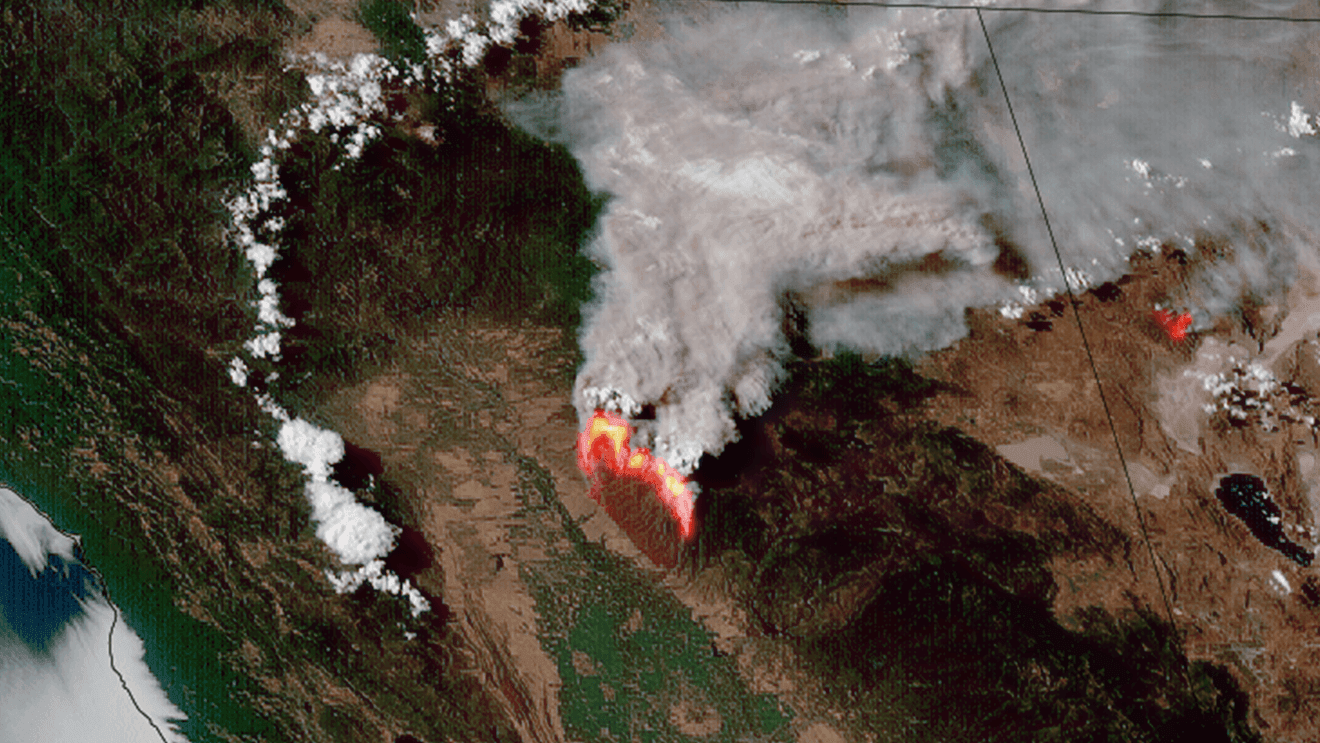
We’re still more than a month away from the beginning of Summer, but we’ve already had one significant heatwave that brought 90’s to the Central Valley in March. We now have triple digits coming our way in mid-May. Add in the fact that the Sierra Nevada snowpack is almost gone, and it’s beginning to look like it could be an active fire season this year.
After a dry Winter, I often hear people talking about how “Everything is dried out. It’s going to be a bad fire season”. I also hear after a wet Winter people saying “It’s been so wet! There’s so much new grass out there… come September, we’re doomed.” While it’s true that our fire seasons have really picked up in the past 20 years, there still is some variability. Some years are worse than others, and the data backs up that dry Winters often lead to bad fire seasons, while wet Winters do not.
The Sierra Nevada snowpack is a very good indicator of the upcoming fire season: A low April 1st snowpack will often lead to a busy fire season, while a robust April 1st snowpack tends to dampen it. April 1st is used because that’s usually when the snowpack is deepest. And the numbers back that up. Back in 2023, the Sierra snowpack was 232% of average on April 1st. That’s a lot of snow! And fire season was a mellow one, with only 332,000 acres burned. 2019 was similar – 175% of normal on April 1st, and only 277,000 acres burned. 2011: the April 1st snowpack was 171% of normal, and only 168,000 acres burned that summer.
Contrast that with the dry years: in 2021, the April 1st Sierra snowpack was only 62% of normal, and 2.5 million acres burned that Summer – including California’s 2nd largest wildfire ever, the 900,000 acre Dixie Fire. In 2020, the April 1st snowpack was half of normal – 50%. The following Summer was our worst fire season ever, with over 4 million acres burned. In 2018, the April 1st snowpack sat at 58% of normal, and the following Summer was terrible: 1.9 million acres burned, including both the deadly Carr and Camp fires.
At first glance, 2017 seems to be an anomaly: the snowpack was 159% of normal on April 1st, yet 1.6 million acres burned – a bad fire year. But dig deeper into those fires: the largest was the Thomas Fire in December (!) of 2017 in Santa Barbara and Ventura counties, where there is no snowpack. The Wine Country fires of the North Bay were in October of that year – again, in a place with no snowpack. The 50,000 acre Garza Fire burned in western Fresno County, once again, in an area with no Winter snowpack. So again, it seems like a healthy Sierra snowpack acts to keep the grass and other fuels moist longer into Summer, which shortens and weakens our fire seasons.
So, what was the Sierra Nevada snowpack on April 1st of this year?
18%. That’s it. 18%. One of the lowest readings ever. I don’t want to sound like an alarmist, but that’s not good at all. We did get a little snow after April 1st, so it’s currently about 20% of normal for this date… but that’s still really low.
Another thing to consider is something a lot of people have been buzzing about: El Nino. While it’s possible strength is still up in the air, it does seem like we’ve got a good chance to go into some kind of an El Nino this winter. And the warm water of the Pacific leading up to that often makes for an active Pacific hurricane season – and Pacific hurricanes absolutely impact California. Not with a direct impact, but the remnants of the dissipated storm bring thunderstorms our way, and that lightning can spark fires. Remember Hurricane Olaf in 2021? Thunderstorms from it’s leftovers sparked both the KNP Complex (which burned 88,000 acres and around 2000 Giant Sequoias) and the Windy Fire, which burned 97,000 acres and around 1000 Giant Sequoias in the southern Sierra Nevada. And back in 2020, Tropical Storm Fausto was only a tropical storm for a few hours – but it’s remnants sparked a spectacular lightning show in northern California, with thousands of lightning strikes in the Bay Area and Sierra Nevada on August 16 and 17. Those lightning strikes sparked California’s largest fire ever, the August Complex, our only 1 million acre fire. It also sparked the terrible Bear (or North Complex) Fire in Plumas & Butte counties, which burned through Berry Creek and Feather Falls on September 8th, killing 15 people and burning over 1500 homes. And it also sparked the SCU Complex Fire, which is California’s 5th largest fire.
But tropical remnants have also brought us beneficial rain – like Hurricane Hilary did in 2023. So, an active Pacific hurricane season is still a wild card.
This is a first look at our upcoming fire season. Justin Willis and myself will be digging deeper in the next couple of weeks, and putting out an update with hopefully better news – although with the low snowpack and early season heat, it’s not the best start. We’ll see.