
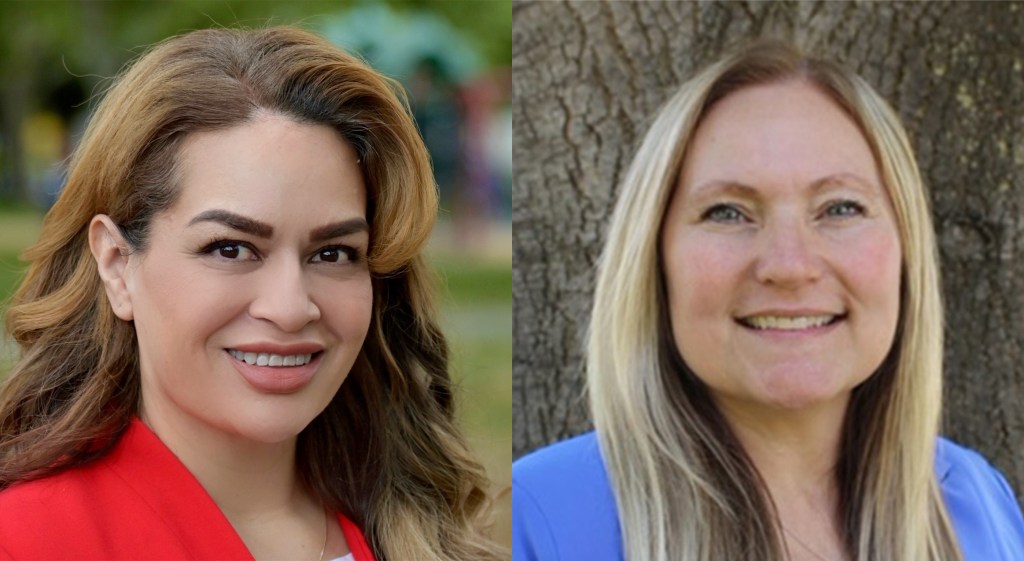
In the only contested race on the Santa Clara County Board of Supervisors, first-term school board trustee Rebecca Munson is challenging incumbent Sylvia Arenas to represent District 1 in the June election that will decide who will help steer the county through one of the most dire financial shortfalls in decades.
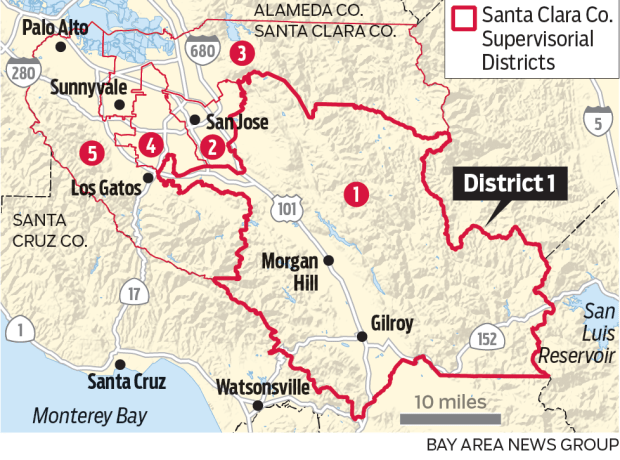
District 1 — which runs from south San Jose to the southern extremes of the county, covering Gilroy, Morgan Hill and large swaths of unincorporated and agricultural land, including San Martin — is the county’s largest and most rural. Its cities to the south have long grappled with gaining equal access to emergency healthcare and county services while facing disproportionate need.
 The winner of the District 1 race will help tackle these problems while balancing a budget plagued by years of growing costs, stagnating revenues and massive cuts to Medicaid from the Trump administration’s landmark spending bill. Despite the passage of a temporary sales tax, Measure A, and job cuts earlier this year, the county is forecasting a $500 million shortfall in the 2027-28 fiscal year.
While Arenas is the experienced incumbent defending her record in South County, Munson argues the county needs greater financial scrutiny during a budget crisis so it can maintain and expand services.
Arenas, 52, currently represents District 1 on the Board of Supervisors and has long been a familiar face in South Bay politics. She was first elected to the seat in 2022, after serving for eight years as a San Jose City councilmember and two years on the Evergreen Elementary School District Board of Trustees. She previously worked in youth and early childhood education agencies.
Arenas touts her efforts to bolster the county’s support for those in its southern half, pointing to expanded access to services and healthcare, including the opening of a new South County health clinic and an upcoming center for victims of child abuse in Morgan Hill. She also spearheaded the Latino Health Assessment, a report which revealed glaring health disparities affecting the county’s Latino community, which is concentrated in East San Jose and South County.
“I think I’ve been doing well by our community and our residents. I think they have the trust in me to continue to do that. I want to respect that trust and continue to do the work,” she said. “The work isn’t done.”
Munson, 51, is a trustee for the Morgan Hill Unified School District elected in 2024. She worked in banking for 18 years before becoming a teacher for the last 14 years and teaches at the Oak Grove School District in San Jose.
She points to her personal experience — witnessing a family member face homelessness, mental illness and addiction — as inspiration for her to run and hopes to address budgetary challenges to help fund social welfare programs.
“I have a passion for the greater need of our community,” said Munson. “I think and feel that our community deserves better.”
Both candidates said child welfare reform should remain a priority. Arenas has been outspoken in her efforts to reform child welfare following high-profile deaths of children under county supervision, including the fentanyl overdose of infant Phoenix Castro and, most recently, the death of 2-year-old Jaxon Juarez.
“There’s a lot of systemic changes that we need to make,” said Arenas. “If our children aren’t doing well, they’re not going to succeed. It’s going to hurt the next generation.”
Munson, however, voiced concerns that not enough was being done. “Yes, we can call for reform, but we need to actually make sure it’s happening,” said Munson. “If there’s no accountability and structural reform, the senseless death of children will continue.”
They also voiced concerns that budget cuts could affect crucial programs such as behavioral and mental health services.
Arenas, in particular, spoke about the importance of preventive services like behavioral health care, particularly for youth, in keeping struggling residents from falling into more difficult, expensive problems. “Inadvertently we are going to shoot ourselves in the foot,” she said of wholesale cuts to those services, suggesting that any cuts to those programs must be made with “a scalpel” to preserve them as much as possible.
She and others at the county are lobbying state legislators to help get funds from the state to preserve those services. Meanwhile, the county is looking to find ways to make the healthcare system more efficient by consolidating care in different hospitals or finding new ways to generate revenue.
Munson, citing her experience in banking, called the budget “alarming,” and argued she could help address the county’s financial situation. She maintained that Measure A “wasn’t going to fix the problem” and critiqued it as raising costs on “our most vulnerable.”
She argued that money should come from the county health system, which makes up the majority of the county’s spending, not by cutting services but through cost saving measures and by increasing revenue. Munson suggested an “audit or review” of county agencies to find places where they could operate more efficiently.
“I don’t have all the answers but I’m willing to ask the questions,” she said.
On homelessness, Munson wants to double down on preventative measures such as rental assistance as well as permanent supportive housing. While the county has an existing prevention program and has quadrupled the number of permanent supportive housing beds since 2010, Munson noted that “there wasn’t enough (supportive housing) to begin with,” and said she is focused on ensuring mental health services are readily available where people are homeless.
Arenas has pushed to create a county plan specifically to address homelessness in South County, and said she is exploring ways to expand housing and shelter options for both homeless people and seasonal farmworkers.
On housing, Arenas noted her efforts to make planning and development more streamlined to speed up building, and pointed out how her office worked on a state bill, signed into law in 2024, that would ease permitting requirements and allow for denser farmworker housing.
Munson promised to collaborate with cities and avoid a “one-size-fits-all” approach to housing by encouraging housing appropriate to different communities, such as more density near transit and more ADUs in aging communities.
District 1 faces an imbalance of jobs and housing, making the region commuter-heavy and leading to its own slate of issues.
To help boost business in the district, Arenas re-established the office of economic development, which is meant to coordinate business efforts outside of the region’s cities, including agriculture, a mainstay of South County. She also touted her efforts to help fund key cultural events that draw tourism to the region – such as through grants to the revived Gilroy Garlic Festival, downtown business associations, and smaller agricultural projects.
“We have really great bones,” said Arenas of the region’s existing agriculture and business. “I’m hoping with additional resources, we’ll get to a different level.”
Munson would also seek to offer grant programs and said she would explore streamlining permitting processes for small businesses like farm stands, as well as highlighting what each city already offers.
In addition to the District 1 race, Supervisor Susan Ellenberg will be running uncontested to keep her seat in District 4 – a region that encompasses West San Jose, Campbell and Santa Clara. She was first elected to the Board in 2018 and again in 2022, when she also ran unopposed. She previously served as a trustee for San Jose Unified School District and worked as an attorney. Currently, she is the president of the California State Association of Counties.