
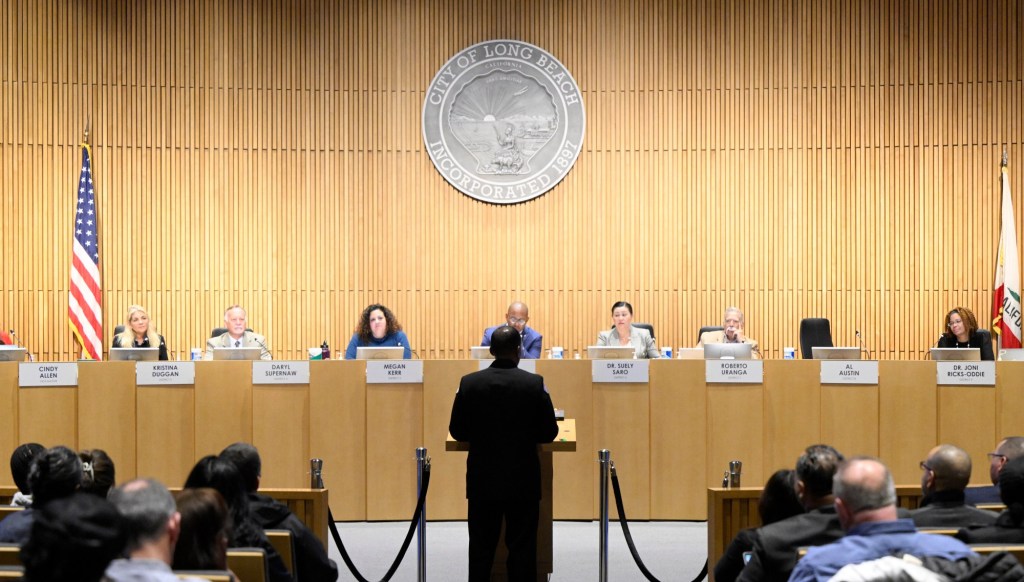
Some changes to how the City Council operates may be on the horizon, as Long Beach considers ways to make its meetings more engaging and accessible to the general public.
The Government Operations and Efficiency Committee recently forwarded several recommendations on how to make public meetings more accessible to the City Council for consideration — while asking for additional research and city input on some other proposals intended to achieve the same thing.
“Frankly, we’ve heard from residents on how sometimes it’s difficult to come to City Council and feel heard, or it takes too long, because people have kids and they don’t know when items are able to come up,” committee chair and Third District Councilmember Kristina Duggan said last week. “The goal of this is really we want to make our meetings more predictable, so residents can come be heard and speak about items that staff is working so hard to put on the agenda.”
The committee, prior to its Oct. 21 meeting, sent out a survey asking residents to provide feedback on City Council meeting accessibility — with questions seeking information about how often they attend, what prevents them from participating and what changes would make it easier to participate.
The survey, though, was only answered by 69 people, with the majority of respondents residing in the 90803 and 90802 ZIP codes. That prompted some discussion among the committee — whose other members include Ninth District Councilmember Joni Ricks-Oddie and First District Councilmember Mary Zendejas — about potentially sending out an additional survey.
“I didn’t see a lot of respondents in the survey results in regards to Central Long Beach or West Long Beach, so we need to find a way that’s more equitable to be able to get more,” Zendejas said. “We’re making decisions for our entire city of Long Beach, and so everyone should have an opportunity to weigh in their voices — especially if they want to be civically engaged, and they just don’t know or they haven’t been reached out to.”
The results of the initial survey, though, still provided some good feedback for the committee to consider. Common issues residents face, according to the committee, are scheduling conflicts, transportation challenges and child care responsibilities, among others.
That feedback, alongside general feedback councilmembers have heard from their constituents, helped inform five main proposed changes to existing City Council policy, aiming to make it easier for people to engage with their local government.
As it stands, City Council meetings only allow 10 speakers to comment on non-agenda items during general public comment at the beginning of meetings before the start of regular business.
Those speakers have to arrive at least 15 minutes before the meeting’s scheduled start time, which is usually at 5 p.m. If they miss that initial public comment period, residents have to wait until the end of the meeting to speak on non-agenda items — usually well past 9 p.m.
So to address that problem, the committee proposed increasing the number of speakers at the beginning of the meeting from 10 to 15 people. The city may also consider adopting amendments to allotted speaking time that mirror time limits for public comments on agenda items, which would reduce speaking time from three minutes to 90 seconds if there are more than 10 speakers.
“Limiting it to 10 means that those who have the flexibility in their calendar are the ones that get prioritized early,” Ricks-Oddie said. “Getting those folks who only came to do public comment the expanded ability to do that at the beginning makes it so people (will have) less frustration and anger around the public comment process.”
Zendejas also suggested that the committee explore the possibility of adding a mid-meeting public comment period.
The committee’s second idea proposes establishing estimated wait times for agenda items that are of high interest to the public. Currently, residents get an approximately four-hour time frame for when the item they’d like to speak about will come up during the meeting.
“This proposal would request that the mayor and city manager assign estimated start times — I think that’s a key word, estimated start times — for high-interest agenda items when applicable,” Duggan said. “Council offices could submit requests for these designations which would be labeled on the supplemental agenda.”
The mayor and city manager, Duggan added, would still have the authority to adjust agenda times as needed — but the idea is to give residents a better ballpark time frame of when council discussion on particular items will actually begin during a meeting.
And in relation to high-interest agenda items, the committee has also suggested an amendment to the Long Beach Municipal Code that would allow the mayor and city manager to change allotted public speaking times based on the amount of speakers signed up, as follows:
Three minutes for 10 or fewer speakers.
90 seconds for 11-20 speakers.
60 seconds for more than 20 speakers.
The first two time allocations are already in effect during City Council meetings, but they’re only implemented under the discretion of the mayor — meaning those windows aren’t a requirement so much as they are an option to help speed things along if there are many speakers signed up for one item.
“We’ve seen this used over some really high-interest items over the last couple of months, and the benefits of that, it balances meaningful public participation with efficient meeting management,” Duggan said. “This ensures all voices are heard while keeping meetings on schedule, and it reduces the late night sessions, improving accessibility for residents, staff and council.”
The committee also proposed starting City Council meetings at 3 p.m. or later to cover run-of-the-mill procedural items that are of little interest to the public.
“This doesn’t mean we would want to start every City Council meeting at three o’clock,” Duggan said. “This offers an option to start at 3 (p.m.) when we have a packed schedule, or something that potentially could draw us into the evening.”
That would allow the council to schedule agenda items that are of interest to the public during times that are easier for people to attend, she added.
“This prevents late night deliberations (and) prioritizes public engagement so procedural items are handled earlier,” Duggan said. “It supports better decision making, (so) key votes take place at reasonable times and not in the middle of the night.”
Zendejas said that while she believes it would be wise to start council meeting earliers when they know there is a packed agenda, her concern is that moving meetings up may actually make them less accessible for the general public.
“My only concern with that is the fact that we never know what is of importance to our community, and though city staff may feel and the council may feel that (a particular item) is not as important (and) put it in the 3 p.m. slot,” Zendejas said, “that, a little bit, contradicts with what I feel would be giving more accessibility to those that can come afterwards.”
The committee’s final main recommendation would limit ceremonial and other presentations — which often take up a large chunk of time at the beginning of City Council meetings — to no more than three per meeting, each no longer than five minutes.
“Ceremonial segments frequently will stretch for a very long time, 30 to 45 minutes, and we’ve even seen it longer,” Duggan said, “and this pushes our policy discussions later into the evening, making it unpredictable for those coming to chambers to speak at public comment or to hear what’s going on.”
Ceremonial presentations that need to last longer than five minutes could be submitted to the council as receive-and-file items, and again, the mayor would maintain authority to extend ceremonial and other presentation times.
The committee voted during that meeting to forward those five main proposals to the City Council for further discussion and consideration. But they’ve also asked the city manager and city clerk’s office to return a report providing comment on analysis on a few other potential proposals, which the committee says need more research before being sent to the council.
“The items in the second bucket really need to be discussed more, and we need to come up with some more information so (council members, the mayor and the city manager) can have input,” Duggan said. “We talked with the city manager about it, and there are some concerns for some of these second bucket items, but there are also some of these that people are excited about.”
The additional six suggestions include potentially amending the approval process for community sponsorships that total less than $5,000, which currently require City Council approval. Instead, the approval authority would be passed on to city staff — which could potentially free up a significant chunk of time during council meetings.
Those funds transfers would still be made public, the committee said, but this change would end the ability for the council and public to “preemptively challenge small dollar fund transfers publicly,” a presentation for the meeting said.
The committee will also explore defining “urgency” for supplemental agenda items. Currently, the city clerk’s office posts the council’s regular agenda on Monday the week before each meeting. But there’s also the supplemental agenda, which council offices can use to submit “urgent” items for the next council meeting that didn’t meet the original Monday deadline by the Friday before the next meeting, leaving less time for the public to get familiar with the item.
“When we do that,” Zendejas said, “we limit our residents from being able to research and do all of the information gathering that they need to be able to be fully educated on the item that is before us.”
The proposal would effectively standardize the definition of urgent items that qualify for addition to the supplemental agenda.
“I think many of us already within our own offices make an assessment of what is actually considered urgent,” Ricks-Oddie said. “but I think codifying this and defining it and making it standardized for everyone is actually to our benefit as a city.”
Along those lines, the committee is also considering moving the supplemental agenda deadline from Friday to Thursday to allow the public and city staff more time to prepare for upcoming meetings.
Other ideas that will be explored more thoroughly by the committee in the future include potentially scheduling standalone study sessions for high-interest items to streamline council discussions; publishing tentative public schedules of future council agenda items; and potentially expanding or pre-recording city staff reports for complex and nuanced City Council items.
The committee also asked the city manager and city clerk’s office to provide a report back about the city’s implementation of Senate Bill 707 — which was signed into law this month and will go into effect next year. The law provides major updates to the Ralph M. Brown Act, which regulates open government meeting requirements, to accommodate for modern technology.