
Other state legislation aims to strengthen battery safety and emergency planning while continuing to speed up clean-energy infrastructure. The bills address how these projects are constructed and managed while largely sidestepping where they should be built.
Christian previously insisted that this was not New Leaf’s preferred outcome, emphasizing last month that “we have always been committed to the local process”—a path chosen “out of principle.” But the May 1 letter to the county formalized the shift to the CEC’s opt-in process, with plans to apply in early summer. Christian cited “timing and commercial risk” tied to a March 2027 CAISO deadline for keeping Seahawk on track to connect to the state’s grid.
The county maintains that any project like Seahawk should be subject to stricter local terms. The draft BESS ordinance is designed to protect active farmland through setbacks, safety requirements, and permanent agricultural conservation easements, Tiffany Martinez, communications officer for the county’s Community Development and Infrastructure Department said. New Leaf’s move was “not unexpected” given that the company had been meeting with the state, but the county’s expectations “remain unchanged,” she added. “Any project must show that agricultural impacts are fully addressed and balanced with wider community benefits.”
Local land-use, environmental, and safety concerns—both governmental and community-raised—are reviewed “openly and on the record,” for a California Energy Commission review, said CEC Senior Information Officer Stacey Shepard, and can “help shape the analysis and potentially the conditions placed on a project.”
The agency weighs concerns “alongside broader reliability and clean energy needs,” considering alternatives or mitigation if a project conflicts with local standards. Absent a feasible fix, the commission can still approve it under state environmental review and AB 205 if it concludes that the benefits outweigh the impacts. In other words, local input, including public meetings and comment, may shape the process without necessarily determining the outcome.
Farmland Under Pressure
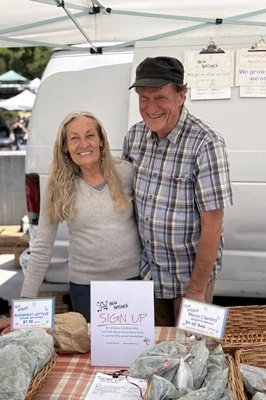
Farmers Sandra Ward and Ken Kimes grow microgreens at their farm, New Natives, which has been certified organic since 1983. (Photos courtesy of New Natives)
Ken Kimes, chair of Santa Cruz County’s Agricultural Policy Advisory Commission, has spent more than four decades in organic farming. He sees battery storage as “critical” to the state’s drive to decarbonize. Yet in a county that’s spent decades steering development away from farmland, he views Seahawk as a test of whether state energy priorities will outweigh local protections meant to keep fields in production.
“It’s a conundrum,” Kimes said.
New Leaf’s move to the state process is concerning, Kimes added, because any risks would be borne by nearby farmers and residents. “It’s not a Luddite situation,” he said. The local opposition, he argued, is rooted in concerns about contamination, farmland loss, and public input, not anti–clean-energy sentiment.
Battery storage may be essential infrastructure for decarbonization, but so is high-quality farmland, he added. Santa Cruz County’s agricultural economy depends on rare soils, a unique coastal climate, and a web of growers and support businesses. “It’s a big puzzle to put together,” he said. “You start to take it apart, it’s going to be [death by] a thousand cuts.”
Other pressures are bearing down on California’s farmland as well. Due to intense development, California has some of the nation’s highest land values, with farmland routinely targeted for housing, industry, and infrastructure, said Tom Stein, California regional director of the nonprofit American Farmland Trust (AFT). Farmland is especially vulnerable because it’s flat, contiguous, and easier to permit.
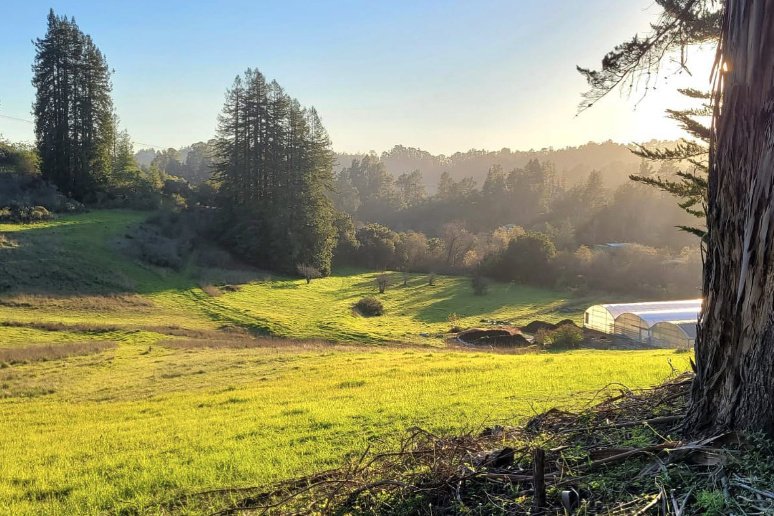
New Natives uses only organically grown seed, organic soil, and water in the production of its microgreens. (Photos courtesy of New Natives)
Expensive land values and lease rates make it harder for growers, particularly small-scale and tenant farmers, to access and retain land. Even perceived risk can become a factor; Broz, the organic farmer, said that the prospect of a battery facility failure could cast doubt on his land’s “viability for agriculture.”
The state is also losing almost 47,000 acres of farmland and grazing land annually. If current trends continue, AFT estimates nearly 800,000 more acres could disappear by 2040. The state’s Sustainable Groundwater Management Act is also expected to take hundreds of thousands of acres out of production as groundwater basins are brought into balance.
State policy is “a major driver” because it sets the terms of demand, said Stein. California’s climate targets and push to expand housing, energy, and digital infrastructure such as data centers send strong signals about where investment should flow. The state may cut red tape to speed needed infrastructure, he added, yet that can limit local input and community influence over decisions with long-term land-use consequences.
Just north of Santa Cruz, Santa Clara County offers a cautionary example. Once known as “The Valley of the Heart’s Delight” for its lush orchards and canneries, the region was gradually transformed by postwar development into high-priced Silicon Valley. As farmland disappeared, so did the packers, shippers, and service networks farms rely on, making agriculture hard to sustain. California’s current climate buildout, Stein said, risks repeating that pattern unless policy steers projects away from highly productive land.
“We need more energy infrastructure, more housing in California, but let’s develop where we should, not just where we can,” Stein said. “Once farmland is paved over, it’s not coming back.”