
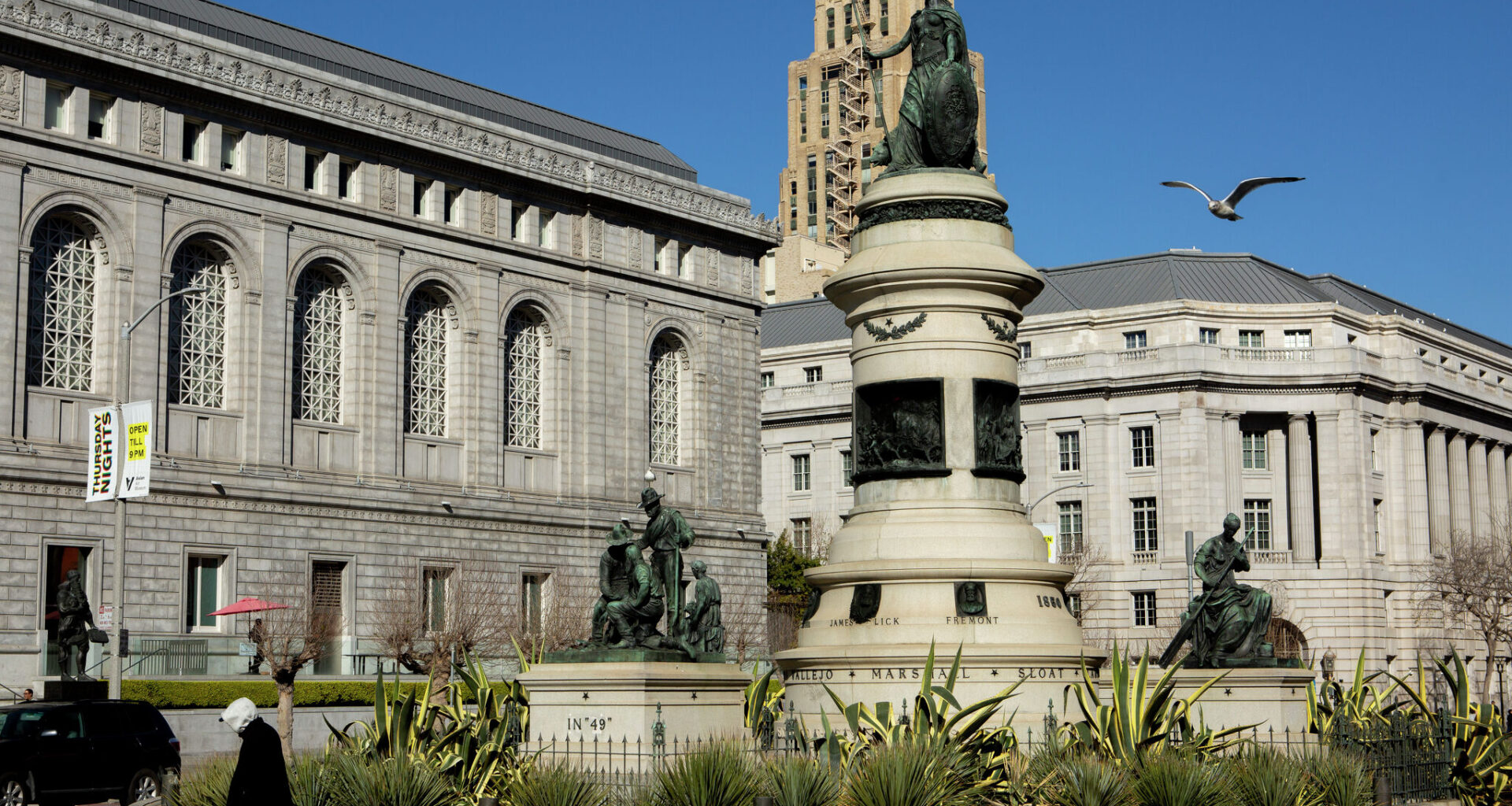
The Pioneer Monument in San Francisco’s Civic Center Plaza, photographed in 2019, depicts the suppression of Native Americans. The Shaping Legacy Project calls on the city to deconstruct its history to decide which stories deserve to shape its public spaces.
Santiago Mejia/S.F. Chronicle
In the heart of San Francisco’s Civic Center stands the Pioneer Monument, a bronze narrative of westward expansion that, for generations, has monumentalized the suppression of Native Americans. It is a painful architecture of dominance positioned in one of the city’s most important public squares. For too long, we have treated such monuments as unchangeable facts of history, and any monument that only touches part of the story has limitations and requires intentional exploration.
True, in 1996, a plaque was added to acknowledge Native Peoples in the state, and years of community advocacy finally resulted in the 2018 removal from the monument of the highly offensive “Early Days” statue depicting a Native American at the feet of a Catholic missionary and Spanish vaquero. But we can do more. We must become active architects of our future.
Through the San Francisco Arts Commission’s Shaping Legacy Project, made possible with support from the Mellon Foundation, we are moving beyond a simple audit of our collection. We are calling on the city to build a new civic muscle — the ability to deconstruct our history and, with intention, decide which stories deserve to shape our streets and plazas.
Article continues below this ad
To move forward, we must first understand the difference between a monument and a memorial. Too often, we monumentalize what should be memorialized, creating cultural confusion in the process.
In Washington, D.C., for example, the Lincoln Memorial stands as a solemn reflection on the Civil War’s human tragedy, while the Washington Monument celebrates the enduring idea of democracy embodied in a new nation.
San Francisco Chronicle Logo
Make us a Preferred Source to get more of our news when you search.
Add Preferred Source
We must apply that same clarity in San Francisco. The city has a civic responsibility to memorialize the neglected genocide of the Ramaytush Ohlone and the Indigenous people of Yelamu. At the same time, we should monumentalize the values we claim to uphold today — freedom of expression, identity and the Bohemian creative spirit of constant reinvention.
The era of the permanent bronze statue of a single heroic figure is over. The Shaping Legacy Project calls for a more dynamic, living approach to public art — one that builds new and innovative practices from our shared cultural legacies. To that end, we are launching five temporary activations across the city that are prototypes for a new era of storytelling.
Article continues below this ad
In the Bayview, we are illuminating the massive gantry crane at the Hunters Point Shipyard. This is an invitation to finally see the unseen: the Black migrants who built the ships that won wars and the families still living with the environmental burden of that nuclear history.
From Chinatown to the Mission, we are celebrating the hands of the Central American and Chinese American garment workers who sustained global industries. This is a monument to labor and immigrant contributions, not to a single figurehead.
When we encounter these new installations, I am not asking that we simply admire them. Rather, I hope they provoke engagement, questions, quandaries and even healthy controversy.
Guest opinions in Open Forum and Insight are produced by writers with expertise, personal experience or original insights on a subject of interest to our readers. Their views do not necessarily reflect the opinion of The Chronicle editorial board, which is committed to providing a diversity of ideas to our readership.
Read more about our transparency and ethics policies
San Francisco celebrates itself as a world-class city for the arts, yet our public spaces often tell a narrower story. We must invest our resources and our intention in building a cultural infrastructure that sustains artists who teach us to see ourselves more honestly.
Article continues below this ad
We cannot heal what we do not acknowledge, and we cannot advance without confronting our past. I urge every San Franciscan to see our monuments not as static relics, but as part of a living civic practice. Let us stop allowing the past to dictate our landscape and start actively shaping the legacy we choose to leave behind.
Charles Collins is the San Francisco Arts Commission president at large.