
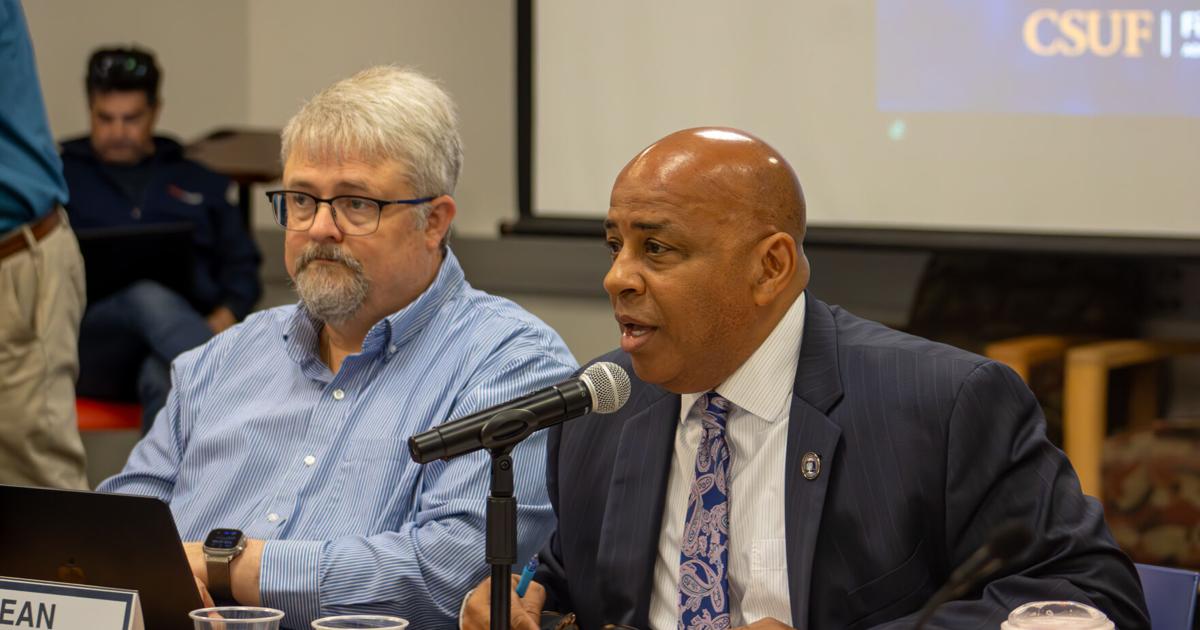
Cal State Fullerton’s Planning Resource Budget Committee presented a breakdown of current funding and the projected funding for the 2026-2027 academic year at the CSUF Academic Senate meeting on May 7.
According to the PRBC presentation, the overall outlook for the current academic year budget is positive. However, the committee pointed out how strong enrollment growth with “modest” budget increase can strain faculty’s workload and student support resources.
As part of their budget proposal for the upcoming academic year, PRBC emphasized support and stability for employees, investing in funding for student programs and addressing academic integrity problems due to artificial intelligence use.
The Vice President for Administration and Finance and Chief Financial Officer Laleh Graylee also presented the fiscal state of the university at the meeting, highlighting the budget for the upcoming year for CSUF and broader CSU campuses.
The main operating income is from general funding and tuition fees, adding up to $613.4 million — 79.8% of the overall funding for the 2025-2026 academic year — which supports ongoing programs on campus.
The remaining 20% of the budget, adding up to $155.7 million, comes from auxiliary/special funds. This money supports parking, the Auxiliary Services Corporation, housing, University Extension and the Philanthropic Foundation, among other campus programs.
The presentation then addressed expenditures of the main operating funds third quarter for the 2025-2026 academic year compared to 2024-2025. This category included salary wages, work study wages, benefits, communication expenses, utilities, travel, library acquisitions, financial aid, contractual services, information technology, equipment and operating expenses.
The 2025-26 academic year’s third quarter spending totaled out to $540,066,524 compared to the 2024-25 third quarter, with a total of $517,920,131 — a 4% change.
The highest change was for the 2025-2026 academic year for contractual services. There was a 56% decrease in spending, going from $3,836,585 in 2024-25 to $1,688,124 in 2025-26.
The second highest decrease was for travel at 42%. The 2025-26 school year spent $616,734 compared to the 2024-25 total spending at $1,059,830.
The senate reviewed the CSU’s budget request from the state for the 2026-27 academic school year. The total budget is $597.1 million – $273.4 million for essential priorities and $323.7 million for baseline commitments.
There was also a plan for CSU’s enrollment reallocation “realigning funding with actual students served.” CSU’s enrollment plan for 2025-26 was 37,151 students. There is a minimal increase for the 2026-27 enrollment plan with 37,186 students.
According to the presentation, more than half of the CSU campuses were below their enrollment goals.
The budget plan showed California State University had $760 million under Economic Uncertainty also known as the “Rainy Day Fund.” This fund would support CSU operations for 32 days, falling short of the university policy and best practices by three to six months.
The topic of Instructionally Related Activities funding was briefly brought back to the floor by Senator and Professor of Communications Studies Jon Bruschke, where he restated concerns on the effects of decreased levels in funding for campus programs.
“We will not leave this room with everyone being happy, but it is important we find a way in which we implement and we support the process that we believe in and the process was exercised,” said CSUF President Ronald Rochon in response to concerns.
A task force to review the IRA procedures aimed at mitigating the impacts on programs was established at the end of April. The members include Keoni Guerrero, Cesar Mendoza, Joshua Lopez and Deniz Suzer as student representatives, Dr. Jidong Huang as chair, Dr. Kristi Kanel, Dr. Zia Salim and Dr. Sean Walker.
“I also want to be very clear that I will never endorse spending money that we don’t have. I keep hearing cuts, cuts and cuts, this was not a cut. We have a baseline budget that was generated by student fees that the supporting committee was able to operate with,” Rochon said.
Assistant News Editor Sathya Chaib contributed to this article.