
San Francisco is experiencing a new housing boom, going against the national trend that has seen sellers across the country competing to gain the attention of spooked, reluctant buyers among sluggish demand and ongoing affordability challenges.
For a city that prides itself on its uniqueness, it is perhaps fitting that San Francisco is making a comeback just as the rest of the country struggles. It is, after all, the exact opposite of what happened during the COVID-19 pandemic, when the city faced a “doom loop” of exiting businesses and residents while much of the country experienced an explosion in demand for housing and a wave of newcomers—especially in the South.
While year-over-year data still reflects an overall cooling of the national housing market, year-to-date figures show demand is accelerating in the City by the Bay, Realtor.com economist Jiayi Xu told Newsweek.
The median listing price in the San Francisco metro climbed 16.2 percent year-to-date through April 2026, reaching $998,400, according to Realtor.com data—outpacing the 12.8 percent gain recorded over the same period in 2025. The median listing price of the typical U.S. home was $425,000 in April, up from $399,900 in January.
“At the luxury end, the trend is equally telling: the 95th percentile price threshold rose 4.7 percent year-to-date to $3,837,596, nearly double the 2.6 percent growth seen at this point last year,” Xu said.
At the root of this roaring comeback of the San Francisco housing market is the hype around artificial intelligence (AI)—an industry which promises to bring the city riches while also threatening its residents with rising prices, and potentially, displacement.
For the city, the quick growth of the AI industry, anchored by companies like OpenAI and Anthropic, means a new lifeline into its economy, which struggled greatly to stay afloat during the pandemic and the rise of remote work. But for many residents, especially essential workers such as teachers and nurses, it means likely being priced out of the place they call home.
For all Americans, San Francisco could be the stage where they see the AI story play out, as the industry reshapes the city’s housing market in its image—and how this could get out of hand if cities are not prepared to build more housing for all.
How ‘The Heat Has Been Turned Up’ by AI on San Francisco
The AI hype is bringing a particular category of homebuyers in the San Francisco area—the ultrawealthy.
In the two years following the launch of ChatGPT, luxury zip codes in the San Francisco Bay Area saw a 13.4 percent average increase in home prices, according to Redfin data. That was a much bigger jump than the one reported within the same period in any other price segment, and more than double the 6.3 percent average increase in the segment immediately below luxury.
“The Bay Area housing market has picked up tremendously,” local Redfin Premier real estate agent Ali Mafi said in a statement. “There has been an influx of AI companies opening up shop and they’re giving employees giant compensation packages. Some people are getting $1 million bonuses. Homes are getting dozens of offers, which is driving up prices and causing many to sell for hundreds of thousands of dollars over the list price. It’s reminiscent of 2020.”
Xu told Newsweek the AI boom is flooding the city with high-earning talent, adding that professionals are being drawn by lucrative salaries, stock options, and equity packages that dwarf what most industries offer.
“That influx is translating directly into housing demand, pushing prices higher and acts as a kind of permanent price floor to keep property values stay resilient,” Xu added.
That this increase is closely linked to the rise of AI is made clear by the data. In New York, luxury zip codes saw the slowest growth in the two years after the launch of ChatGPT, according to Redfin.
“I did notice it happening gradually, but I think in the last six months, a little bit longer, the heat has been turned up in the luxury market, so now we’re seeing some crazy prices. And you can definitely see it the most in the luxury market, though other markets are affected as well,” Kevin Patsel, Compass regional vice president for NorCal, told Newsweek.
“You have something like AI, which is catching on, and you’ve got Anthropic coming in and then everybody starts to see the opportunity here. They all flood into the market,” Patsel, who oversees nearly 5,000 real estate professionals across Northern California and is based in San Francisco, added.
For ‘People Who Keep San Francisco Running,’ Things Might Get Worse
San Francisco residents are already feeling the impact of rising home prices in the city.
The median listing price in San Francisco County in April was $1.17 million, according to Realtor.com, down more than 2 percent from a year earlier though higher than the $1,062,500 reported in January.
But further price hikes are threatened by inventory levels. Active listings in the city in April were down 32 percent year-over-year, the real estate brokerage reported, signaling a tightening market likely driven by the AI boom.
“AI-driven demand is flooding the premium, move-in-ready end of the market—and that pressure doesn’t stay contained,” Xu said. “Would-be move-up buyers, priced out by deep-pocketed tech competition, don’t leave the market. They cycle back down, competing for starter homes they would have left behind. Those owners, in turn, have nowhere to go—so they stay put.”
She added: “Entry-level inventory quietly dries up, prices rise from the bottom, and the squeeze is being felt across every tier of the market.”
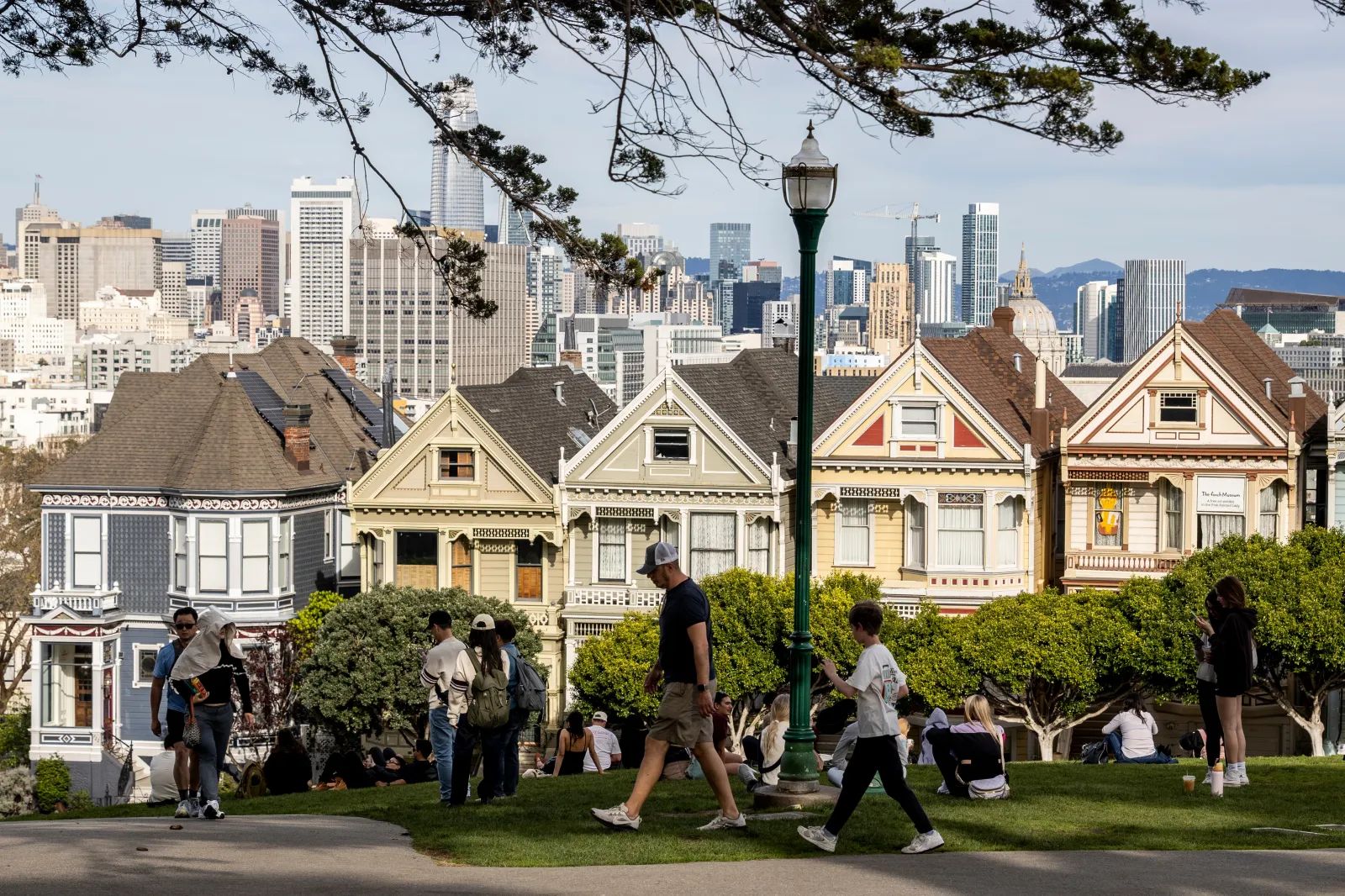
Barr Haney, the founder of Own Marin real estate, told Realtor.com, people start to see huge percentages of appreciation and price jumping because the competition is strong and inventory is somewhat limited.
“Therefore, these properties in the city are getting five-, 10-, 15-, 20-, 25-plus offers on them and selling for double, triple the asking price, and it starts to get a little crazy,” he said. “You start to see these buyers getting fatigued and sick of getting beat out in these crazy multiple-offer situations, and they start to look at alternate options.”
Xu told Newsweek the affordability crisis is expected to deepen as housing costs increasingly detach from local wages.
“For example, teachers, nurses, and other essential workers—the people who keep San Francisco running—earn salaries anchored to public budgets and community needs, not to the AI economy,” she said. “Yet they’re being asked to compete for homes in a market shaped by it.”
The rise in prices in San Francisco has “ripple effects” in the rest of the peninsula, Patsel said, and the northern California economy, as residents move to the suburbs for better affordability.
“You start to look at places like Oakland, Berkeley, Lafayette, Danville and the East Bay, and then you look at Marin, Sonoma, Napa counties and the North Bay,” Patsel said. “They’re not quite feeling the effects of this AI boom yet, but we know from experience that they will, that there are people right now that are being priced out of homes because they’re competing with some of this AI money.”
He continued: “They may choose to move to the East Bay or maybe move to the North Bay, which forces other people out or puts pressure on other people in those markets. It is starting to reverberate a little bit already, but it’s not at the levels where we are right now in the peninsula in San Francisco.”
There is also the possibility that the AI boom will burst eventually, though many are invested in avoiding that. If it did, though, San Francisco would not be exactly surprised.
“It does seem like we have this boom and burst cycle here in San Francisco, so I would just say we’re in the boom part of that cycle now. We’re on the upside and we’ve been here before,” Patsel said. “We’re kind of riding the waves, and I think most people and even most realtors know that the market goes up, the market goes down, and we are prepared to deal with it no matter which direction it takes.”