
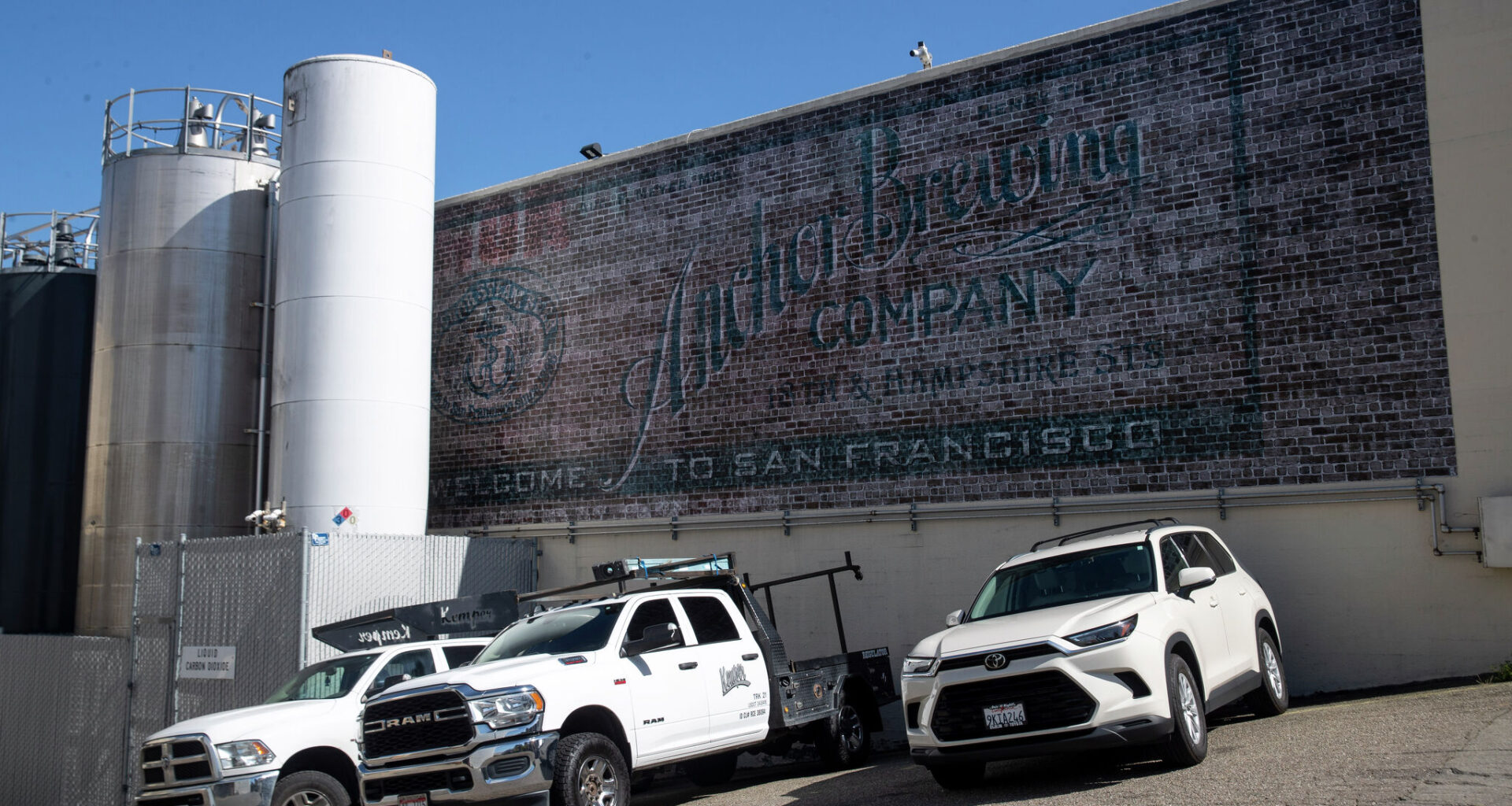
Signs of life at Anchor Brewing, two years after it sold to Chobani founder Hamdi Ulukaya, include a pair of work trucks parked at the brewery in April from Kemper Industrial, an Idaho company that specializes in industrial refrigeration.
Sage Russell/For the S.F. Chronicle
On May 31, 2024, nearly a year after San Francisco institution Anchor Brewing announced it had brewed its last beer, an unlikely savior appeared: billionaire yogurt mogul Hamdi Ulukaya, the founder of Chobani.
He promised to revive it, and quickly. “Let’s get back to work,” Ulukaya told the Chronicle that same day, even teasing the return of Anchor’s beloved Christmas ale for the 2024 holiday season. “I don’t want to sit around.”
Two years later, Anchor beer is still missing from Bay Area store shelves and bar taps. Another San Francisco Giants season is underway without fans lining up for pints of Anchor Steam between innings. There have been no further updates from Anchor since that initial announcement. Representatives for Anchor and Ulukaya have not responded to the Chronicle’s numerous requests for comment over the past 20 months; they did not respond to requests for comment for this story, either.
Article continues below this ad
“In an industry as incestuous as beer,” said Austin Sharp, chief executive officer of the East Bay’s Headlands Brewing, “they’re doing a great job of keeping things really close to the chest.”
Anchor insiders have also been met with “crickets,” said Patrick Machel, former Anchor employee and board chair of the Anchor SF Cooperative, which was formed in 2023 by brewery union members who attempted to buy Anchor after its closure by Sapporo Brewing. Ulukaya told the Chronicle that he planned to hire back as many former workers as possible, but Machel said the group hasn’t heard from Ulukaya’s camp, despite several attempts to connect. “We’ve since moved on,” Machel said. “That was a huge chapter in our lives. It’s unfortunate that we got the cold shoulder.”
San Francisco Chronicle Logo
Make us a Preferred Source to get more of our news when you search.
Add Preferred Source
To hopeful San Franciscans, the two-year silence has been both heartbreaking and deafening, because the return of Anchor is about something more than bringing back a beloved beer or even local manufacturing jobs in a city that now seems to only produce code. “It’s the very myth of San Francisco in a bottle,” wrote former Chronicle wine critic Esther Mobley. “It’s a relic of the Gold Rush, a harbinger of the it-happened-here-first innovation that our region hopes to be known for. Anchor was a survivor, for 127 years, of San Francisco’s periods of buoyant boom and brutal bust.”
Finally, there are signs of life at the 2.1-acre Potrero Hill campus, and even word of the involvement of a prominent Bay Area brewer.
Article continues below this ad
Caution tape lines a protective covering over part of Anchor Brewing’s exterior in April.
Sage Russell/For the S.F. Chronicle
The unbreachable wall of silence around Anchor has allowed numerous rumors to spread over the past two years. In 2024, noxious fumes coming from the brewery led to speculation that Anchor was dumping gallons of old beer. The odor turned out to be sediment collected at the bottom of the brewery’s wastewater system, which had not been cleaned and decommissioned since Anchor shut down. This past December, American Craft Beer falsely reported that Anchor was leaving San Francisco after misrepresenting a San Francisco Standard article. (Anchor confirmed to the Standard that the rumor was false.)
All the while, things have gotten bleak in the world of beer. Anchor revenue had declined by two-thirds between 2016 and 2023, according to former parent company Sapporo, and the craft beer industry has continued to falter amid a record low in U.S. alcohol consumption; craft beer production volume declined 5% in 2025, according to the Brewers Association. In November, Bay Area craft beer trailblazer 21st Amendment shut down after the brewery, which said sales had plunged 20% annually since 2021, lost its lender. (21st Amendment was sold to Evil Genius Beer Company of Philadelphia, which recently started selling the beloved beer again.) In March, Berkeley’s Trumer Pils announced it was leaving the Bay Area.
The worrisome state of the craft beer industry could understandably give Ulukaya pause. But there is evidence Anchor is getting ready to brew again. Four Bay Area beer industry sources recently told the Chronicle that Anchor has hired Shaun O’Sullivan, the co-founder of 21st Amendment Brewing, as a consultant. O’Sullivan has three decades of brewing experience, 20 of which were spent building 21st Amendment into one of the Bay Area’s largest breweries, with a taproom in San Francisco and a massive production facility in San Leandro. The brand was, at one point, the country’s 26th largest brewery by volume. O’Sullivan did not respond to the Chronicle’s request for comment.
Andrea Devries, who worked as Anchor’s quality assurance manager for 28 years before the sale, is still with the company, according to her LinkedIn profile. She was a contract brewing operations consultant starting in May 2024, the month that Ulukaya bought Anchor, but since February 2025, she has been working as Anchor’s director of brewing and logistics, according to her profile. She did not respond to the Chronicle’s request for comment.
Article continues below this ad
A construction worker is seen through a fence at Anchor Brewing in late April.
Sage Russell/For the S.F. Chronicle
A LinkedIn profile for Nick Zeigler includes a role as Anchor’s director of operations from August 2024 through February 2026. The profile describes several responsibilities for the role, including assessing the state of the brewery, identifying required repairs and upgrades, and developing a “continuous improvement plan.” Zeigler confirmed to the Chronicle that he is no longer affiliated with Anchor, but would not comment further.
In February 2025, Shepherd Futures — Ulukaya’s family office, the entity that owns Anchor, which is separate from his Chobani holdings — received a new Alcohol Beverage Control permit to produce beer, as well as import and wholesale beer, wine and spirits. There’s no steam pumping from Anchor’s stacks, but people are working within the brewery. At the end of April, a photographer for the Chronicle, shooting from the street, captured several people donning safety helmets and vests throughout the Anchor campus. The photos reveal construction equipment through a large, fenced-in opening on Carolina Street, including what appears to be a baler — used at breweries for waste management, such as recycling cardboard, plastic and aluminum — holding electrical cords and covered in stickers for Firestone Walker Brewing’s 805 Beer.
Large parts of the brewery’s facade on Del Haro Street were draped in white protective covers and caution tape in late April. The protective covers suggest that Anchor is working on the brewery’s exterior. In 1984, Everest Waterproofing and Restoration Inc., was hired by former Anchor owner Fritz Maytag to “redo the whole outside of the building” ahead of the Democratic Convention, founder Keith Goldstein said. “I maintained the exterior and many parts of the interior for at least 30 years.”
Goldstein sold his company to longtime employee Seth Achayara in 2016. Achayara said he was approached by development company Presidio Bay Ventures, on behalf of Anchor, last year to submit a quote to restore the exterior. Achayara, who lives a few blocks away from the brewery, said he never heard back, but that he can see another company is doing the job. “On the south side, you can see scaffolding, and they’ve stripped the paint, which means the project has already started,” he said. Presidio Bay Ventures declined to comment.
Article continues below this ad
Barnum Mechanical, a design-build engineering company that lists numerous breweries — and Chobani — as clients, is one of the firms that is working onsite at the Anchor Brewery.
Sage Russell/For the S.F. Chronicle
The vest of one worker, captured in the Chronicle’s photos, displayed a logo for Barnum Mechanical, a design-build engineering company based in Loomis (Placer County) that specializes in brewhouses and food & beverage production facilities. On its website, Barnum lists breweries including Sierra Nevada, Drake’s, Stone Brewing and 21st Amendment as past clients. Also on its client list: Chobani. (Dairy processing is one of its other markets.) Russian River Brewing hired Barnum to lead the build of its 85,000-square-foot production brewery and taproom in Windsor, which opened in 2018. “They are the absolute best,” Russian River co-founder Natalie Cilurzo said. “We have a saying in the beer industry: If it’s good enough for Sierra Nevada, it’s good enough for us, and they’re Sierra’s go-to engineer.”
Barnum did not reply to requests for comment.
Chronicle photos of an alleyway on Del Haro also show two work trucks parked in front of Anchor’s historic brick wall displaying logos for Kemper Industrial, an Idaho company that specializes in industrial refrigeration. According to its website, Kemper designs, installs and maintains ammonia and carbon dioxide refrigeration systems, which are necessary for large-scale brewery operations. Like Barnum, Kemper lists Chobani as one of its clients. Kemper did not respond to the Chronicle’s request for comment.
Goldstein, who is also the president of the Potrero Dogpatch Merchants Association, lives near the brewery and said that he has spotted “about six or eight workers coming out of different doors” last month while driving past. “Things are happening. Crews are working there and bringing the mechanics and the bones of the brewery back to life, from what I understand,” he said.
Article continues below this ad
Despite the company’s deafening silence, there is evidence Anchor is getting ready to brew again.
Sage Russell/For the S.F. Chronicle
Public records show that Anchor has not applied for any building permits with the city of San Francisco. Representatives from the city’s planning department and the Office of Economic and Workforce Development (OEWD) told the Chronicle they haven’t been contacted by Anchor. Given that, Cilurzo speculated that Anchor likely isn’t “doing anything structural” — i.e., not jackhammering floors, ripping down walls or doing electrical or plumbing work. “That’s the kind of stuff that’s going to trigger the requirement for a building permit,” she said.
Despite these signs of progress it’s unclear how much is left to do or when the brewery might fully reopen. “With the amount of work required to get the brewery in shape (because of how long it was mothballed), they seem to be taking their time,” speculated Headlands Brewing’s Sharp, who estimated Anchor could be “properly operational for 2027.”
Many questions remain unanswered, including if the taproom will reopen, or whether Ulukaya will come through on his promise to bring back former employees. But one thing is certain: “We all want to see it come back to life,” Cilurzo said. “If the Chobani guy can continue its legacy, we’ll be very happy.”
J.K. Dineen contributed reporting to this story.