

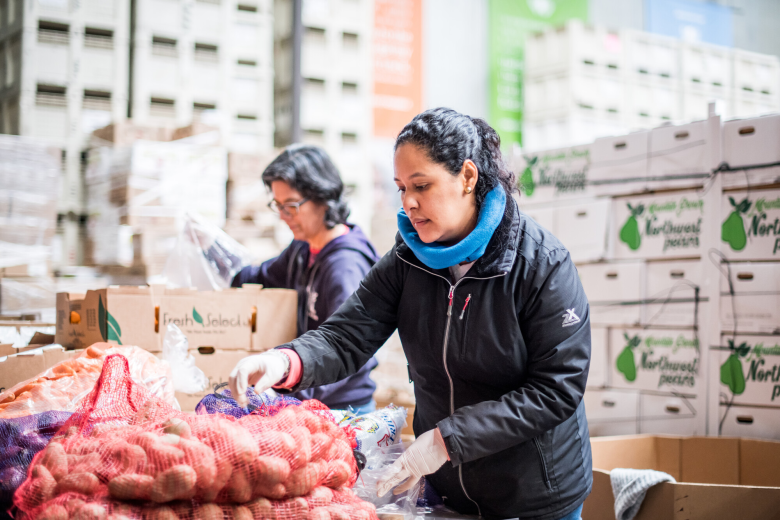
 Volunteers work to sort donated food at the San Francisco-Marin Food Bank in San Francisco’s Dogpatch neighborhood on Wednesday, March 18, 2020. Credit: Beth LaBerge/KQED
The government shutdown has reached its fifth week. And it’s confirmed that the 5.5 million Californians who use CalFresh — the state’s version of the Supplemental Nutrition Assistance Program, formerly known as food stamps — will have their November SNAP payments delayed.
Around the Bay Area, food banks are now preparing to meet the needs of thousands of people who will almost certainly see their access to food greatly reduced over the next few weeks, with the Thanksgiving holidays fast approaching.
We’ve compiled a list of food banks and additional meals and food resources in Berkeley.
And if you don’t need the services of a food bank right now, you might be wondering how to best support your local nonprofit providing food assistance to your neighbor, either by volunteering your time or donating to them financially.
Where can I find a food bank or food pantry in Berkeley?
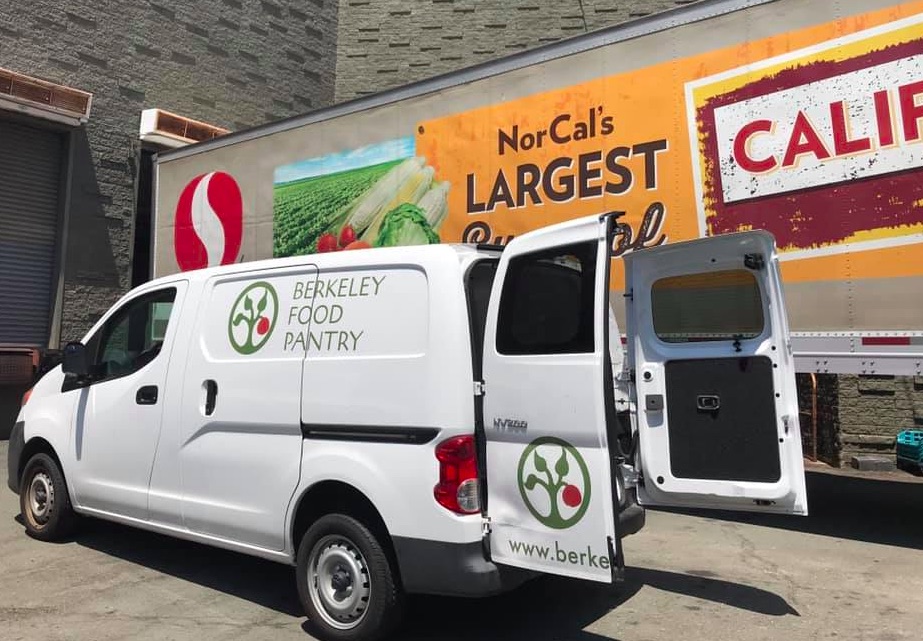 The Berkeley Food Pantry has been in operation for over half a century. Credit: Berkeley Food Pantry
Remember, most food banks are not the actual site to get your meals, but rather a distributor to participating food pantries, organizations, nonprofits and churches.
You can find a map of all Alameda County sites through the Alameda County Community Food Bank locator.
If your family will be impacted by the November CalFresh delays, and you’re interested in sharing your story on the record, please reach out through our tips form. Tell us a little about how you’re preparing and how your family will be affected.
Berkeley Food Pantry
Berkeley Food Network recently took over the Food Pantry, but its operations have not changed.
Who is eligible: Anyone who resides, works or attends school in Albany and Berkeley and is in need of emergency groceries.
What you’ll get: Bags of groceries filled with USDA food, including shelf-stable staples, frozen meat, fresh fruits, vegetables, dairy and bread every 30 days. You won’t be turned away if you come more than once a month but will get a smaller amount of groceries.
What to bring: On your first visit, you’ll want to bring documentation to confirm that you either live, work or study in Berkeley. For the following visits, a photo ID will do.
Website: https://www.berkeleyfoodpantry.org
Location: Berkeley Friends Church, 1600 Sacramento St.
Hours: 2-4 p.m., Mondays, Wednesdays and Fridays
Basic Needs Center at Berkeley City College
Who is eligible: Berkeley City College students enrolled in at least one class (no unit minimum).
What you’ll get: Produce and grocery items from Berkeley Bowl through the Berkeley Food Network and Alameda County Food Bank, including milk and eggs.
What to bring: Berkeley City College Student ID with a sticker indicating you’re a current student and a bag.
Website: https://www.berkeleycitycollege.edu/basicneeds/
Location: Atrium (basement level) at Berkeley City College, 2050 Center St.
Hours: 12-3 p.m., Thursdays when class is in session.
Basic Needs Food Pantry at UC Berkeley
Who is eligible: UC Berkeley students, staff, visiting scholars, student researchers, and postdocs.
What you’ll get: Fresh produce, freezer items, baked goods from places like Fournee and Boichik Bagels, eggs, tofu, pasta, rice and other shelf-stable food.
What to bring: UC Berkeley ID and a bag
Website: https://basicneeds.berkeley.edu/pantry
Location: Check in on the first floor of the MLK Student Union near the North entrance before visiting the pantry downstairs.
Hours: Vary; check the website for details
The program, which has been serving hot meals five days a week since the ’70s, is Berkeley’s longest-running daily free meal program.
Who is eligible: Anyone who needs food
What you’ll get: A free hot meal, with a vegan option
What to bring: Just show up
Website: https://insighthousing.org/what-we-do/food/
Location: The Hope Center, 2012 Berkeley Way
Hours: 3-4 p.m., Monday through Friday
Mercy Brown Bag Program
Who is eligible: Anyone in Alameda County 60 years and older and has an income less than 232% of the federal poverty line.
What you’ll get: Fresh produce, milk, eggs, shelf-stable pantry items like spaghetti sauce, tuna and peanut butter.
What to bring: Identification showing proof of residence in Alameda County
Website: https://mercybrownbag.org/get-food/
Location: South Berkeley Senior Center, 2939 Ellis St. More locations can be found on the program’s map
Hours: 9:30-10:30 a.m., first and third Fridays
Berkeley Food Network
(The 9th Street warehouse will be closed on Thanksgiving)
Who is eligible: Anyone who lives, works or studies in Berkeley and Albany
What you’ll get: Seasonal produce and rotating shelf-stable pantry items. Milk, bread, eggs and protein when available.
What to bring: On your first visit, you’ll be asked to fill out a short, confidential registration form, available in English, Spanish, Chinese and other languages, after which you’ll receive a membership card that works at any BFN pantry. Bring the membership card and a bag.
Website: https://www.berkeleyfoodnetwork.org/getfood/
Berkeley Technology Academy, 2701 Martin Luther King Jr. Way
1-2:30 p.m., second and fourth Wednesdays
Albany High School (cafeteria), 603 Key Route Blvd., Albany
1:30-2:30 p.m., first and third Fridays
South Berkeley Senior Center, 2939 Ellis St.
2-3 p.m., second and fourth Mondays
Berkeley High School, 2200 block of MLK, at the gate between the athletic fields and Building G
3:30-4:30 p.m., first and third Wednesdays from September through May
9th Street Pantry, 1925 Ninth St.
11 a.m.-6 p.m., Tuesdays and Thursdays. The pantry will be closed on Veterans Day (Nov. 11) and Thanksgiving
The county food bank doesn’t have an onsite food pantry, but resource workers are available to offer help with CalFresh assistance and more. You can also call the helpline for food support at 510-635-3663 or visit foodnow.net.
Location: 7900 Edgewater Drive, Oakland
Hours: 9 a.m.-4 p.m., Monday through Friday
Where else can I find food assistance during the shutdown?Check if you’re eligible for food assistance through WIC
The Women, Infants and Children Supplemental Nutrition Program (WIC) provides food assistance to lower-income families who have young children or are expecting a new child, including grandparents. Like CalFresh, it’s federally funded and income-based, and you can receive WIC benefits on top of your CalFresh benefits — but unlike CalFresh, the state has confirmed that November WIC payments won’t be affected during the shutdown.
Look for restaurants near you offering meals to CalFresh families
A growing number of Bay Area restaurants are offering free or discounted meals during the government shutdown to families using SNAP.
Get your existing EBT balance doubled at a farmer’s market
The Market Match program allows CalFresh users to show their EBT card at certain farmer’s markets and receive tokens for double their chosen dollar amount from the card to spend at the market. Use the Farmers’ Market Finder online tool to find Bay Area locations which accept Market Match.
Be aware you’ll need to have existing funds left on your EBT card ahead of the November CalFresh delay, and have a plan for how you’ll best store fresh produce to preserve it — like freezing it.
Look at Alameda County’s food access programs
Food assistance from Alameda County:
How can I best support my local food bank?
The quickest way to offer your support is by visiting an organization’s website and signing up there to volunteer or make a donation.
Don’t feel you need to wait until the holidays to volunteer or donate
“The holidays are definitely busier times when we tend to get more volunteers coming in,” said Elizabeth Gomez, vice president of impact at the Alameda County Community Food Bank. “But the truth is that we need volunteers every day of the year.”
And while the Thanksgiving holiday is a particularly popular time to volunteer at food banks around the country, SNAP payments are typically paid onto recipients’ EBT cards in the first ten days of the month — meaning that with the shutdown delays, many people’s urgency around accessing food will start early in November.
ACCFB has already seen a 12% increase since July in people using its food distribution sites, Gomez said. And now, the CalFresh delays “couldn’t come at a worse time,” she said. “This is November: It’s a time for family, for food, for togetherness.”
Many people on CalFresh are particularly relying on these funds to feed their families at the holidays, noted Gomez, “especially during the winter months when not only our food prices go up, but electricity bills go up.”
Be open to different volunteer roles …
Food banks — and the programs they distribute to — have a wide variety of volunteer roles to be filled, from warehouse roles like stocking shelves, packing boxes and cleaning facilities to “front of house” opportunities where volunteers work directly with members of the public.
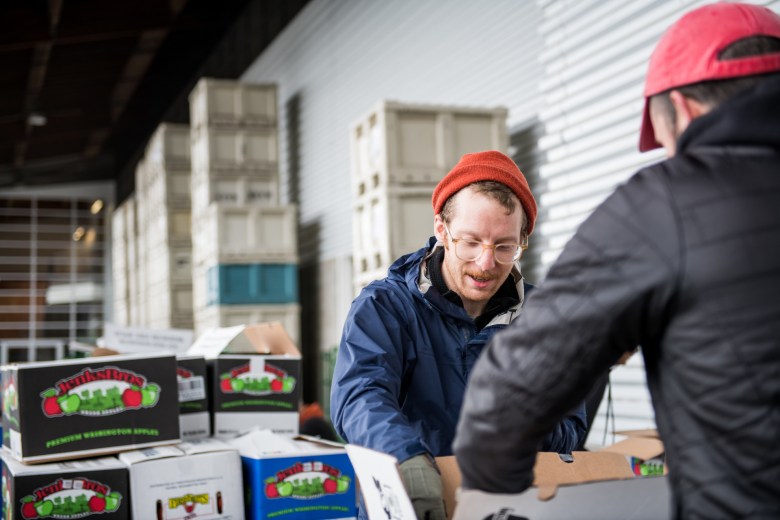 Volunteers sort donated apples at the San Francisco-Marin Food Bank. The organization’s workers voted to unionize in 2020 following a growing sense among employees that management was ignoring institutional problems. Credit: Beth LaBerge/KQED
Different organizations may have different needs. The Berkeley Food Pantry has in the past cited a shortage of volunteer drivers as the reason it can’t accept more deliveries.
At the Berkeley Food Network, the most crucial volunteer role is that of greeter, executive director Andrew Crispin said: people who welcome clients, “letting them know what’s on the menu, letting them know that this is a safe space.”
… and volunteering at different places
Cody Jang, senior associate director of community engagement at the San Francisco-Marin Food Bank, suggested would-be volunteers seek out opportunities at smaller locations in their communities: “schools, community centers, senior centers, soup kitchens, all kinds of different places.”
Not only does donating volunteer hours to one of these smaller pantries help “with the chain of getting food to those in need,” your work there is more likely to impact your actual neighbors, Jang said.
Know that donating money has greater impact than donating food
“We’d never deter anybody from donating actual food to us, but it’s most impactful to make monetary donations to the food bank because we are able to do so much with that,” Michael Altfest, spokesperson for the Alameda County Community Food Bank, told Berkeleyside in 2023. “What someone may pay for a jar of peanut butter and donate to us, for the cost of that we can provide many meals worth of food.”
Donating money rather than food gives food banks far more flexibility, as these nonprofits are able to negotiate special deals for the food they buy in bulk — at much better prices than you can access as a private customer at a store.
“We can really stretch people’s dollars far,” said Leslie Bacho, CEO of Second Harvest of Silicon Valley. “And believe me, they are really needed in this moment.”
See if your employer will match your donation
Some companies will match whatever you donate to a food bank, so it’s worth inquiring with your employer. ACCFB’s donation page even allows you to type in your company’s name to see if they’ll match the amount you give.
Food banks will typically welcome nonperishable, unopened food. And you’ll want to make sure your product can be accepted at the particular food bank you want to donate to.
For example, ACCFB has a list of foods “our community loves” to guide food donations, which include:
Ready-to-eat meals, especially in easy-open cans or pouches
Chilis, stews, ravioli and soups
Chicken, tuna and salmon
Snacks for children (like healthy lunch snacks, bars, and fruit or veggie pouches)
Nonperishable fruit (in cups, bowls or cans)
Peanut butter
Cereal (boxes or single-serve bowls)
Nutrition and protein bars
Items the food bank asks people not to donate:
Soda, carbonated drinks, energy drinks or alcohol
Items with major dents or damage
Produce that’s overripe, moldy, wilted or extremely bruised
Items that have been previously thawed
Ice cream
Some food banks may also accept products needed by the community, like detergent, period supplies, diapers or other personal care items, and Feeding America suggests you contact your local organization directly to check.
Host a food drive to collect physical donations …
While food banks across the country paused their traditional food drives at the height of the COVID-19 pandemic, they’re once again an option for people wanting to support their local food bank with food donations.
ACCFB also welcomes “large-scale food drives” in which groups like schools and larger businesses commit to collecting over 400 lbs. of food, i.e., at least three completely full food drive barrels.
… or start a virtual food drive
ACCFB has a tool that allows supporters to host virtual food drives online, inviting donors to “shop” for the food bank’s most needed fresh items, like milk, eggs and produce, which can’t be collected in a typical food drive’s barrels.
“Thanks to our bulk purchasing power, the money you’d spend in a grocery store to fill just one food drive barrel is enough to fill 3–4 virtual barrels,” ACCFB’s website said.
This story was co-produced by KQED and Berkeleyside. A previous version of this story was first published in 2023. It contains reporting from KQED’s Francesca Fenzi, Nastia Voynovskaya, Amanda Hernandez and Berkeleyside staff.
“*” indicates required fields