
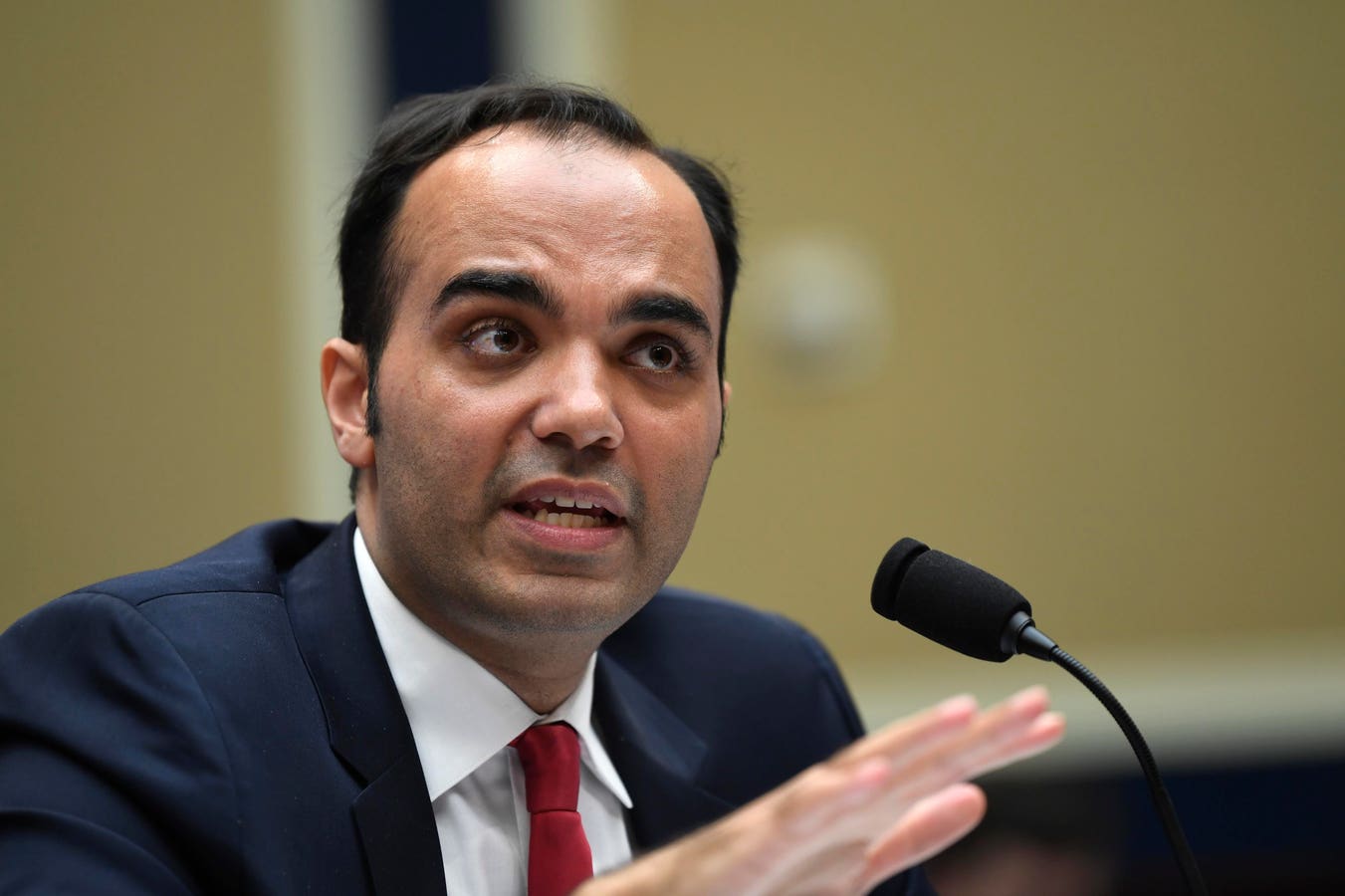
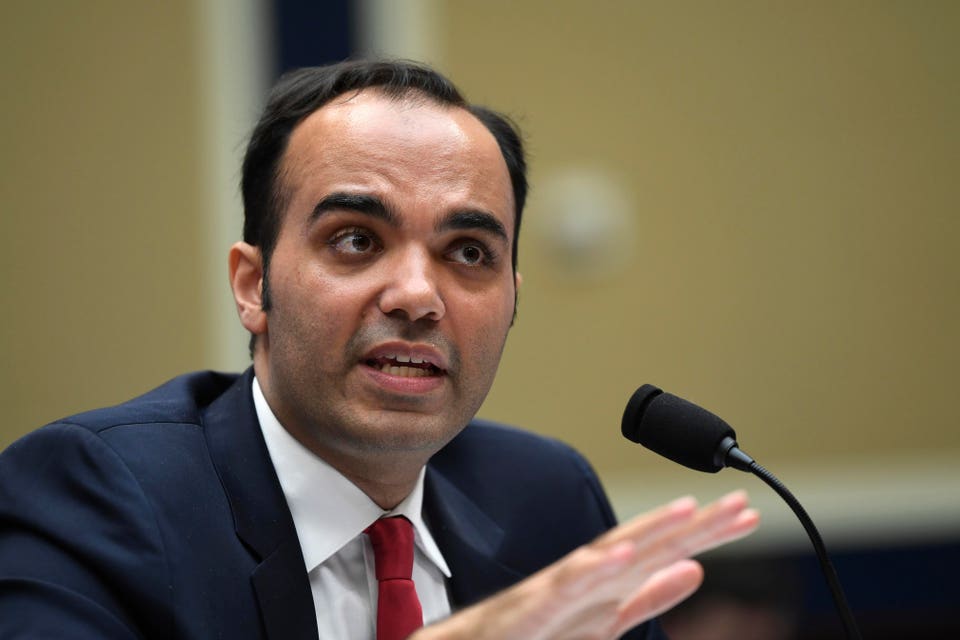
FILE – In this May 8, 2019, file photo, Federal Trade Commission commissioner Rohit Chopra testifies during a House Energy and Commerce subcommittee hearing on Capitol Hill in Washington. In its first move since getting a new director, Rohit Chopra, the Consumer Financial Protection Bureau is ordering Apple, Amazon, PayPal and other tech giants to disclose how they operate their proprietary payment networks, which have to come to dominate large portions of e-commerce and person-to-person payments. (AP Photo/Susan Walsh, File)
Copyright 2019 The Associated Press. All rights reserved.
Since early 2025, the federal government has been pulling back on consumer financial protection. Washington scaled back enforcement, narrowed the CFPB’s mandate, and sent a clear message that products once under scrutiny could operate with less friction. Most fintech companies read that as a green light. California is now moving to shut it off.
Yesterday, Governor Gavin Newsom appointed Rohit Chopra as Secretary of the state’s newly created Business and Consumer Services Agency. The Trump administration fired Chopra from the CFPB in February 2025 after he clashed repeatedly with the financial industry over nonbank supervision, junk fees, and algorithmic lending. Companies that assumed his exit from Washington meant he was out of the picture should revisit that assumption.
Inside The Agency Chopra Now Controls
The BCSA is a cabinet-level restructuring that takes effect July 1, 2026, when the existing Business, Consumer Services, and Housing Agency dissolves and splits into two standalone bodies. Chopra will run the consumer-facing half. His agency will house the Department of Financial Protection and Innovation, the Department of Consumer Affairs, the Department of Real Estate, the Department of Cannabis Control, and the Department of Alcoholic Beverage Control, among others.
The DFPI is the member department that matters most to fintech. It holds supervisory and enforcement authority under the California Consumer Financial Protection Law over a wide range of nonbank financial products, including earned wage access, buy now pay later, digital assets, consumer lending, and money transmission. Under the prior agency structure, the DFPI operated with a fair degree of autonomy. Chopra now sits above it as Secretary, with authority to set enforcement priorities, coordinate strategy across member departments, and steer the agency’s consumer protection agenda in line with his federal track record. The DFPI keeps its independent statutory authority, but the person running the show above it has changed.
The Blueprint Chopra Left Behind At The CFPB
In January 2025, days before leaving the CFPB, Chopra oversaw the release of “Strengthening State-Level Consumer Protections,” a report that read like an operating manual for states looking to build enforcement capacity without federal help. It urged states to ban “abusive” practices under their own statutes, give attorneys general broader investigatory powers, lower the evidentiary bar for private plaintiffs, prohibit junk fees, and beef up consumer data rights. It also pushed states to expand private rights of action so that enforcement could move forward even where companies had buried arbitration clauses in their consumer agreements.
Chopra wrote the report knowing that federal enforcement was about to shrink fast, and he used it to hand off what he had learned to the states. California’s consumer financial protection law already tracks much of what the report recommended, including a ban on abusive acts or practices modeled on the federal standard. Chopra now runs the agency responsible for taking it further.
How Chopra Built The Infrastructure Before Taking The Job
The California appointment did not come out of nowhere. In December 2025, the Democratic Attorneys General Association hired Chopra to lead its Consumer Protection and Affordability Working Group. That put him at the center of a multistate effort coordinating with state AGs on enforcement strategy across financial services, technology, and health care. The working group was built to produce recommendations that attorneys general could act on fast, and Chopra spent the intervening months building relationships and lining up research while California was still putting its new agency together.
Chopra shows up in Sacramento having already road-tested his policy agenda across multiple state enforcement offices. His agency will not need months to figure out where to focus. The January 2025 CFPB report gave state enforcers a playbook, the AG working group gave them coordination, and the California appointment gives all of that an executive home in the most populous state in the country.
The Products In The Crosshairs
Chopra’s enforcement record at the CFPB is the best guide to where California will point its attention. Earned wage access was a sustained priority — in July 2024, the CFPB under Chopra proposed an interpretive rule that would have classified EWA products as loans subject to the Truth in Lending Act, directly challenging the industry’s longstanding argument that wage advances fall outside federal lending definitions. The current administration pulled that proposal in December 2025. Buy now pay later providers faced similar heat, with the CFPB issuing an interpretive rule applying credit card protections to BNPL products and opening a supervisory examination program for larger market participants.
Digital payment platforms caught attention on two fronts. Chopra used the CFPB’s larger participant authority to bring general-use digital consumer payment apps under examination coverage, and he went after platforms he saw as enabling fraud without adequate consumer protections. Data brokers came up again and again, with the CFPB publishing research on how third parties harvested and sold consumer financial data in ways that created risks well beyond financial services.
AI-driven underwriting and credit decisioning was an area Chopra flagged repeatedly, both through enforcement and through public warnings that algorithmic systems could produce discriminatory outcomes that traditional fair lending analysis might miss. California already has its own statutory rules on automated decision-making, and the overlap between Chopra’s enforcement priorities and California’s existing legislative stance on AI makes this a jurisdiction where companies relying on algorithmic credit models will face hard questions from more than one direction.
What ties all of these categories together is Chopra’s view that product design itself can be an unfair or abusive practice, independent of any specific misrepresentation — a theory of liability that goes further than what most fintech compliance programs are built to handle.
What Companies Should Do
Companies serving California consumers should treat this appointment as a reason to take a hard look at their compliance programs. How they disclose fees, how they make and explain credit and underwriting decisions to consumers, how they structure subscription and cancellation terms, and whether products they have positioned outside traditional lending definitions would hold up under serious examination. All of it deserves a fresh review rather than the assumption that what worked before still works.
The exposure goes beyond direct state enforcement. The January 2025 CFPB report Chopra helped produce called for expanding private rights of action, lowering proof requirements for consumer injury claims, and letting nonprofit organizations bring representative suits on behalf of the public. When state regulators get more aggressive, private litigation tends to follow — plaintiffs’ counsel watches what regulators are doing and builds cases around the same conduct. Companies that get ahead of their California compliance issues before an examination or a civil investigative demand shows up will be in a much stronger position to respond.
The Larger Picture
New York, Pennsylvania, and Massachusetts have each expanded their consumer financial protection rules over the past year, and state attorneys general across the country have been coordinating enforcement strategy more closely since the federal pullback forced their hand. California stands apart because of what is now concentrated in one place: a regulator with federal enforcement experience, a cabinet-level agency with consolidated authority over the DFPI and multiple consumer-facing departments, a consumer protection statute modeled on federal law, and a policy network that has spent six months building strategy.
Companies building for national distribution are dealing with a regulatory environment where the level of oversight varies sharply by state, and California is now the place where it is ramping up fastest. Newsom gave Chopra executive authority over an agency that controls the primary regulator of California’s fintech industry, and Chopra shows up having already drafted the enforcement strategy he plans to execute.