
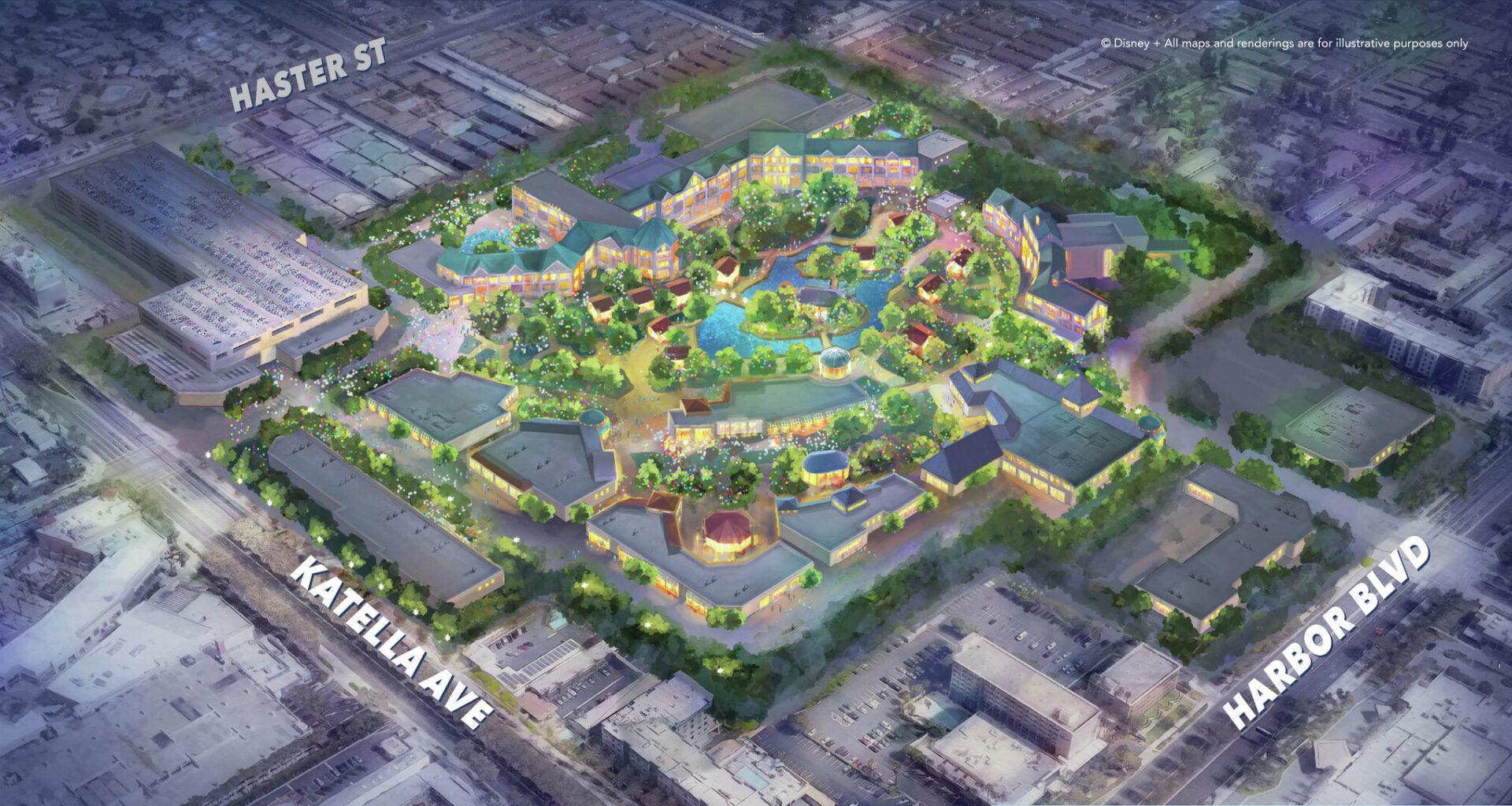
If Disneyland truly is planning a third theme park — a subject about which Disney has been very quiet — then recent moves by the company could indicate that progress is actually happening toward that goal. Recently, Disneyland filed building permits with the city of Anaheim for one of the locations named in DisneylandForward, the massive multiyear development plan that will likely lead to the company’s third California park.

Today, the plans — and the new park — feel closer than ever. But these plans aren’t new; in fact, they predate the entire DisneylandForward project by decades. Disneyland has been working toward opening a third gate for nearly 30 years, all the way back to Disney’s Eisner era.
A rendering of the DisneylandForward expansion in Anaheim, Calif.
Disneyland/Courtesy
Headed into the 1990s, the Walt Disney Company was in a boom period. With the 1989 smash hit that was “The Little Mermaid,” the company emerged from its early 1980s slump, when flops like “The Black Cauldron” threatened the future of its animation division altogether. Then-CEO Michael Eisner looked to aggressively expand, especially in the company’s reliably lucrative theme parks division. Disney began construction on EuroDisney (what’s now Disneyland Paris) in 1988, working up to its eventual 1992 opening.
Article continues below this ad
Closer to home, Eisner set his sights on fixing a longstanding problem at Disneyland: The company didn’t own the Disneyland Hotel, which bore the name of the park but over which Disneyland had no real control. Walt Disney, facing huge financial constraints while building his eponymous theme park, had no spare money for the hotel he knew he needed at Disneyland. He turned to friend and real estate developer Jack Wrather in 1954, offering him a 99-year land lease at a very favorable price. The Wrather Corp. built the Disneyland Hotel and operated it for the following three decades, until Disney finally succeeded in purchasing the business in 1988.
A rendering of the new entrance area, including a pedestrian bridge over Harbor Boulevard, planned for the Disneyland Resort.
Courtesy of Disney
Reporting on the purchase, the Los Angeles Times speculated that Disney’s newly acquired land would pave the way for a new park. “In addition to a planned studio-tour and shopping complex in Burbank, the company has long been studying a major addition to its Anaheim theme park,” the paper wrote at the time.
Make SFGATE a preferred source so your search results prioritize writing by actual people, not AI.
Add Preferred Source
To acquire the hotel, the Walt Disney Company purchased Wrather’s business altogether, which also meant taking over the operational lease on the Queen Mary, the cruise ship that’s now a permanently docked hotel in Long Beach. On land, Disney would build a $2 billion entertainment complex, called Port Disney, with five hotels. There would also be a new theme park, DisneySea, which “would revolve around Oceana, a complex of futuristic bubbles that depict the evolution of the seas and a working Future Research Center, where scientists from the world’s leading institutions would gather for oceanographic studies,” the LA Times wrote in 1990.
Article continues below this ad
But the project was not certain, especially because Disney was simultaneously in negotiations with the city of Anaheim to build WestCot, a West Coast version of Walt Disney World’s Epcot, at Disneyland.
“I think it’s an excellent opportunity for the city of Long Beach, and I think we can work out the problems,” Long Beach Mayor Ernie Kell said at the time. “But if we don’t work out the problems, I won’t support it. We don’t want to get gobbled up by the giant.”
Residents strongly opposed the project, in part because Disney wanted city funds to bolster necessary infrastructure upgrades and also because the company had built up ill will with recent bad-guy moves like firing Queen Mary employees who refused to shave their mustaches. After nearly 18 months of tense negotiations, Long Beach refused to meet Disney’s terms, and the project died. Disneyland would get its WestCot after all.
Disney artist rendering of what a Disney Springs-inspired area could look like at Disneyland.
Courtesy of Disneyland
Without Port Disney, the Queen Mary project no longer made sense. The company gave up its operational lease in 1992. That same year, EuroDisney opened to massive criticism, with locals describing the park as a “cultural Chernobyl.” Its first few years were marked by deep financial struggle and put the company’s balance sheet in dire straits.
Article continues below this ad
Back at home, Anaheim approved plans for a $2.75 billion Disneyland expansion in 1993 — but money was bad enough that the huge, ambitious WestCot plans got scaled back by half in 1994 and scrapped altogether in 1995. What replaced the groundbreaking park was the first iteration of Disney California Adventure, announced in 1995. That cost-cutting park opened in 2001 to middling reviews and was called “Eisner’s misadventure” by some.
Even before California Adventure opened, people were speculating about Disneyland’s plans for a third park — chatter that was encouraged by the company itself. In 1998, Disney purchased a huge parcel of land on Harbor Boulevard, which had previously been a long-defended strawberry farm owned by a family who refused to sell for decades. In 1999, the LA Times speculated that the hard-won land could be devoted to building a third gate. The purchase, the paper wrote at the time, “[provided] for the first time enough land for Disney to consider a third theme park in the city.”
In July 2000, Disney announced its intention to develop the site into a third park. “Company officials said the new complex could include an amusement park that would borrow popular rides from Disney venues in Florida, Tokyo and Paris, and perhaps a water park, retail center and hotel rooms,” the LA Times reported, adding that the new park could be operational as early as 2003.
A rendering of the new “Coco” ride planned for the Paradise Gardens part of Disney California Adventure in Anaheim, Calif.
Courtesy of Disney
“In Anaheim, Disney has long wanted to create an urban resort — a vacation destination that could draw the multiple-day stays that Florida’s Disney World does — and better compete against the multitude of attractions in Southern California, from Hollywood to Sea World in San Diego,” the story continued.
Article continues below this ad
Neighbors balked at the idea. Some feared more years of construction and ripped-up roads, while others were concerned about the low-income workers the new jobs would bring to the area. “We just don’t want the city saying Disney needs 5,000 more people so we’re going to build more affordable housing in our neighborhoods,” one disgruntled Anaheim resident said at the time.
By August 2000, just a month after Disney announced its intended third park, pushback was building. “We support the project, but there are impacts that need to be addressed,” Garden Grove City Manager George Tindall told the LA Times at the time. “If there are problems, they need to mitigate any impacts.”
By the following summer, largely owing to low attendance at California Adventure and a lukewarm local response to further development, plans had all but stalled. That land eventually became the Toy Story Parking Area that occupies the plot today. In 2015, then-CEO Bob Iger told shareholders, “We have plans at Disneyland for an expansion that we have not announced but those plans at the present do not include a third gate.”
The Toy Story lot is where the Walt Disney Company recently filed confidential building permits, according to Theme Park Wizard. Clearly, some development is happening there, but what will happen is unknown, and no timeline for a possible closure has been announced. The city of Anaheim and Disneyland did not respond to SFGATE’s requests for more information.
Article continues below this ad
A rendering of the new “Avatar” land planned for Disney California Adventure in Anaheim, Calif.
Courtesy of Disney
But theme park experts speculate that the Toy Story lot will play a pivotal role in Disneyland’s likely eventual third park. Now that a massively improved parking structure is underway on land directly across from Disneyland’s Harbor Boulevard entrance, as outlined in the DisneylandForward development proposal, the Toy Story lot will be free to develop for other uses.
Dusty Sage, owner of Disney fan site Micechat.com, believes the property could be used to create an expanded Downtown Disney shopping and dining district that’s separate from the parks, like Disney Springs at Walt Disney World, which could include hotels. “It would bring the higher-end immersive dining and shopping experiences like Disney Springs that we expect and have never gotten at Disneyland,” he told SFGATE in 2025.
Once that project has added hotel room capacity to the Disneyland Resort, the company could develop its underused land around the Disneyland Hotel into an eventual third gate. In 2022, the Orange County Register said that a parking lot in that area is “land Disneyland has identified as the future home of a major theme park expansion.”
Article continues below this ad
Disney has not made any recent comment on long-term plans for a third park, other than noting in the DisneylandForward proposal that the rezoning that resulted from the now-approved plan means that its land can now be used for, “a new kind of Disney entertainment — could include theme park, hotel, retail dining and entertainment.”
Currently, Disneyland is working on California Adventure additions like a “Coco” ride and an “Avatar” land. If and when a new park does happen, it could include lands dedicated to “Frozen” and “Zootopia,” like Disney parks around the world are building. For now, the plans remain confidential — and park fans are left to think up Mickey-shaped pipe dreams about what it will be.
Get insider access to all things Happiest Place on Earth, from historical deep dives to trending park news and beyond. Sign up for our Dispatches from Disneyland newsletter here.