
California’s attorney general has written to FIFA regarding World Cup ticketing maps that some fans have labeled misleading.
In a letter sent Wednesday to FIFA’s legal department, Rob Bonta, the state’s attorney general, requested a variety of information from the global soccer governing body “to assess whether California law may have been violated” during the ticket sales process.
Bonta wrote that his office, which represents the state in legal matters, “is particularly concerned about recent reports that FIFA sold tickets by categories based on seating zones depicted on stadium maps but then changed those seat categorizations before assigning precise seat locations.”
FIFA, throughout the fall and winter, sold millions of tickets to the 2026 World Cup in four categories, with each category corresponding to a range of sections at each stadium, per color-coded maps embedded in the ticketing portal and published online.
But The Athletic detailed last month how FIFA had altered those maps from one sales phase to the next, then assigned a minority of ticket buyers a seat that, in an earlier phase, had belonged to a different category.
Several fans told The Athletic that they felt “misled” or worse. They cited the fact that hospitality seating maps contradicted standard seating maps, but also the map changes. “You can’t change the rules of the game after someone’s played,” one fan, Jordan Likover, said.
The two California stadiums — SoFi Stadium near Los Angeles and Levi’s Stadium in Santa Clara — were not among those cited by fans in the April report. They, like all others, were indeed subject to map changes, but ironically, the changes at both stadiums might have benefited some ticket buyers.
The original map of “Los Angeles Stadium,” as it will be called for the World Cup, assigned the entire 100 and 200 levels, plus 24 sideline sections on the 300-level, to Category 1; and most upper-deck sections to Category 2.
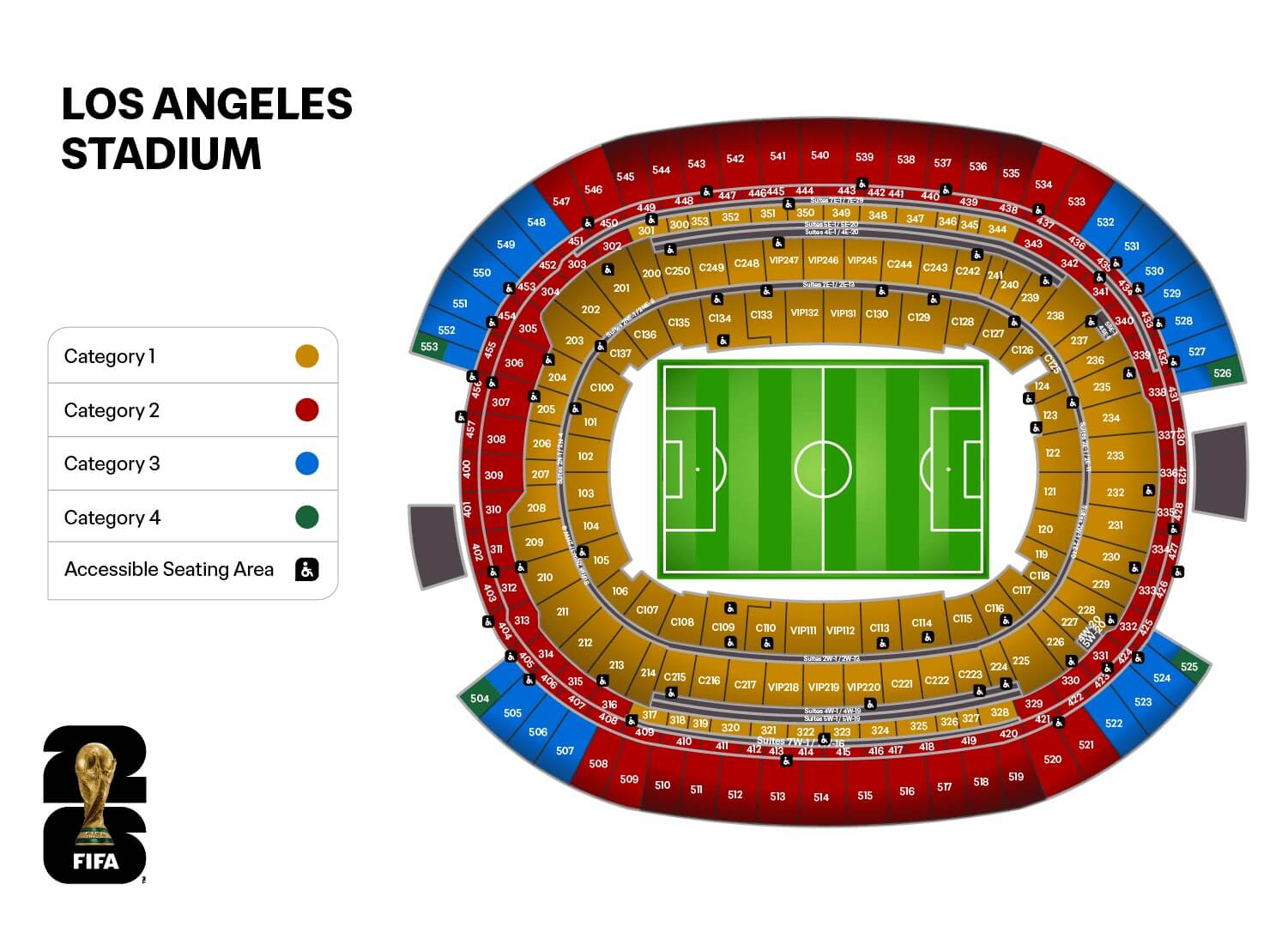
The original FIFA seating map for SoFi Stadium outside Los Angeles (FIFA)
Subsequent iterations, including the December version that added supporters sections, flipped all of those 300-level sections to Category 2; and changed some upper-deck sections from Category 2 to 3. The current iteration is below.
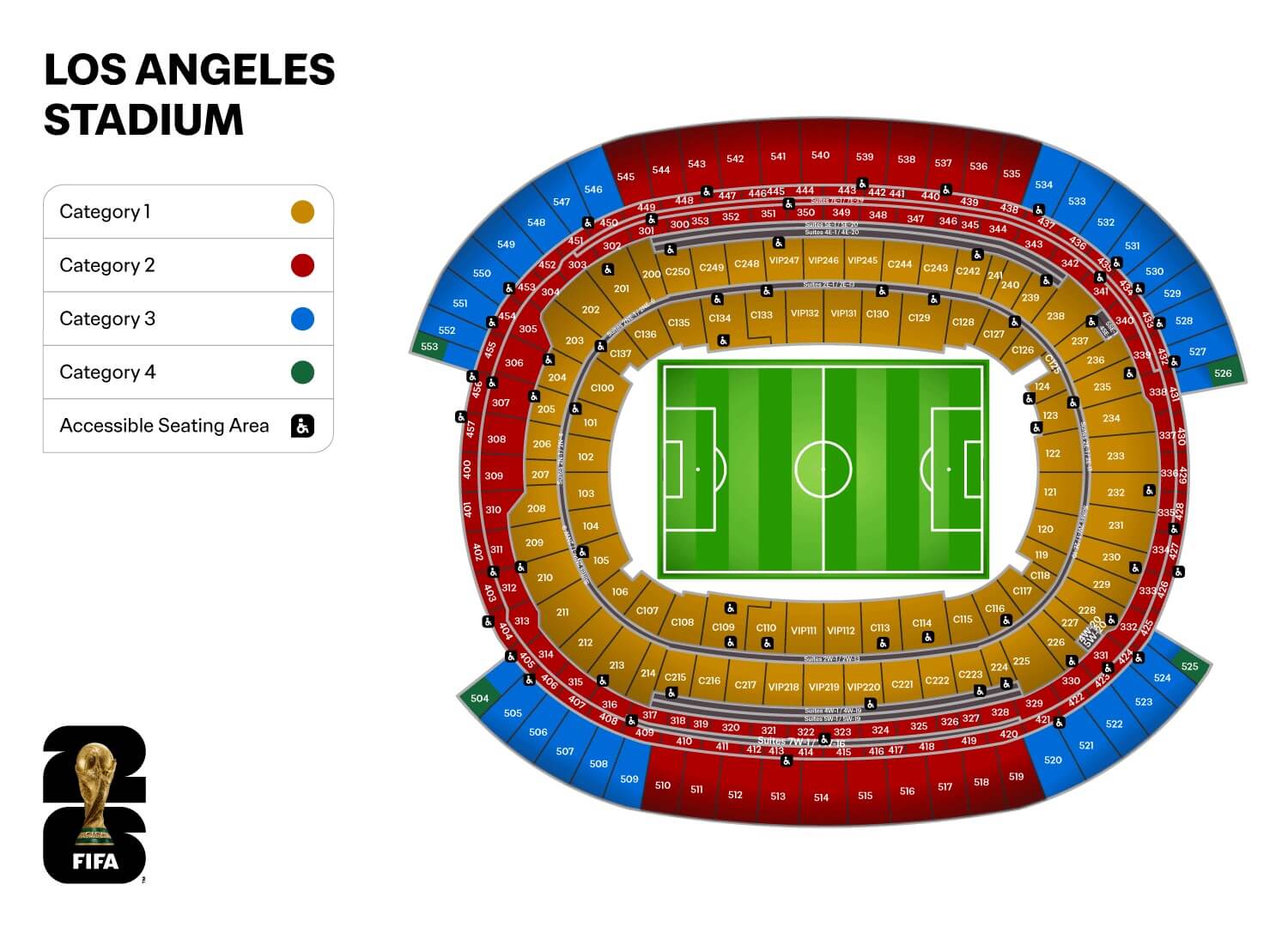
FIFA’s updated seating map for SoFi Stadium from April 2026 (FIFA)
Current listings on FIFA’s ticket resale platform, meanwhile, suggest that, for all eight Los Angeles games, seats have been assigned in line with the current maps or in sections that were initially part of a better category. For Iran’s opener against New Zealand, for example, the entire upper deck appears to have been converted to Category 3, where tickets were sold for $140, compared to $380 for Category 2.
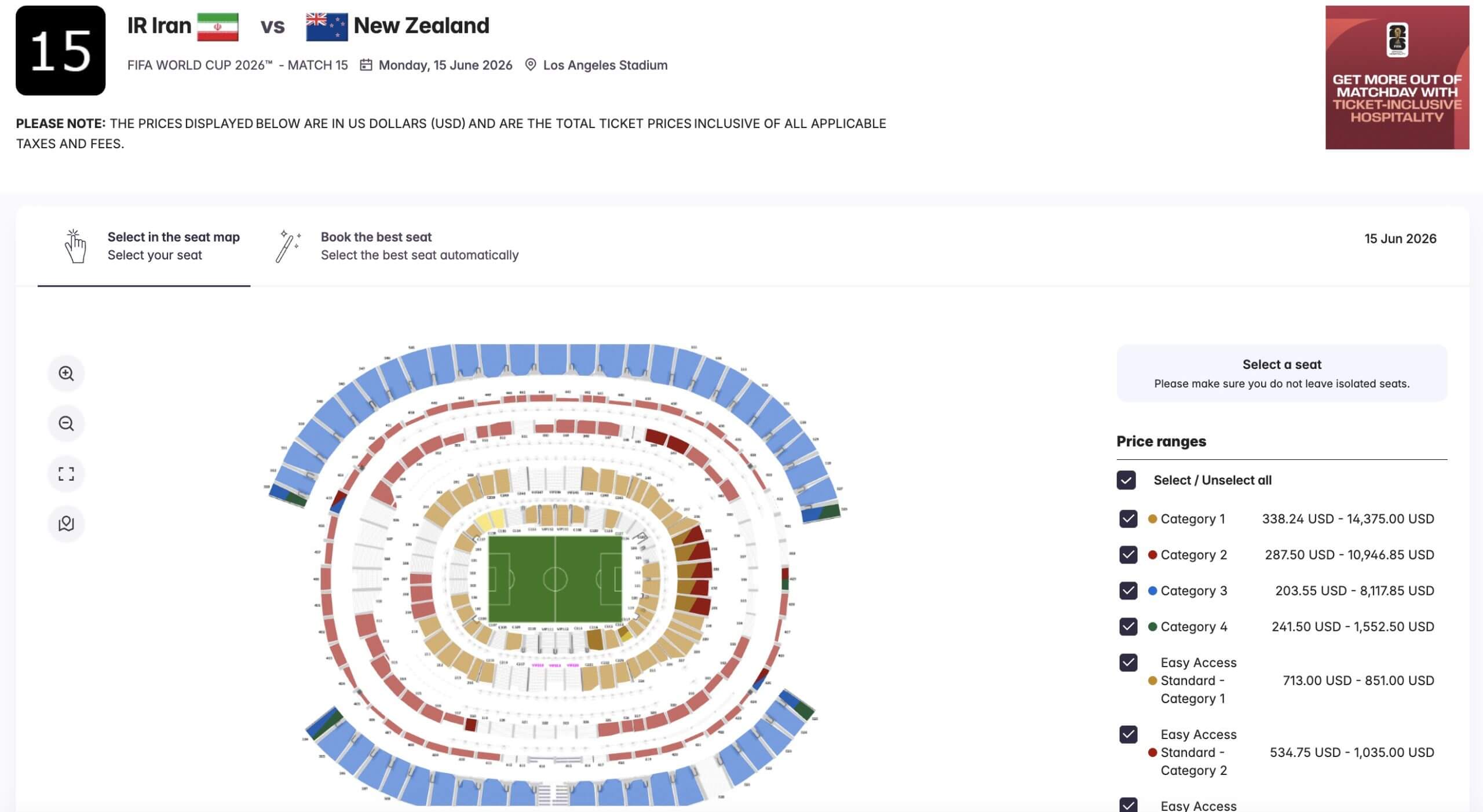
Resale prices for Iran vs New Zealand at the World Cup (FIFA)
Similarly, in Santa Clara, which received the least appealing slate of matches among the 11 U.S. host cities, some lower-bowl seats were assigned to (and are now being sold to) Category 2 buyers at all five group-stage games — Qatar vs. Switzerland, Austria vs. Jordan, Turkey vs. Paraguay, Jordan vs. Algeria and Paraguay vs. Australia.
The more prevalent complaint from fans has been that many of the best Category 1 sections — in lower levels near midfield — have actually been reserved for hospitality ticket buyers, per separate maps; or are now being sold at higher prices.
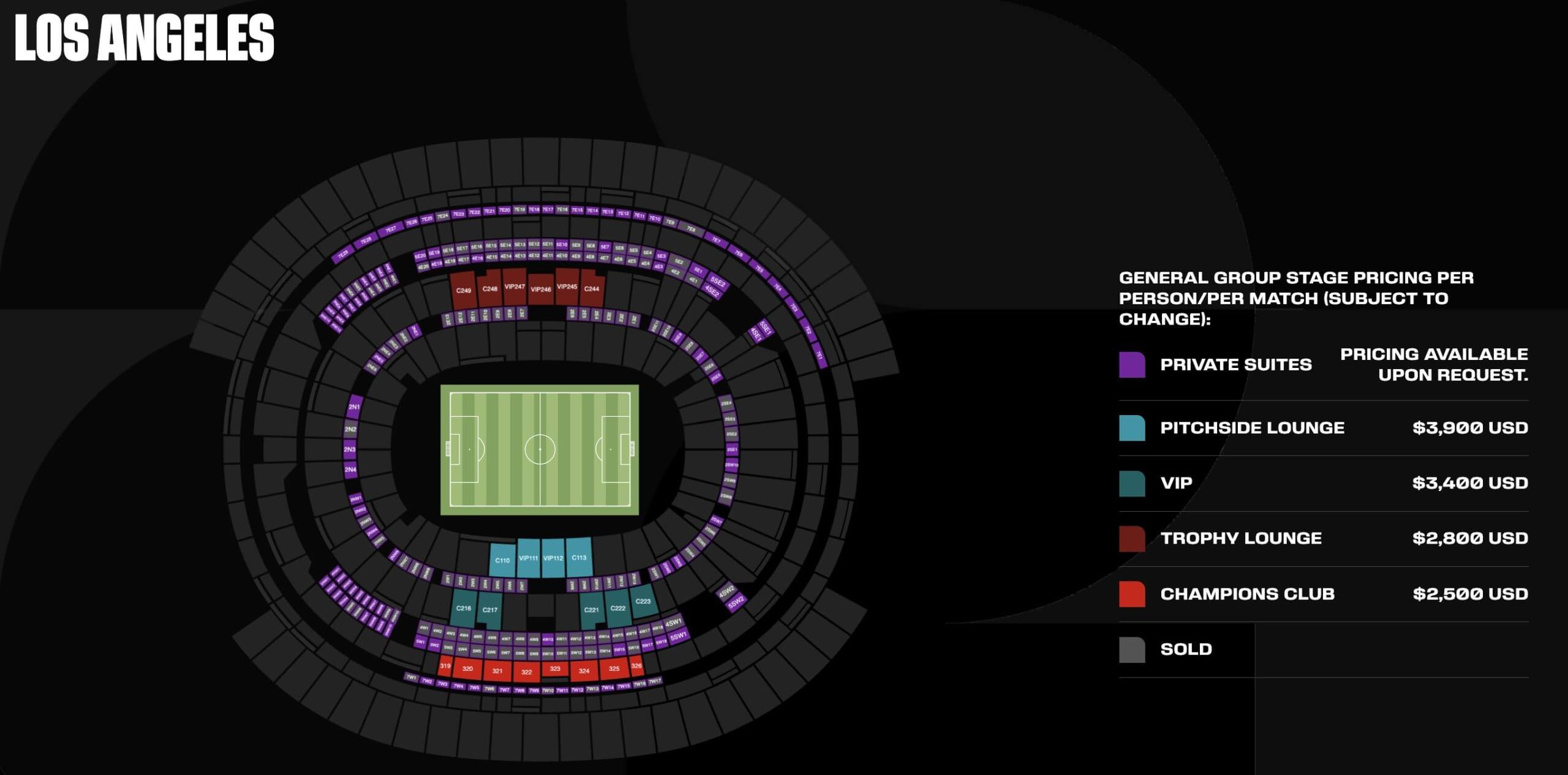
Hospitality seating in Los Angeles for the World Cup (FIFA)
Nonetheless, Bonta requested:
Copies of each iteration of each stadium map
Copies of each page displayed during the ticket purchase process in earlier sales phases
“The number of ticket buyers, if any, who were ultimately assigned seats that would have been designated in a lower category based on the seating map available at the time they purchased their tickets.”
“A full explanation of what, if any, efforts were made to assign these buyers to seats that were ‘comparable to or better than’ seats that, at the time of their purchase, corresponded to the category they selected.”
“All disclosures, if any, that FIFA provided to consumers that FIFA could change the boundaries of ticket categories after ticket purchases for those categories were made.”
A description of “what, if any, refunds, discounts, or other remedial efforts FIFA has provided or plans to provide to ticket buyers who were assigned seats that were categorized differently at the time they purchased their tickets.”
FIFA, in a statement last month responding to concerns raised by fans, said the “indicative category maps” were “to help fans understand where their seats could be located within a stadium. These maps were designed to provide guidance rather than the exact seat layout, and reflect the general extent of each ticket category within the stadium.”
FIFA’s “Ticket Terms of Use” also state: “Any visual representations of Ticket Categories on the Ticketing Website, such as Stadium maps and illustrations, are for guidance purposes only and may not reflect the actual layout and boundaries of a particular Stadium.”
Two paragraphs later, the terms add: “The Ticket Holder acknowledges that FIFA Ticketing or the relevant Stadium authorities may determine the Seat Location and change the Seat Location for a given Ticket at any time, including after a Ticket has been purchased and on the day of the Match, provided that the Seat Location is in an area applicable to the same Ticket Category or a Ticket Category of Tickets with a comparable or better value.”
Bonta, however, citing legal precedent, wrote that in California, “businesses and organizations cannot defend [potentially misleading] practices by relying upon fine print or terms disclosed elsewhere that a reasonable consumer would not have reviewed or understood.”
He also cited sections of California’s “Business and Professions Code” that relate to false advertising.
Bonta’s office requested the above information by May 29, two-and-a-half weeks from now — and two weeks before the World Cup is set to begin. (The U.S. national team’s opener, on the second day of the tournament, is at SoFi Stadium on June 12.)
“Californians deserve transparency and fairness when purchasing tickets for any event held in our state,” Bonta said in a statement. “The FIFA World Cup only comes once every four years — and as someone who played soccer in college and beyond, has a daughter and daughter-in-law who play professional soccer, and still has a deep passion for the sport — I understand the significance these matches hold for fans. Californians should be able to trust that the seats they purchase match the representations made during the sales process. We look forward to receiving the requested information from FIFA as part of our ongoing review.”
FIFA spokespeople have been approached for comment.