

The number of people experiencing homelessness — whether on the streets or indoors at shelters — in Sacramento County rose 12.7% since 2024, according to a January count.While the count found a rise in both the unsheltered and sheltered population, there was a bigger increase in the number of people connected to shelter or transitional housing, Sacramento Steps Forward also said.This year’s “Point in Time” count determined 7,458 people were estimated to be experiencing homelessness, or 46 out of every 10,000 residents. (See a presentation here.)The unsheltered count was 4,205 people, a 6.6% increase from 2024, and those ranks are becoming more dispersed across the county.The sheltered count was 3,253 people, a 21.8% increase.About 96.7% percent of adults with children were sheltered. That compared with 33.5% of adults without children. Both categories saw increases in the overall PIT count. “This year’s data shows that investments in shelter and coordinated access are making a meaningful difference,” Sacramento Steps Forward CEO Lisa Bates said in a statement. “To build on this progress, our community must continue expanding pathways from homelessness to permanent housing through sustained investments in housing, prevention, and coordinated access.”Sacramento Mayor Kevin McCarty called the count a “mixed bag” with progress on getting people into shelters and connecting them with services. But there were still “unacceptably high” numbers of those experiencing homelessness and a lack of affordable housing, he said in a statement.”We must stay the course by strengthening regional collaboration with the county, expanding beds and services, and delivering compassionate, cost-effective and accountable solutions,” McCarty said. Point-in-time (PIT) counts are mandated by the Department of Housing and Urban Development for federal funding and take place across the country. Sacramento’s PIT count has historically taken place every other year. But going forward, the count will be conducted annually, according to Sacramento Steps Forward. This year’s count took place on two nights in January with the help of 779 trained volunteers, a 30% increase from 2024. The project covered 200 census tracts across the county and involved 1,200 surveys. More findings from the count: Sixty-nine percent of the increase in the PIT count involved people staying in shelter or transitional housing. About 582 more people were staying indoors on the night of the count than in 2024. Sacramento Steps Forward said that investments in shelter capacity have meant 491 more emergency shelter and transitional housing beds than were available two years ago. The count also found more “high-vulnerability” populations staying in shelters or transitional housing. That included a 91% increase in adult survivors of domestic violence who were sheltered and a nearly 62% increase in the number of people experiencing chronic homelessness who were sheltered. But there were also increases for members of those vulnerable groups living on the streets. The unsheltered ranks of domestic violence survivors rose 6.9%, and there was an increase of 11.7% for the chronically homeless without shelter. In a positive development, veterans homelessness declined overall, which Sacramento Steps Forward said was impacted by targeted outreach. The decline was 4% for unsheltered veterans and 15% for veterans staying in shelters. There was also a 2.7% decline in homelessness among unsheltered adults with serious mental illness, compared to a 71.4% increase in those who were seen in shelters. Where are the unsheltered living? The PIT count found unsheltered homelessness has become more dispersed, declining in the city of Sacramento but rising in unincorporated parts of the county and surrounding communities. The city of Sacramento’s 2,463 unsheltered population represented 59% of the total count across the county. But that number was down 19% from 2024, with 590 fewer people.Unincorporated Sacramento County, which represented 27% of the total unsheltered homeless population, had an 103% increase in the ranks of the unsheltered with 579 more people than last counted. Rancho Cordova saw the biggest percentage increase, up 303%, or 158 people. Elk Grove saw a 48.2% increase (40 more people) and Citrus Heights 153.2% (95 more people). The 2026 PIT count aligned with trends observed monthly in a community dashboard called the Management Information System, Sacramento Steps Forward said. What else did the surveys find? About 17% of those surveyed said they became homeless within the past year, while 65% had been experiencing homelessness at least two years. The vast majority of those surveyed, 78%, said they first became homeless while living in Sacramento County. Asked what led to becoming homeless and what Sacramento could do to help led to a wide variety of responses, as respondents gave more than one answer. The leading reason for becoming homeless was because of a job loss or lack of income. Respondents also cited conflict with family or “other,” along with reasons that included eviction, substance abuse and cost of living issues. Less than half of those surveyed believed more affordable housing would resolve their homelessness crisis, though that was the top choice of possible solutions. “Other” was the second leading choice, followed by providing jobs or training, safe ground or parking spaces and more beds at emergency shelters.Learn more about the count and survey here. See more coverage of top California stories here | Download our app | Subscribe to our morning newsletter | Find us on YouTube here and subscribe to our channel
The number of people experiencing homelessness — whether on the streets or indoors at shelters — in Sacramento County rose 12.7% since 2024, according to a January count.
While the count found a rise in both the unsheltered and sheltered population, there was a bigger increase in the number of people connected to shelter or transitional housing, Sacramento Steps Forward also said.
This year’s “Point in Time” count determined 7,458 people were estimated to be experiencing homelessness, or 46 out of every 10,000 residents. (See a presentation here.)
The unsheltered count was 4,205 people, a 6.6% increase from 2024, and those ranks are becoming more dispersed across the county.The sheltered count was 3,253 people, a 21.8% increase.
About 96.7% percent of adults with children were sheltered. That compared with 33.5% of adults without children. Both categories saw increases in the overall PIT count.
“This year’s data shows that investments in shelter and coordinated access are making a meaningful difference,” Sacramento Steps Forward CEO Lisa Bates said in a statement. “To build on this progress, our community must continue expanding pathways from homelessness to permanent housing through sustained investments in housing, prevention, and coordinated access.”
Sacramento Mayor Kevin McCarty called the count a “mixed bag” with progress on getting people into shelters and connecting them with services. But there were still “unacceptably high” numbers of those experiencing homelessness and a lack of affordable housing, he said in a statement.
“We must stay the course by strengthening regional collaboration with the county, expanding beds and services, and delivering compassionate, cost-effective and accountable solutions,” McCarty said.
This content is imported from Twitter.
You may be able to find the same content in another format, or you may be able to find more information, at their web site.
Point-in-time (PIT) counts are mandated by the Department of Housing and Urban Development for federal funding and take place across the country.
Sacramento’s PIT count has historically taken place every other year. But going forward, the count will be conducted annually, according to Sacramento Steps Forward.
This year’s count took place on two nights in January with the help of 779 trained volunteers, a 30% increase from 2024. The project covered 200 census tracts across the county and involved 1,200 surveys.
More findings from the count:
Sixty-nine percent of the increase in the PIT count involved people staying in shelter or transitional housing. About 582 more people were staying indoors on the night of the count than in 2024.
Sacramento Steps Forward said that investments in shelter capacity have meant 491 more emergency shelter and transitional housing beds than were available two years ago.
The count also found more “high-vulnerability” populations staying in shelters or transitional housing.
That included a 91% increase in adult survivors of domestic violence who were sheltered and a nearly 62% increase in the number of people experiencing chronic homelessness who were sheltered.
But there were also increases for members of those vulnerable groups living on the streets. The unsheltered ranks of domestic violence survivors rose 6.9%, and there was an increase of 11.7% for the chronically homeless without shelter.
In a positive development, veterans homelessness declined overall, which Sacramento Steps Forward said was impacted by targeted outreach. The decline was 4% for unsheltered veterans and 15% for veterans staying in shelters.
There was also a 2.7% decline in homelessness among unsheltered adults with serious mental illness, compared to a 71.4% increase in those who were seen in shelters.
Where are the unsheltered living?
The PIT count found unsheltered homelessness has become more dispersed, declining in the city of Sacramento but rising in unincorporated parts of the county and surrounding communities.
The city of Sacramento’s 2,463 unsheltered population represented 59% of the total count across the county. But that number was down 19% from 2024, with 590 fewer people.
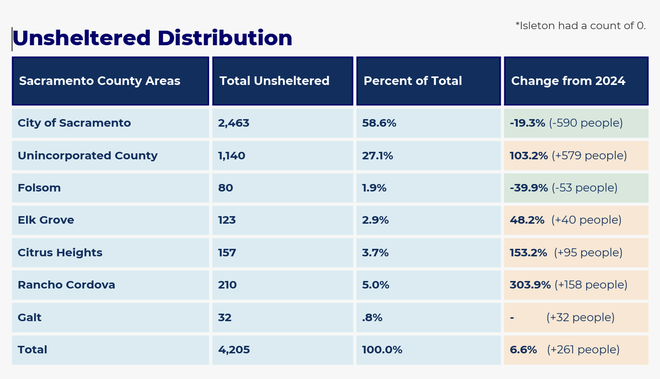
Unincorporated Sacramento County, which represented 27% of the total unsheltered homeless population, had an 103% increase in the ranks of the unsheltered with 579 more people than last counted.
Rancho Cordova saw the biggest percentage increase, up 303%, or 158 people. Elk Grove saw a 48.2% increase (40 more people) and Citrus Heights 153.2% (95 more people).
The 2026 PIT count aligned with trends observed monthly in a community dashboard called the Management Information System, Sacramento Steps Forward said.
What else did the surveys find?
About 17% of those surveyed said they became homeless within the past year, while 65% had been experiencing homelessness at least two years.
The vast majority of those surveyed, 78%, said they first became homeless while living in Sacramento County.
Asked what led to becoming homeless and what Sacramento could do to help led to a wide variety of responses, as respondents gave more than one answer.
The leading reason for becoming homeless was because of a job loss or lack of income. Respondents also cited conflict with family or “other,” along with reasons that included eviction, substance abuse and cost of living issues.
Less than half of those surveyed believed more affordable housing would resolve their homelessness crisis, though that was the top choice of possible solutions. “Other” was the second leading choice, followed by providing jobs or training, safe ground or parking spaces and more beds at emergency shelters.
Learn more about the count and survey here.
See more coverage of top California stories here | Download our app | Subscribe to our morning newsletter | Find us on YouTube here and subscribe to our channel