
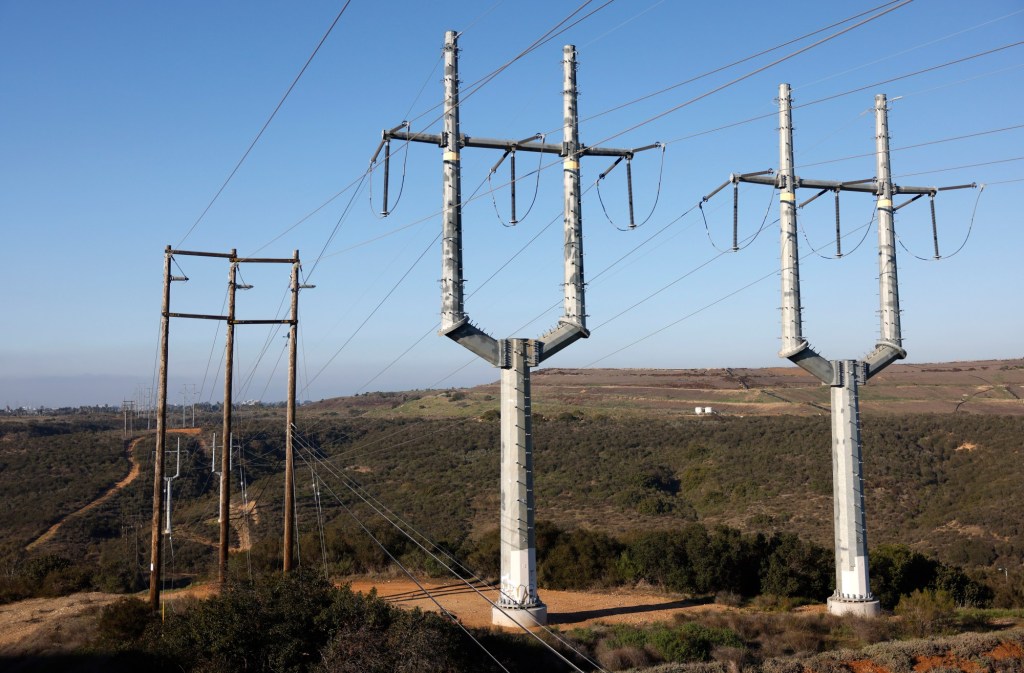
The option of placing the Golden Pacific Powerlink, a proposed high-voltage transmission line covering about 145 miles, underground came up during a “virtual open house” hosted by San Diego Gas & Electric on Tuesday.
But SDG&E officials, while not dismissing the idea out of hand, raised issues with that course of action — including higher costs that would be passed onto ratepayers.
And the Anza-Borrego Foundation that opposes the power line going through any portion of the Anza-Borrego Desert State Park told the Union-Tribune that undergrounding the line within the park is not a satisfactory solution.
“At this scale, underground construction is dramatically more expensive and I know rates are top of mind for a lot of folks,” Melinda Keesee, SDG&E’s manager of major construction, said during the online meeting. Keesee added that placing lines underground “can be significantly more complex to build, operate and maintain” than traditional overhead infrastructure.
SDG&E did not say how much more it would cost to place the line underground, but filings with the California Public Utilities Commission as recently as two years ago showed that placing standard powerlines below ground in SDG&E wildfire areas were estimated to cost $2 million per mile.
SDG&E has released a preliminary map of where the Golden Pacific Powerlink may traverse, which includes just over 22 miles of the Anza-Borrego Desert State Park.
The proposed route has drawn opposition from conservationists who say overhead lines will mar park’s views, obscure the clear night sky and cause environmental harm to species such as bighorn sheep, among other concerns.
But what about limiting the undergrounding to just the 22 miles inside the park? Could that be a workable compromise?
“In addition to the significant increase in cost, (that option) would also require extensive excavation and construction activity within Anza-Borrego State Park, which can increase permanent environmental and community impacts rather than reduce them,” SDG&E spokesperson Alex Welling said in an email to the Union-Tribune.
Bri Fordem, executive director of the Anza-Borrego Foundation, doesn’t like the idea either.
“Undergrounding is extremely invasive,” she said. “You’re still digging up the ground, burying the line.”
Fordem also raised concerns about disrupting the park’s cryptobiotic soils — a living, fragile crust of microorganisms that acts as a “living skin” on arid desert landscapes — as well as possibly disturbing ancient Kumeyaay sites. “So I think there’d be a bigger problem with undergrounding it, honestly,” she said.
Last month, SDG&E released its suggested route for the Golden Pacific Powerlink, a 500-kilovolt line that would act as an electricity corridor running from Imperial Valley in the east to the border of San Diego and Orange counties in the west.
The proposed line came as part of a 180-page transmission plan for some 45 infrastructure projects requested by the California Independent System Operator. Also known as the CAISO, the system operator manages the electric grid for about 80% of the state and a small portion of Nevada.
The plan cited assumptions that the power system needs to add more than 40 gigawatts of new resources over the next 10 years to keep the electric grid reliable and resilient — as well as meeting California’s clean energy mandates.
The Golden Pacific Powerlink is proposed start in the east at SDG&E’s existing Imperial Valley substation and then connect to a still-to-be-constructed substation where San Diego and Orange counties meet. just north of the San Onofre Nuclear Generating Station and Camp Pendleton.
The exact location of the substation on the western end of the line has not been released yet. Horizon West Transmission LLC will build it.
SDG&E is contracted to build and operate the Golden Pacific Powerlink line itself. According to a tentative timeline, SDG&E calls for construction of the transmission corridor to begin in the fall of 2029, with the CAISO requesting the transmission corridor go into service in mid-2032, or “2034 at the latest,” one SDG&E official said last month.
But the project is not a done deal.
The California Public Utilities Commission will have the final say on whether the line gets built or not.
A pair of “virtual open houses” on Tuesday marked the start of what promises to be a years-long process that includes public hearings, environmental impact reviews and regulatory proceedings on the local, state and federal levels.
The estimated cost of the powerlink has not been released yet, but is expected to come later this year when SDG&E submits its filings to the public utilities commission. The price tag will be spread proportionally among all ratepayers of investor-owned utilities in CAISO’s jurisdiction. Of that, SDG&E customers will shoulder 9% of the cost.
During the Tuesday afternoon session, Erica Martin, SDG&E’s director of project development, said one of the benefits of the Golden Pacific Powerlink will come from reducing congestion on the grid, and compared it to traffic jams on the freeway.
A new high-voltage connection “provides another pathway to move electricity across the region,” Martin said. “It helps to strengthen overall reliability and gives operators more flexibility during those times when there is a lot of demand on the system, such as extreme weather events.”
It’s been forecasted that electricity demand in California will grow to 160 gigawatts by 2045. For perspective, 160 gigawatts is twice as large as the state’s current energy use.
During a Q&A session that went through a public relations person, SDG&E’s principal engineer on the project said the size of the poles would range in height from 125 to 191 feet.
When asked if any data centers will be connected to the powerlink, senior project affairs manager Bernadette Butkiewicz said the CAISO “identified the need for this new transmission line to support the regional power grid, not to supply power to any specific industry like data centers.”
Since the western end of the proposed route goes through at least a portion of Marine Corps Base Camp Pendleton, Martin of SDG&E said the line “will likely require” right-of-way access from the Department of War and trigger federal review under the National Environmental Policy Act.
“We’ve been having early discussions,” Martin said, with Camp Pendleton, as well as with officials at the naval air station in El Centro that has facilities near SDG&E’s substation in Imperial Valley at the eastern end of the project.
Two other 90-minute “virtual open houses” will be held Thursday — one session at noon and another at 5:30 p.m. To take part, register by going to Golden Pacific Powerlink’s dedicated website, www.goldenpacificpowerlink.com.
This summer and fall, SDG&E plans to host in-person open houses for people to ask direct questions and find out more about the project and its proposed route.