
Preliminary data from this year’s homeless Point-in-Time Count show reductions in homelessness throughout The City, according to Mayor Daniel Lurie’s office — but homelessness advocates said that due to changes in its methodology, this year’s tally can’t accurately be compared with previous counts.
“By shifting it from a nighttime to a daytime count, it’s not an apples-to-apples comparison,” said Christin Evans, a former Homelessness Oversight Commissioner. “The Point-in-Time Count is a flawed count, and there are other indicators that homelessness in San Francisco has actually gotten worse, not better.”
The Point-in-Time Count is conducted every two years as part of a federally mandated evaluation by the U.S. Department of Housing and Urban Development. The data are often used to shape policy decisions.
In years past, the data was collected at night by teams of city employees and volunteers in different zones in The City. This year, the count time was shifted from night to morning, and it included only city employees.
In another first this year, teams were tasked with approaching and asking people to participate in a survey that could take up to 10 minutes to get through, depending on participants’ answers, instead of just visually counting people suspected to be homeless.
The Examiner shadowed a team from 5 a.m. to 10 a.m. during the Jan. 29 count. Minor glitches were seen with a new tool used in the count this year — an app, Counting on Us, used for tallying and surveying unhoused people and providing team and geographic assignments to city employees.
Kunal Modi, the city’s chief of Health and Human Services, said city officials felt the changes to this year’s count would actually help with the accuracy of the count.
“The survey that is associated with the count used to happen after the fact,” he said Tuesday during a press conference. “We did it during the count itself, so we could have more accurate data. We feel very positive about the integrity of the count and the ability for us to get really clean data to help us understand what’s going on.”
Modi did acknowledge that there were “some parts of the survey from 2024 or previous years that we won’t compare to 2026,” but he didn’t clarify what parts those might be.
“The PIT Count is just one indicator, and we look at it alongside a bunch of other data,” he said.
The Mayor’s Office said Tuesday that compared with the previous count in 2024, this year’s count saw a 4% decrease in homelessness overall, a 22% decline in unsheltered homelessness, and an 85% drop in people living in tents, from 650 in 2024 to fewer than 100 this year.
Overall, homelessness had reached its lowest level since 2011, Lurie’s office said.
But Evans and other advocates said that — aside from the comparison issues — the numbers don’t match up with other metrics for measuring homelessness in The City, such as the shelter waitlist numbers. In March 2024, there were 51 people on the adult shelter waiting list compared to 412 people in March of this year, according to Department of Homelessness and Supportive Housing data.

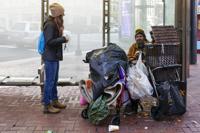
Cricket Miller of the San Francisco Department of Homelessness and Supportive Housing speaks with a homeless person sitting at a Market Street bus shelter during the Point-in-Time Count.
Craig Lee/The Examiner
“We know from the service providers that are interacting with people struggling to stay in their housing and to access housing that the problem has not gone away,” Evans said. “It’s really counterproductive of the mayor to try to paint a different narrative.”
Karin Adams, the director of programs at the Homeless Youth Alliance, said the 54% decrease in youth homelessness identified this year from 2024 is “not reflective” of her organization’s experience on the ground. If anything, she said, demand for its services has only increased in the last two years.
“We work with dozens and dozens of youth experiencing homelessness, and we’re an agency of 10 people, and our youth-only services are just picking up and gaining momentum and becoming busier and busier,” she said.
Adams, who said she participated in the count this year and in previous years in the Haight Ashbury-Golden Gate Park area, said the switch to morning from night was a significant hindrance in counting young people.
“People are hiding in the park; they are sleeping; they’re not awake yet,” she said. “They’re really working diligently to protect themselves and not be seen or found, let alone counted and issued a very in-depth survey at that time of day.”
She said that The City’s homeless population has likely been more inclined to hide since the 2024 U.S. Supreme Court ruling in City of Grants Pass v. Johnson, which allowed for cities to penalize people sleeping or lying on sidewalks.
“Youth are especially vulnerable to policies implemented like Grants Pass,” Adams said. “So they are hiding and engaging in riskier behavior to keep themselves safe.”
Adams said that after one particularly difficult survey encounter, she and her team decided to stop administering the survey that morning altogether, with one member who had formerly been homeless themself saying it felt like the “dignity” had been taken out.

A trio of wealthy men might soon be among The City’s most influential politicians as personal fortunes and outsider messaging reshape state, local races

New Bay Area Council Institute study says high taxes are slowing San Francisco’s economic recovery amid battle over upcoming ballot measure
Graduate business program joining UC Law San Francisco’s 356,000 square-foot Academic Village this fall
“We felt like it was traumatizing, and not trauma-informed,” Adams said.
One portion of the unhoused population that did increase this year, according to the PIT Count data, was family homelessness, which increased 15% from 2024.
Megan Rohrer, the policy director at Compass Family Services, a family homelessness organization, told The Examiner that figure is likely conservative based on the wide range of metrics needed to capture family homelessness.
“It’s really hard with PIT Counts to quantify homelessness, in part because the definition of homelessness is much more narrow than what we see,” Rohrer said.
Rohrer said that Compass partnered with HSH and Catholic Charities to perform a survey of homeless families on the family shelter list as part of the PIT Count and found that while they often stay in vehicles, that could change on any given night.
“What we learned from them is some of them is that particular night, they stayed on someone’s couch, as opposed to in their car,” Rohrer said. “They were not included in this recent PIT Count number.”
Such families are more “mobile,” Rohrer said, and are moving around a lot. Rohrer said that night alone, three families the team surveyed were in the hospital.
“We also noticed there were a number of families that were living in places not meant for human habitation, like in unconverted garages,” Rohrer said. “There was at least one family that we called that was sleeping with an infant in a park.”
Rohrer said that population has increased for a variety of reasons in the last couple of years, including changes to federal resources — such as funding from the U.S. Department of Housing and Urban Development — and rising costs in general, from groceries to rent.
Lurie’s administration has focused on expanding services and shelter options in the last year for people experiencing homelessness who are also experiencing behavioral-health and substance-use issues, opening up a 24/7 stabilization center in the Tenderloin and an involuntary sobering center in SoMa.
But aside from a program moving families from living in RVs into shelter, there have been few efforts to provide more housing options and resources for homeless families.
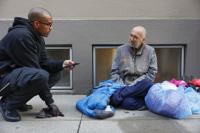
Brian Shepperd of Urban Alchemy speaks with Kurt Hergenroeather, 52, on Clay Street during the 2026 Point-in-Time Count on Jan. 29.
Craig Lee/The Examiner
Modi told The Examiner that the PIT data on that issue will inform how The City finalizes its upcoming budget proposal, set to be presented later this month.
“RV homelessness is intended to address one portion of the family-homelessness challenge, and we invested a lot in rapid rehousing in the last budget,” he said. “We’re going to lean into that in this upcoming budget, focusing on prevention, on more rapid rehousing.”
That’s in line with what Rohrer and other advocates have been calling for from The City, particularly with more housing subsidies for families that are living in smaller vehicles, not just RVs.
“We know that not everyone’s struggling on our streets, behavioral health crisis, families and crisis, while families sometimes are missed, so we do see them, and we’re going to make them a priority,” Modi said.
The current budget proposal would cut resources for youth homelessness, leading to the closures of both Cole Street Youth Clinic at Huckleberry Youth Programs and the Michael Baxter Larkin Street Youth Clinic, which serve homeless youth.
Sherilyn Adams, the CEO of Larkin Street Youth Services, said that while some progress has been made in the last year, such as the expansion of rapid rehousing subsidies for young people, they are also still seeing an increase in demand for their services.
“We’re seeing more young people who still need housing, still need support,” she said.
Karin Adams said she feels that the lack of continued investment for youth homelessness is “politically motivated” and ultimately misguided.
“Most people experiencing homelessness first experience homelessness as a young person,” she said. “The lack of prioritization on young people is not doing the city of San Francisco or our generations of homeless folks and communities any favors.”