
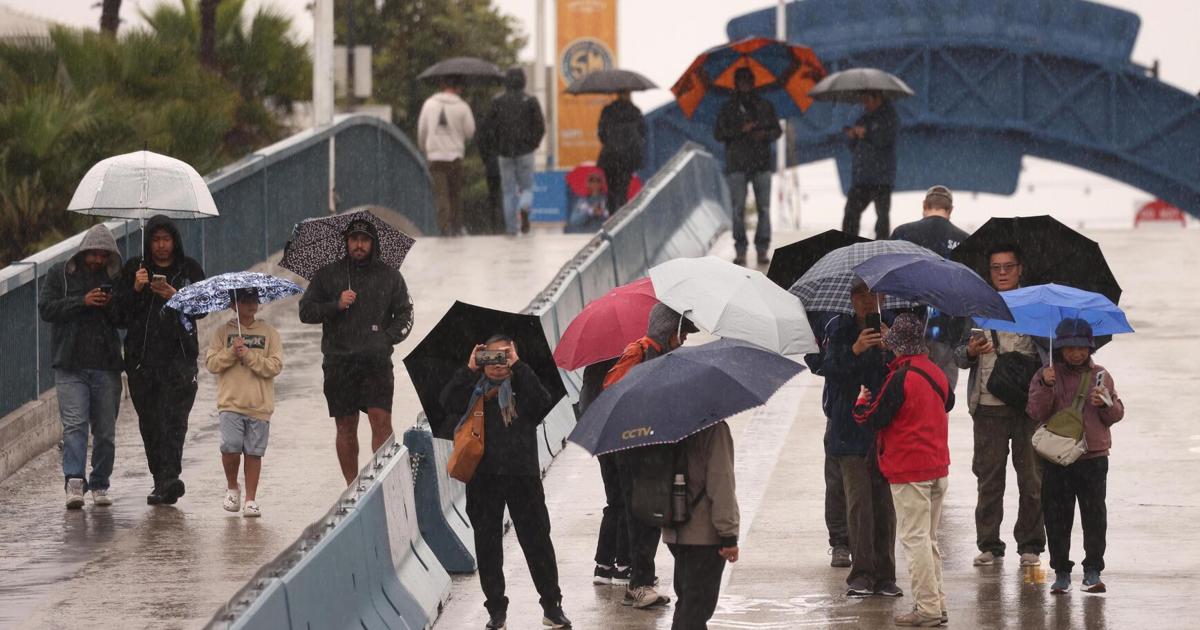
Rainfall across much of California and the West has become more clustered in heavier storms, with longer dry spells in between.
The net effect is a drying out, researchers found in a new study. It isn’t just the western United States; the same is true in much of the rest of the world.
The research is the first to reveal how this concentration of rainfall into fewer, heavier events dries out the landscape.
“The more concentrated rainfall you get, the drier you become,” said Justin Mankin, an associate professor of geography at Dartmouth College who co-authored the study.
The occasional heavy rain is just too much for the land, and the soil can absorb only so much at once. Mankin said it’s like “asking the land to drink from a fire hose.”
“As you concentrate rainfall into heavier downpours, more of that water, it sits on top of the land to be easily evaporated,” he said. It doesn’t have a chance to soak into underground aquifers.
The trend is less clear in Southern California and more pronounced in the North. The America West is one of the places where rainfall has become most clustered or concentrated.
The analysis, published Wednesday in the journal Nature, offers new insight into how rainfall is shifting as the climate warms.
The scientists analyzed precipitation globally from 1980 to 2022. To determine which areas have grown drier or wetter, they used data from satellites that track shifts in water across the landscape.
Experts have long expected global warming to produce less frequent but more intense precipitation. The study shows that rainfall consolidation is already happening across much of the western U.S.
“It’s consistent with what we’d expect from climate change, because a warmer atmosphere can hold more water vapor,” said Corey Lesk, who led the study as a researcher at Dartmouth and is now a professor of Earth and atmospheric sciences at the University of Quebec in Montreal.
As more planet-warming gases are released from burning fossil fuels, rising heat is also causing more moisture to evaporate off the land and making plants absorb more moisture.
California naturally has dramatic and sometimes volatile shifts between droughts and floods. Climate models have projected an intensification of rain in the state, especially from atmospheric river storms.
As temperatures rise in the future, climate models indicate Southern California is likely to get a little drier and Northern California is likely to get a little wetter, said Alexander Gershunov, a research meteorologist at the Scripps Institution of Oceanography at UC San Diego who wasn’t involved in the study.
The research shows rainfall has become more concentrated regardless whether a region has a wet climate or a dry one.
The trend of fewer but stronger storms “really exposes the mechanics of how climate change will affect water resources for everyone,” Lesk said.
Other research has shown that large swaths of the world are growing drier, including a “mega-drying” region that stretches from the western U.S. through Mexico to Central America.
The latest study shows that the amount of water available in a given region depends as much on the concentration of rainfall as it does on the total amount of precipitation, Mankin said.
In California and other western states, he said, the findings suggest current approaches for dealing with drought and floods are insufficient.
“This is just another indicator … we are not adapted to the climate we have, let alone the one that seems to be unfolding,” he said.