
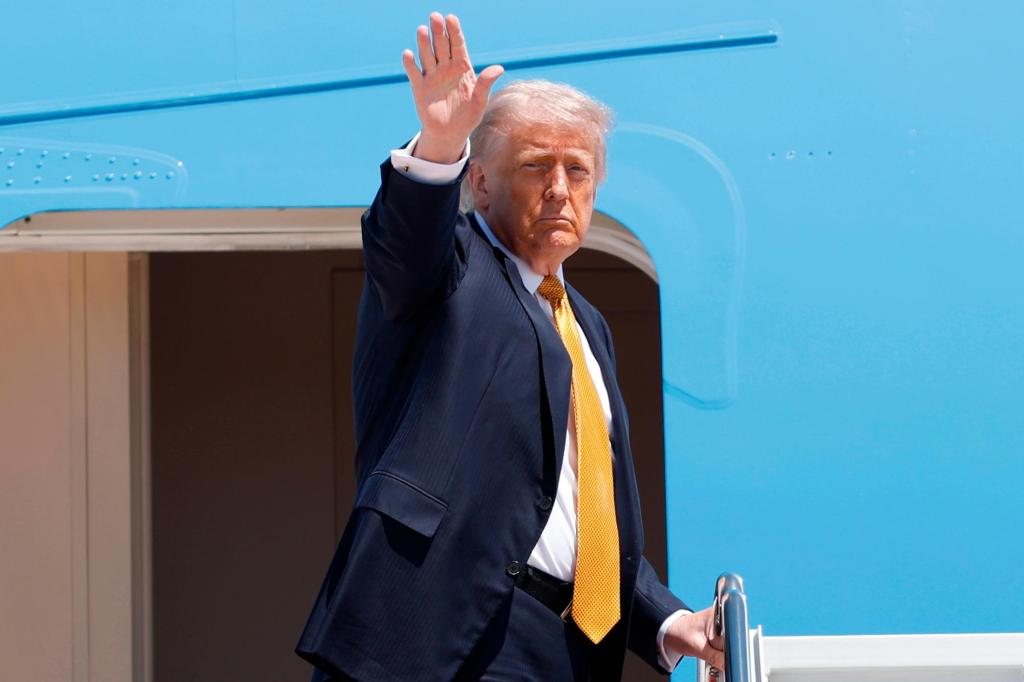
President Donald Trump invited two San Diego CEOs to join him at a high-stakes summit in China.
Seventeen industry leaders in sectors ranging from airplanes to agriculture have joined Trump on his first trip to China in nearly a decade — including Qualcomm CEO Cristiano Amon and Jacob Thaysen, the CEO of Illumina.
Qualcomm, a billion-dollar chip company based in San Diego, makes almost half of its revenue in China. Illumina, a local gene-sequencing giant, also has a significant market in the country.
Trump will likely return to the States on Friday touting relatively easy economic wins for “Boeing, beef and beans,” said Stephen Roach, former Morgan Stanley Asia chairman. “Don’t hold your breath for a spectacular result.”
These three B’s are already a few of America’s largest exports to China. More difficult discussions — AI, nuclear weapons, tariffs and Taiwan — pertinent to the two San Diego CEOs are unlikely to be resolved over three days in Beijing.
Qualcomm did not respond to requests for comment, but did discuss its relationship with China in federal filings.
“A significant portion of our business is concentrated in China, and the risks of such concentration are exacerbated by U.S./China trade and national security tensions,” Qualcomm said, noting the detrimental impact tariffs have had on both price and demand.
Qualcomm generated 46% of its revenue — more than $20 billion — from China in 2025. And business outside of the country still relies on its relationship with Taiwan.
“A significant or prolonged military or other geopolitical conflict involving China and Taiwan could severely limit or prevent us from receiving chipset supply,” Qualcomm said, “which would have a material adverse impact on our business, and likely on the semiconductor industry as a whole.”
Taiwan has been a topic of discussion for decades and is unlikely to be met with any definitive resolution, but there are small, meaningful wins to be had.
“Jacob Thaysen is honored to be part of the delegation of business leaders accompanying the U.S. administration on the trip to China,” Illumina told The San Diego Union-Tribune on Wednesday. “This is an opportunity to strengthen relationships and shape the future of precision medicine.”
In the first three months of 2026, Illumina generated more than $52 million from the greater China region — which includes China, Hong Kong and Taiwan — down 28% from the same period last year.
“We implemented an incremental cost reduction initiative to help mitigate the expected impact of a reduction in revenue and operating income from our greater China” operations, the company said in its government filings, anticipating the impact of Trump’s trade war.
The summit in Beijing was initially scheduled for early April but was pushed back six weeks due to the ongoing conflict with Iran.