
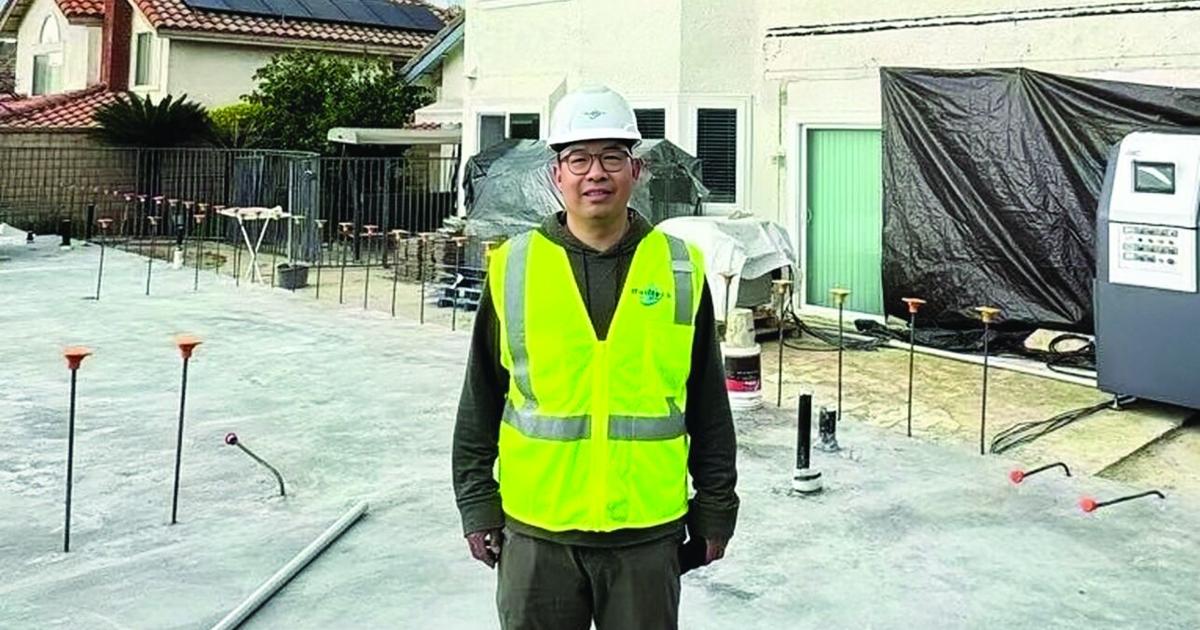
Since the January 2025 wildfires, rebuilding has become a hot topic for Angelenos, even for those who did not lose their homes. Aaron Liu, founder of Builtech Construction and a certified wildfire mitigation specialist, is especially concerned. He has seen that many of the new homes look similar to the old ones that burned. Hoping to affect change, Liu is dedicated to helping people rethink fire safety.
His interest in advancing resilient construction solutions was piqued before 2025. It was when he witnessed the devastation of the 2020 wildfires that he set out on his current path: building noncombustible homes in high-risk wildland-urban interface (WUI) zones in Los Angeles and San Jose.
Since 2025, Builtech has been constructing noncombustible homes using insulated concrete form (ICF) technology, including the first known ICF-based residential project in California designed to meet Type I, the highest fire-resistance classification under the International Building Code (IBC) and California Building Code (CBC).
Wildfire rebuilding has remained slow in Los Angeles for a number of reasons.
Liu explained, “It is not just a construction issue. It is a combination of permitting, cost, infrastructure and changing expectations. Los Angeles has tried to fast-track like-for-like rebuilds, but many homeowners do not want to simply recreate what they had. They want to expand, upgrade or rebuild with better fire resilience. Once you move beyond a like-for-like rebuild, projects often fall outside the expedited process, and timelines extend significantly.”
He shared that cost is another major constraint.
“Insurance payouts often do not reflect the true cost of rebuilding in today’s market, especially when factoring in upgraded materials or fire-resistant construction,” he said. “That gap delays decision-making and slows projects down. Infrastructure upgrades are also adding time. In some areas, utilities are being redesigned, such as moving power lines underground. While this improves long-term resilience, it requires coordination, excavation and redesign, which further delays rebuilding. At a broader level, what we are seeing is a shift from simply rebuilding to rebuilding differently.”
For homeowners who think that building code compliance equals wildfire resilience, Liu tells a different story. He explained that building code compliance sets a minimum standard; it does not guarantee wildfire resilience. Historically, for California building codes, seismic resilience has been the priority, shaping how homes were designed and constructed. By contrast, far less attention was given to how buildings and communities should prepare for wildfire exposure or adapt to prolonged drought. As a result, a home can meet code and still be vulnerable to wildfire.
Fortunately, codes have started to evolve, with requirements such as fire-rated roofing, tempered glass and ember-resistant vents. These are important steps, Liu said, but they still do not address every real-world scenario. For example, tempered glass can still fail under impact during high winds, allowing fire to enter.
“True resilience comes from identifying and strengthening all vulnerable points, not just meeting minimum requirements,” Liu said. “It is about treating the home as a system rather than a checklist.”
Talk of rebuilding might cause panic, because, of course, there is cost involved, and oftentimes large costs; however, Liu shared that fire-resistant homes are not cost-prohibitive. They can be more expensive than traditional construction but often less expensive than what most people assume.
“For new construction, fire-resistant homes typically cost about 10% to 40% more than standard wood-frame homes, depending on the materials and systems used,” he said. “Options such as ICF (insulated concrete form), steel framing or 3D-printed concrete come at different price points, but all offer strong fire performance. For existing homes, hardening upgrades can range from roughly $10,000 to $100,000 or more, depending on the size of the home and the scope of work.”
“The more important consideration is long-term value and return on investment,” he continued. “In many fire-prone areas, insurance is becoming harder to obtain or maintain. I have seen homeowners of fire-resilient homes secure coverage more easily and at lower-than-average premiums. A home that can better withstand wildfire has clear financial value, but more importantly, it protects what cannot be replaced: belongings and memories. A house can be rebuilt. What is inside it often cannot. It is always easier, and often more cost-effective, to build stronger now than to rebuild after the next disaster.”
Liu has advice for homeowners about how to take advantage of the latest insurance discounts for hardening dwelling properties and what measures to take to protect both new and existing homes.
“Most insurance discounts fall into two categories: defensible space and home hardening,” he said. “For defensible space, homeowners can qualify by clearing vegetation and debris near the home, especially within five feet, increasing spacing between trees, and removing combustible materials around the structure. For home hardening, insurers typically look for features such as Class A fire-rated roofing, enclosed eaves, ember-resistant vents, multi-pane windows or shutters and noncombustible materials near the base of exterior walls. The key to qualifying for discounts is documentation. Homeowners should keep records of upgrades and, when possible, obtain inspections or certifications that verify the work.”
“Wildfire protection comes down to reducing risk at every level,” he continued. “In practical terms, this means reducing or avoiding the use of combustible materials such as wood framing and wood-based sheathing. For new construction, the most effective approach is to limit combustible materials.”
For existing homes, the discussion begins with understanding how wood-frame houses are typically ignited during a wildfire. In most cases, there are three primary mechanisms: embers, radiant heat and direct flame contact. Of these, embers are by far the most significant threat. Nearly 80% of homes lost in wildfires are believed to be ignited by embers. They may appear small and harmless, but under strong wind conditions, they can travel hundreds or even thousands of feet, sometimes miles. They accumulate in vulnerable corners of a home, lodge in hidden gaps and penetrate areas homeowners rarely think about. In that sense, they are one of the most dangerous and difficult wildfire threats to defend against.
“Ultimately, the best way to fight a fire is to prevent it,” Liu said. “The most effective approach is to treat wildfire protection as a system, where each layer reduces risk and no single point of failure is left exposed.”