
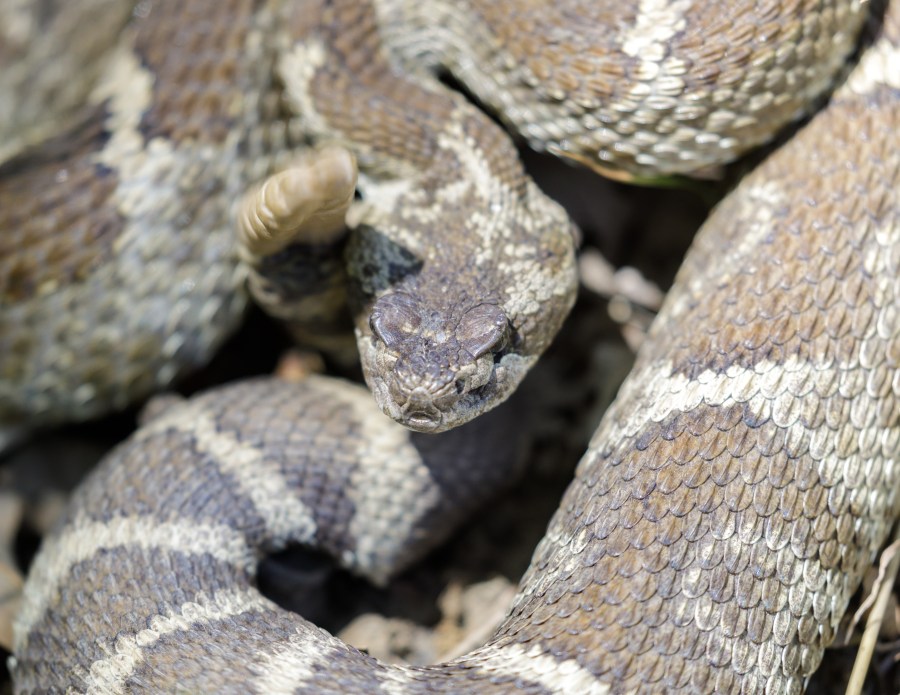
(FOX40.COM) — With the warm weather this month, wildlife experts said rattlesnake encounters are on the rise.
That’s prompting some words of caution about how to reduce your chances of getting bitten by a snake.
An expert in Auburn said it’s been an unusual rattlesnake season so far because a warm March kicked off snake activity earlier than normal. There were three fatal bites statewide between March and early April, and now, after a lull in April, activity is ramping up again.
Glen Stough opened up his bucket to give FOX40 a look at what he captures every day this time of year: the Northern Pacific rattlesnake.
“I have more jobs at this point than I can even get to,” Stough said.
Stough is the owner of Sierra Snake Removal, and he works in tandem with Ramirez Rattlesnake Removal in Auburn.
Stough said both businesses are very busy responding to calls from people wanting them to take snakes away.
“We’re professional, we’re insured,” Stough said.
He confirmed the active season started early with unseasonably warm weather in March. That’s when there were two fatal bites in Southern California. But the snakes went back into hiding in April at a time when the season usually begins.
“Last month was a little bit different because we had a lot of rain, cold weather, forty degrees overnight,” Stough said. “They’re struggling to survive. Now they’re hungry. And so the sun comes out, hits 85 and they’re very active.”
“Trying to stay between 70 and 90 is important for them,” Stough said. “They don’t like to get below 70 and they don’t really like hot weather.”
“Once we start to get to the 100-degree days, now the snakes are hunting all night long, and that’s when we’ve got to be careful,” Stough said.
Stough said people should also be careful during the day when temperatures are in the 70s and 80s.
“If you’re out hiking the trails, just stay down the middle. That’s your best chance. A rattlesnake can only strike half of its body length on a flat surface. So if it’s a three-foot rattlesnake, he only has a reach of about a foot-and-a-half on average,” Stough said. “So as long as you’re down the middle of the trail you should be safe, but of course you’ve got to pay attention to what’s in front of you.”
Stough said Northern Pacific rattlesnakes are not typically aggressive.
“Traditionally, he would coil up. But right now he’s trying to figure out what I’m doing. And he’s watching me, just making sure that I don’t make a move,” Stough said. “Because if I make a move, he’s going to make a move.”
“He’s not going to strike me until he feels threatened,” Stough said.
Stough said people who get bitten are those who got too close and didn’t realize it until it was too late.
“Sitting on a rock, sitting on a log,” Stough said. “Just standing next to a rock outcropping and not paying attention.”
There are also things property owners can do.
“Keep your weeds cut,” Stough said. “And we love to see our bushes up off the ground. We don’t want to give them a place to stop and stay. We want to keep them moving. They won’t stop and stay if they don’t have some protection.”
Stough said he releases all the snakes he catches in a very remote location away from human population centers.
He also said snakes are good for the ecosystem, keeping rodent populations under control and eating pests that could damage crops.
Copyright 2026 Nexstar Media, Inc. All rights reserved. This material may not be published, broadcast, rewritten, or redistributed.
For the latest news, weather, sports, and streaming video, head to FOX40 News.