
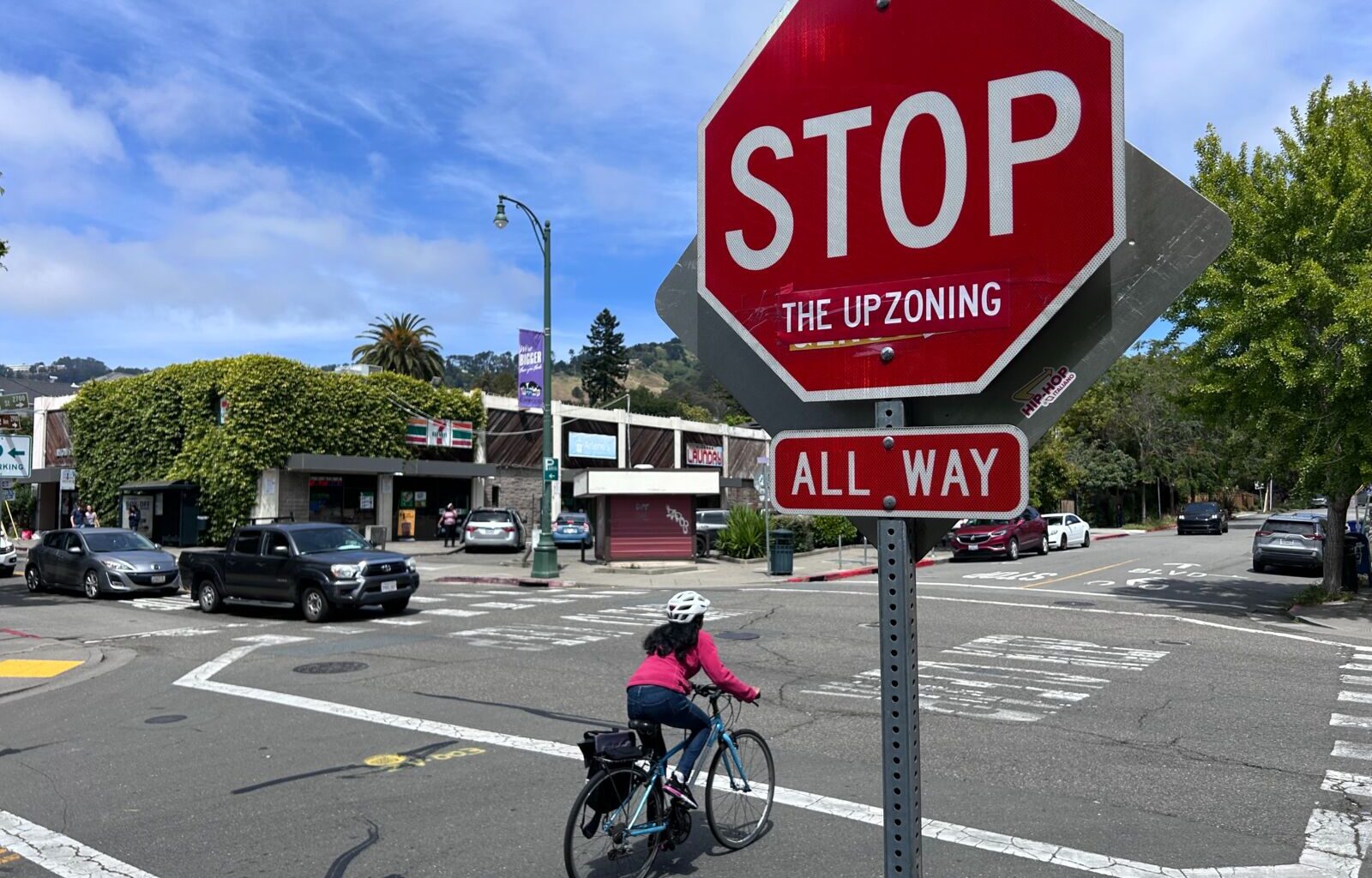
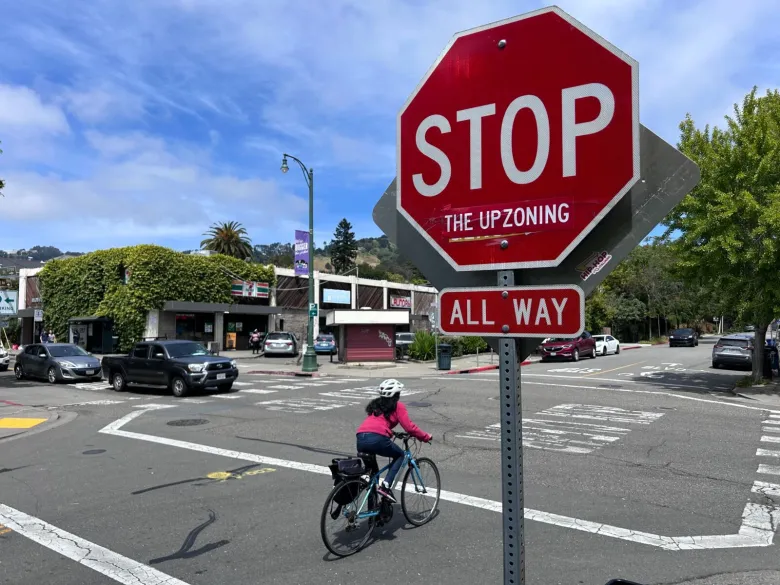
 One of several stop signs in the Elmwood District where someone has added stickers protesting a plan to zone some properties on College Avenue for apartment buildings. The strip mall in the background is one of the sites where city planners say someone could build housing. Credit: Nico Savidge/Berkeleyside
A proposal to raise height limits along portions of College, Solano and northern Shattuck avenues in a bid to bring more housing to some of Berkeley’s most sought-after neighborhoods is headed to the City Council, after members of the Planning Commission signed off on a limited version of the zoning changes.
The question now is whether the council — where a majority of members last year said they wanted to see bigger and more widespread height cap increases — will agree with the vision endorsed by commissioners.
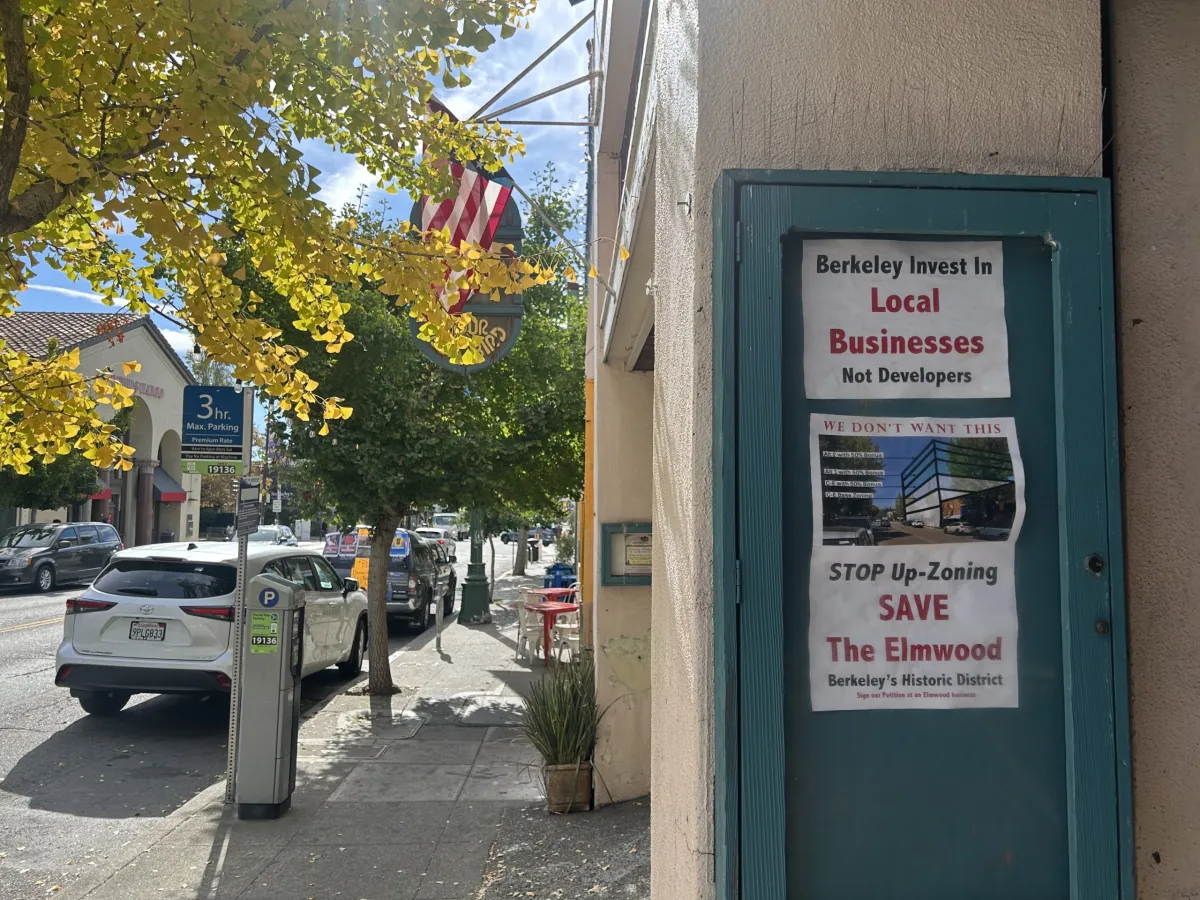
The proposal has sparked fierce opposition from merchants and residents in the Elmwood District and North Berkeley, making it the latest flash point in the city’s long-running debates over housing and development.
Critics who packed two city meetings about the zoning changes last week fear the rules will lead to development that pushes out small businesses and forever changes the cherished shopping districts.
“In 35 years, my grandchildren will be walking down Bay Street,” said Fern Solomon, owner of the Solano Avenue shop Fern’s Garden, referring to the housing-topped Emeryville mall opponents have held up as the antithesis of the Berkeley neighborhoods. North Berkeley resident Stephen Jackson charged during a May 6 Planning Commission meeting that the changes would be “part of the corporatization of Berkeley.”
Housing advocates, including some neighborhood residents, say those worries are overblown, and see the zoning changes as a modest step to open up wealthy neighborhoods where little new housing has been built for decades.
“The wonderful and quaint Elmwood was not immaculately conceived — it was created as an exclusive and exclusionary community,” said David Shere, a member of the city’s Housing Advisory Commission. “The choice is to entrench the status quo or to overturn it.”
A divided Planning Commission last week recommended Berkeley only rezone specific lots that are most likely to be redeveloped, while leaving in place height limits and other regulations for most other properties along the corridors.
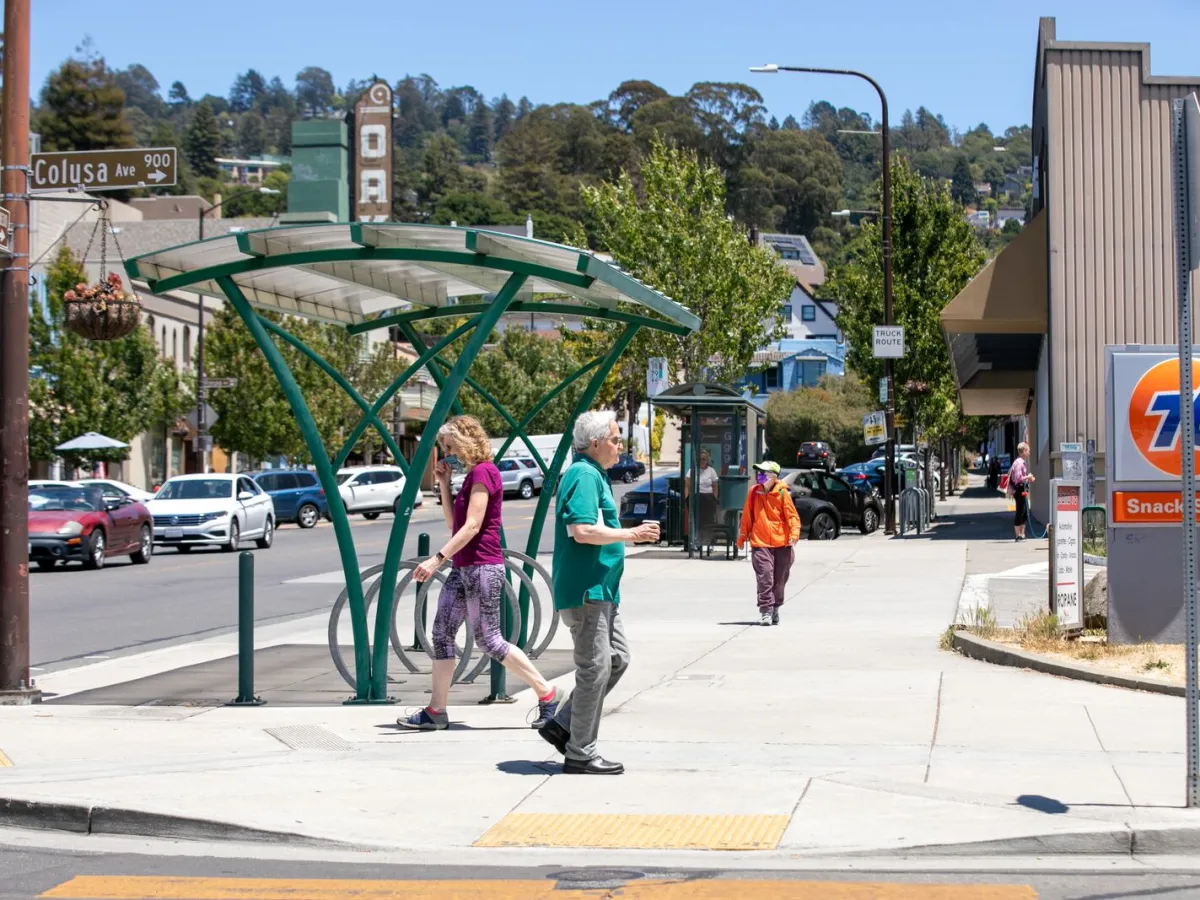
The rezoned sites on College Avenue, such as a strip mall anchored by a 7-Eleven, would have a five-story height cap; the ones on Solano, such as an Andronico’s grocery store and its parking lot, would have a six-story limit; and those on North Shattuck, such as a vacant bank branch next to the Cheese Board pizzeria, would have a seven-story limit.
The City Council is expected to take up the zoning changes sometime this summer, though opponents have raised tens of thousands of dollars for a referendum campaign that could put the changes before Berkeley voters later this year.
Hundreds also signed petitions for another effort asking the city’s Landmarks Preservation Commission to declare the Elmwood’s shops a historic district — a move that would make it more difficult for developers to build in the neighborhood. The landmarks commission deadlocked on the proposal when it met Thursday.
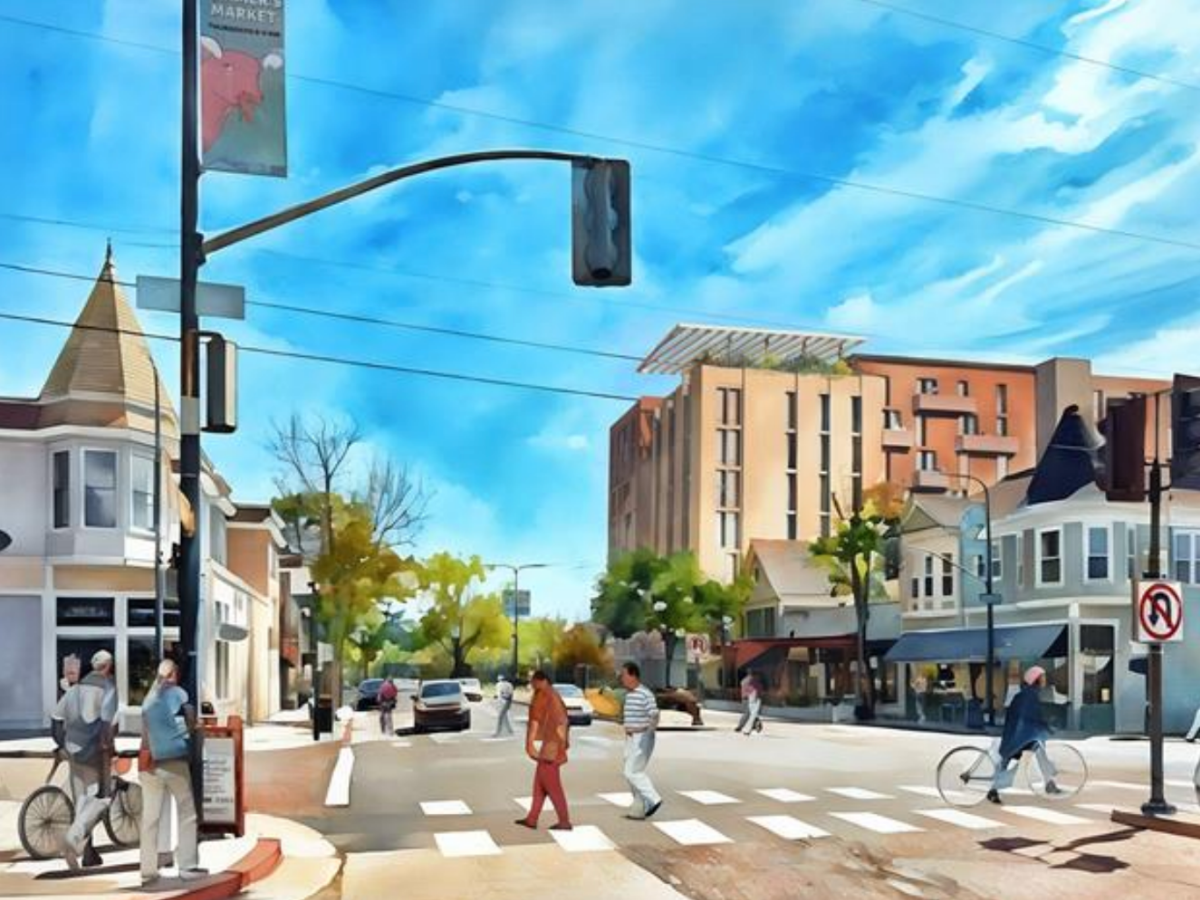
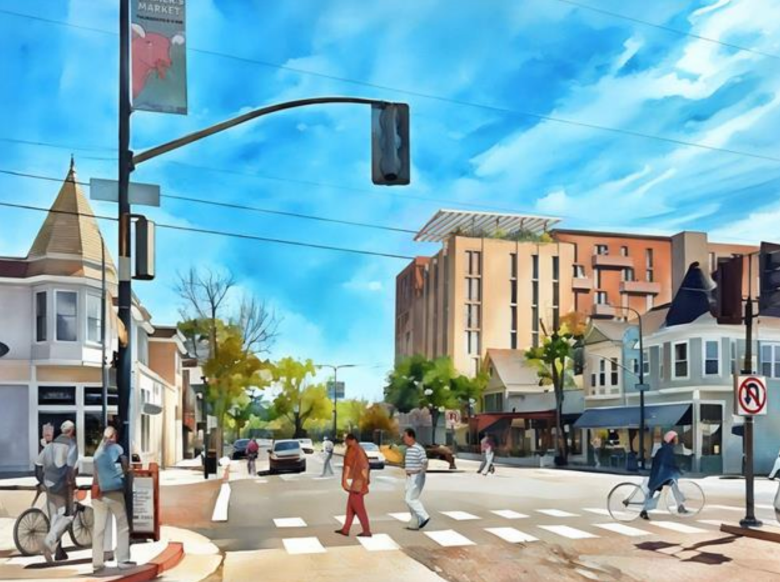 A rendering prepared for a city forum last year shows a hypothetical example of the kind of project that would be allowed under the new zoning rules. No project has been proposed for the site. Credit: City of Berkeley
Opponents call zoning rules ‘completely unacceptable’
The City Council pledged in the eight-year housing plan Berkeley adopted in 2023 to allow for denser development along the College, Solano and North Shattuck commercial corridors, after officials from West Berkeley complained those neighborhoods were unlikely to take on a meaningful share of the city’s new homes without zoning changes. The three avenues today have some of the lowest height caps in the city.
At a council meeting last November to discuss earlier drafts of the rezoning plan, five of the body’s nine members said they wanted Berkeley to set a blanket seven-story height cap on all three avenues, arguing that would be in line with limits on other streets such as West Berkeley’s San Pablo Avenue. Elmwood District Councilmember Mark Humbert was the only one to endorse the idea of limiting the rezoning to specific properties; Humbert has separately put forward a plan to zone portions of Telegraph and Claremont avenues for denser development.
Opposition to the rezoning plan has continued to swell since then: A group formed to fight the proposal called Save Berkeley Shops has created a political action committee that reported raising more than $75,000 through the first four months of the year toward its referendum effort, according to campaign finance records. The group has distributed yard signs now found around the neighborhoods that show a bulldozer marked “city hall” destroying a strip of businesses, while a high-rise looms overhead.
Meanwhile, someone has plastered stickers onto stop signs at several intersections around the Elmwood so they read “stop developers,” “stop the upzoning” and “stop the towers.”
Members of the Planning Commission told city staff they wanted to pursue a more targeted rezoning in March, saying that could allay fears of a wholesale redevelopment of the corridors that forces out large numbers of businesses.
When planning staff returned to the commission last week with two potential versions of a limited rezoning plan, it seemed like a compromise might be in sight as speakers from both sides of the debate indicated during public comments that they could live with the revised plan.
But Donald Simon, an attorney and Elmwood resident who leads Save Berkeley Shops, said changes the commissioners made to the plans were “completely unacceptable and excessive”
“If [the] City Council goes forward with this, we absolutely will be pushing a referendum to take it out of their hands,” Simon said.
The commissioners approved a version of the proposal that identifies more sites as development candidates subject to the zoning changes — including the Elmwood property that today houses Five Little Monkeys toy store and Nabolom Bakery, as well as the building that was once home to Books Inc. on North Shattuck. They also called for amendments to the zoning package, including height limits that were one story taller than those proposed by city planning staff; the caps the commission approved matched the ones they endorsed at their March meeting. Another amendment eliminated a requirement to “step back” upper floors of new buildings from neighboring properties.
According to Simon, those details add up to allow for significantly larger new buildings. And critics of the proposal such as Planning Commissioner Charles Kahn say the taller height caps will mean developers — who today often include a share of affordable apartments in their buildings because doing so lets them use California’s “density bonus” law to exceed local limitations — will have less incentive to include those units.
Khan and Commissioner Christina Oatfield voted against a motion to endorse the zoning changes with those amendments. Commissioners Blaine Merker, Jeff Vincent, Darrell Owens, Alfred Twu, Angela Wang and Savlan Hauser voted in favor.
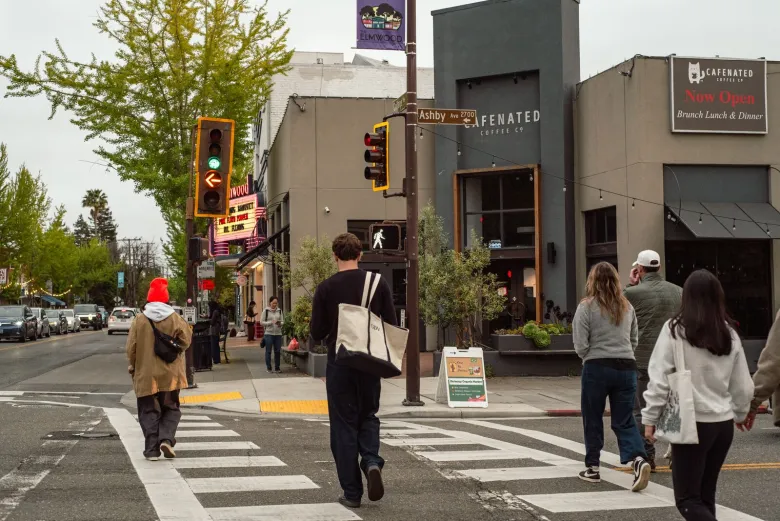 This property, like most of College Avenue in the Elmwood District, would be exempted from zoning changes if the city adopts a proposal endorsed by the Planning Commission. Credit: Ximena Natera for Berkeleyside
Some YIMBYs want changes to go further
Since the Planning Commission is only an advisory body, the council isn’t bound to adopt the version of the proposal the commissioners endorsed — and some housing advocates contend the scaled-back zoning changes don’t go far enough. A newsletter the group Berkeley Neighbors for Housing and Climate Action sent to members ahead of the commission meeting called for the city “to zone for more housing across these entire streets, rather than just certain parcels.”
Planning staff estimated prior to the amendments that the version of the zoning changes the commission endorsed could result in just over 1,700 total new homes across the three avenues — up to 146 on College, 617 on Solano and 1,036 on North Shattuck. Humbert and Owens, both of whom are aligned with “Yes In My Backyard” housing advocates but support the more limited rezoning, note that’s nearly as many new homes as planners say might be built in the neighborhoods under a blanket rezoning of the streets, which has been estimated at 1,814 units.
Still, several council members last year argued setting more restrictive regulations in North Berkeley and the Elmwood than in formerly red-lined areas such as West Berkeley would amount to reinforcing those discriminatory policies. And some pro-upzoning speakers at the Planning Commission meeting echoed that view.
“We are treating these districts so differently from other parts of our city, like San Pablo,” housing activist Sarah Bell said. “And that just feels so wrong.”
Related stories
November 7, 2025Nov. 7, 2025, 8:34 p.m.
Key meetings set this week for plan to rezone wealthy Berkeley neighborhoods for more housing
May 6, 2026May 6, 2026, 3:49 p.m.
9-story housing next to Cheese Board? Berkeley could OK taller buildings on 3 popular streets
August 25, 2025Aug. 26, 2025, 9:15 a.m.
“*” indicates required fields