
Greg Brown and John Park crossed the Bay to Breakers finish line in the middle of the pack in 1976, then declared themselves winners.
Their division: “Twenty-nine-year-olds-in-tuxedoes.”
“Look at that, in his underwear, hairy legs, knobby knees,” Park told a San Francisco Examiner reporter, holding a cigar with his white formal gloves, while gesturing to a runner in more traditional race wear. “We think there ought to be a little dignity in running.”
Bay to Breakers will run its 113th madness-filled, dignity-optional race on Sunday, when an estimated 30,000 people will traverse the city from the Embarcadero to Ocean Beach.
Article continues below this ad
I’ve participated as a runner in the 1980s, worked the 7.5-mile race as a journalist in the 2000s, and at one point lived along the Panhandle portion of the course. But there’s one question I’ve never been able to answer: How did this San Francisco foot race turn from a traditional contest to a mobile party, where clothes are optional and friends might build 20 cardboard police cars to recreate O.J. Simpson’s Ford Bronco chase?
San Francisco Chronicle Logo
Make us a Preferred Source to get more of our news when you search.
Add Preferred Source
The answers, found in the Chronicle and Examiner archives, involve a tireless 1960s reporter, a retired Army general and two knuckleheads who thought it would be fun to wear tuxes and take a limousine to the nation’s biggest road race.
The Bay To Breakers foot race across San Francisco as seen on May 18, 1997, when 70,000 people were expected to participate.
Sam Deaner/S.F. Chronicle
The Bay To Breakers foot race across San Francisco as seen on May 18, 1997, when 70,000 people were expected to participate.
Sam Deaner/S.F. Chronicle
Bay to Breakers started in 1912 as the whimsy-free Cross City Race, where 174 young competitors ran from the Ferry Building to the Pacific Ocean, to celebrate the resurgence of San Francisco after the 1906 earthquake and fire. The winner, St. Mary’s College student Robert Vlught, finished the course in 44 minutes, 10 seconds. (Eleven minutes slower than the current course record.)
Article continues below this ad
The 1971 Bay to Breakers race in San Francisco. The foot race had dwindled to 15 finishers in 1963 before it rebounded.
Dave Randolph/S.F. Chronicle
The 1971 Bay to Breakers race in San Francisco. The foot race had dwindled to 15 finishers in 1963 before it rebounded.
Dave Randolph/S.F. Chronicle
Do you have a story or photo from the 1970s or 1980s Bay to Breakers? Send your memories to totalsf@sfchronicle.com. Stories and photos may be used for future publication in the San Francisco Chronicle.
For a half-century the race puttered along largely unchanged. A race official would fire the starting pistol, jump in his car, and speed to Ocean Beach to hold the finish line tape. Photos show participants dressed in singlets representing their colleges or run clubs. In 1963 just 15 runners finished the race.
(Left) A runner sports a custom shirt for Bay to Breakers 1975. (Right) The runner crowd, complete with giant crustacean, in 1985.
Dave Randolph/S.F. Chronicle, Steve Ringman/S.F. Chronicle
(Top) A runner sports a custom shirt for Bay to Breakers 1975. (Bottom) The runner crowd, complete with giant crustacean, in 1985.
Dave Randolph/S.F. Chronicle, Steve Ringman/S.F. Chronicle
The following year proved pivotal. The Hearst-owned San Francisco Examiner took over sponsorship, assigning late-career sports reporter Walt Daley to cover the race. He came up with the new name — “Bay to Breakers” — and approached coverage like an ace marketer, spotlighting inspiring characters including a 7-year-old boy and 77-year-old surgeon who finished the race. Daley was the first to identify Hayes Street hill, the steepest climb, as the Bay to Breakers’ course boogeyman.
Article continues below this ad
As participation rocketed — 1,241 finishers in 1969 and 4,633 in 1974 — signs of levity appeared. The Examiner placed a number on a crosstown Muni bus and called it an official “entrant.” (The bus finished second-to-last.) Track uniforms gave way to more casual running garb and the occasional back-of-T-shirt sign. “I GET MY THRILL ON HAYES ST. HILL,” one read. Park and Brown started their tuxedo tradition in 1974.
Scenes from madness: Bay to Breakers in 1991.
Steve Ringman/S.F. Chronicle
The year 1976 was a breakthrough. Daley wrote a prominent quippy feature about the tuxedoed friends. Other costumes were photographed, including a runner dressed as Superman. Another Examiner reporter, Art Harris, ran the race, reporting on the growing party atmosphere from the ground, as “winos and perfect strangers” cheered the mass of 7,000 runners on.
“It is not exactly lonely out here under the fog,” Harris wrote. “Spectators proffer beer and Gatorade. Old men push along young boys. Young boys urge on their ailing fathers. Women in ‘Joggin’s a bitch’ T-shirts whiz by them all.”
Runners sport costumes while running through Golden Gate Park during Bay to Breakers 1988.
Tom Levy/S.F. Chronicle
Runners sport costumes while running through Golden Gate Park during Bay to Breakers 1988.
Tom Levy/S.F. Chronicle
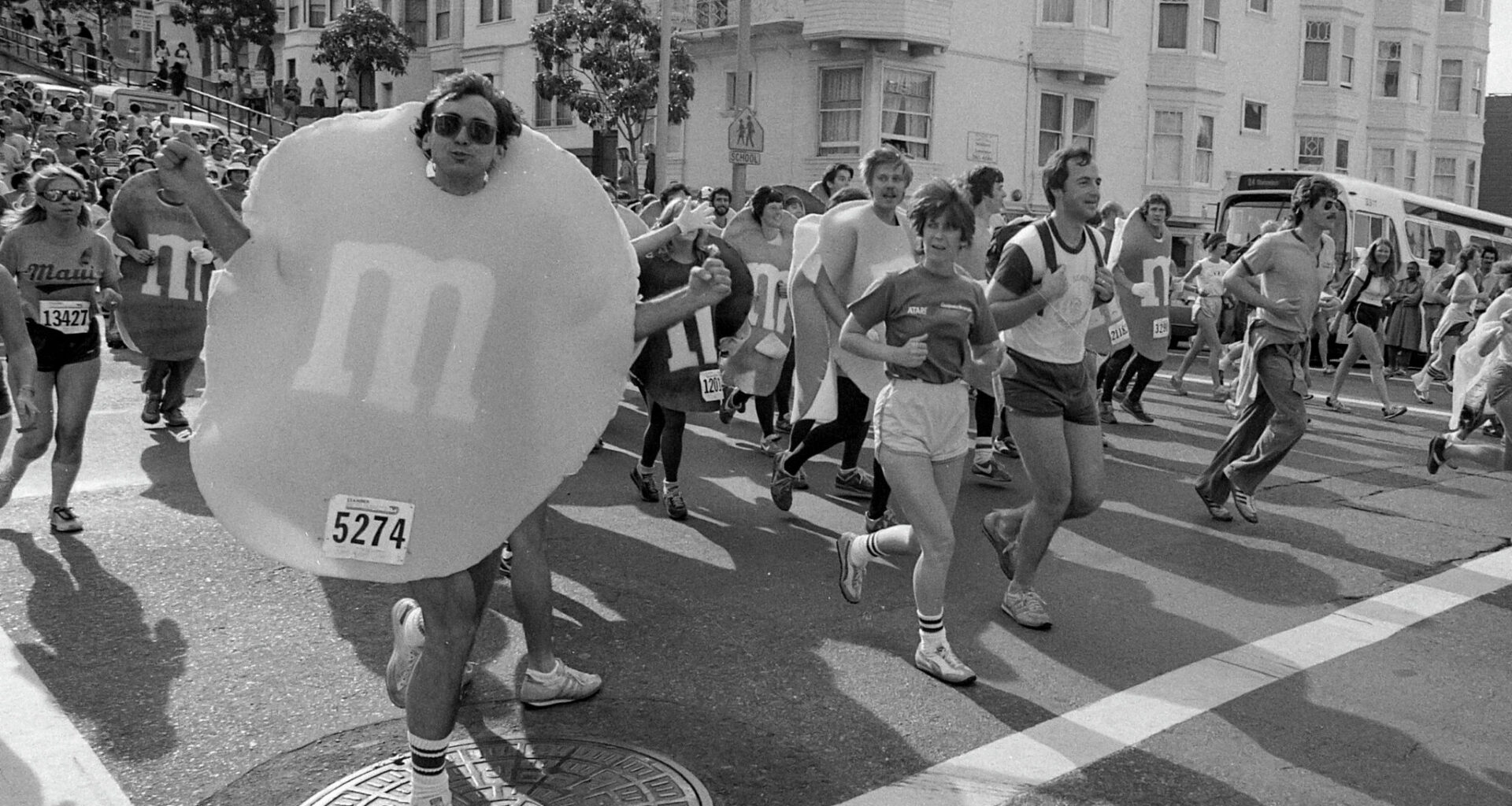
The next year 12,000 people showed up, then 16,000, then 18,000. Costumes, including cows, M&M candies, pumpkins and celebrities-of-the-moment, became the norm; finish times an afterthought. Raiders quarterback Jim Plunkett participated from 1975 to 1980. Archive photos show joggers drinking beer and hauling massive costumes, including airplanes and school bus-sized sneakers.
Article continues below this ad
As the race became a group project, creativity abounded. In 1977, the year after “Rocky” was released, the owner of a Hayes Valley Victorian started blasting “Gonna Fly Now” at the top of Hayes Street hill, replaced two years later by a marching band. In 1978, a group built a 6-foot-long shark with a jogger’s leg sticking out of its mouth — carried the 7-plus miles on a stretcher by four men in Scuba masks.
May 17, 1981: Runners climb Hayes Street hill during Bay to Breakers. The race increased from 15 runners in 1963 to more than 100,000 in the 1980s.
Fred Larson/S.F. Chronicle
By 1981, Park and Brown quit the race. They had become too normal.
“At some point, we were the 40th tuxedoes going by,” Park told the Examiner in 2003. “The bloom was off the lily.”
(Left) Runners dressed as spawning salmon lie in the street during the 1996 race. The salmon, which run every year, move upstream against runner traffic. (Right) Hallie McConlogue, leads the Salmon Run group in a practice “spawning” before they all enter the Bay to Breakers and run against the stream in 2025.
Michael Macor/S.F. Chronicle, Garrett MacLean/For The S.F. Chronicle
(Top) Runners dressed as spawning salmon lie in the street during the 1996 race. The salmon, which run every year, move upstream against runner traffic. (Bottom) Hallie McConlogue, leads the Salmon Run group in a practice “spawning” before they all enter the Bay to Breakers and run against the stream in 2025.
Michael Macor/S.F. Chronicle, Garrett MacLean/For The S.F. Chronicle
If Daley, Park and Brown are the first three faces on the Bay to Beakers’ Mount Rushmore, get a chisel out for Len Wallach. The retired Army brigadier general, who once supervised thousands of soldiers, took over as race director in 1971 and proved the perfect leader to handle the logistics of an event that grew 1,200-fold in 15 years. Best of all: The decorated veteran of three wars was no narc.
Article continues below this ad
When Atlanta’s Peachtree Road Race in 1980 surpassed Bay to Breakers as the largest in the U.S. with 20,000 runners, then banned costumes to keep the event “serious,” Wallach tripled down on the fun.
“The race belongs to everybody — whether they’re official, unofficial, drunk or sober,” he said.
May 16, 1976: The winners of the Bay to Breakers in San Francisco wore a variety of 1970s running shoes.
Gary Fong/S.F. Chronicle
After the late 1970s jogging craze boosted interest into the stratosphere, Wallach instituted changes including earlier start times, a separate starting pen for competitive runners and an official costume contest.
My first outing was in 1983, running with my older sister Toni when I was still in middle school. There were people dressed as Humphrey the lost humpback whale and several group Mediterranean fruit fly costumes. (Medfly insecticide spraying helicopters were passing over homes around the same time.) Three years later Bay to Breakers — boosted in popularity by live television coverage and a post-race festival called “Footstock” — reported a then-world record 110,000 participants, a peak for the race. It took us 30 minutes after the gun sounded that year just to cross the starting line.
(Left) Costumed runners race through Golden Gate Park in 1995. (Right) An impressive prop is carried through the city in 1981.
Brant Ward/S.F. Chronicle, Fred Larson/S.F. Chronicle
(Top) Costumed runners race through Golden Gate Park in 1995. (Bottom) An impressive prop is carried through the city in 1981.
Brant Ward/S.F. Chronicle, Fred Larson/S.F. Chronicle
Bay to Breakers continued over the next four decades as a barometer of the zeitgeist. Costumes honoring the first space shuttle; Ruth Bader Ginsburg; and all things 49ers, Giants and Warriors are plentiful in the Chronicle archive. “Centipede” teams with more than 13 linked runners show up snaking through the course, and runners dressed as salmon run a reverse course. (They’re swimming upstream.) Along with O.J.’s Bronco, photo editor Dan Hernandez found 1995 photos of runners dressed as trial-of-the-century judge Lance Ito.
The race has changed hands frequently in the last two decades, now run by Motiv sports, which hosts dozens of events, including the Golden Gate Half Marathon this November.
But Bay to Breakers remains the people’s run. You will still see tuxedoes and naked people. You will freeze at the beginning and at the end. You almost certainly won’t run a personal best.
May 18, 1997: A stream of runners passes through San Francisco during Bay to Breakers. The 1997 race had 70,000 runners, below the 1986 high of 110,000.
Sam Deaner/S.F. Chronicle
June 1, 1971: Runners line up at the start near the Embarcadero Freeway for the Bay to Breakers foot race across San Francisco.
Dave Randolph/S.F. Chronicle
May 17, 1981: A centipede team runs along Hayes Street in a BART train costume during the Bay to Breakers.
Fred Larson/S.F. Chronicle
May 21, 1995: Runners covered in blue paint pass through Golden Gate Park.
Brant Ward/S.F. Chronicle
May 18, 1997: Runners pass the Hayes Street hill while being doused in water by an open fire hydrant during the Bay to Breakers.
Sam Deaner/S.F. Chronicle
May 15, 2011: Runners dressed as “The Muppet Show” characters walk the last part of the steep Hayes Street hill in San Francisco.
Brant Ward/S.F. Chronicle
May 21, 1995: Joggers in billiards-themed costumes run Bay to Breakers in San Francisco.
Brant Ward/S.F. Chronicle
May 21, 1995: Runners dressed as police cars chasing O.J. Simpson’s Ford Bronco race during Bay to Breakers in San Francisco.
Brant Ward/S.F. Chronicle
May 18, 1980: Runners in formal wear finish the Bay to Breakers in San Francisco.
Vici MacDonald/S.F. Chronicle
May 15, 1988: Joggers carried tubas during the 1988 race.
Tom Levy/S.F. Chronicle
May 15, 1988: Bay to Breakers runners started creating more intricate costumes in the 1970s and 1980s, including this foot-powered garbage truck.
Tom Levy/S.F. Chronicle
A very small price to be a part of history.