
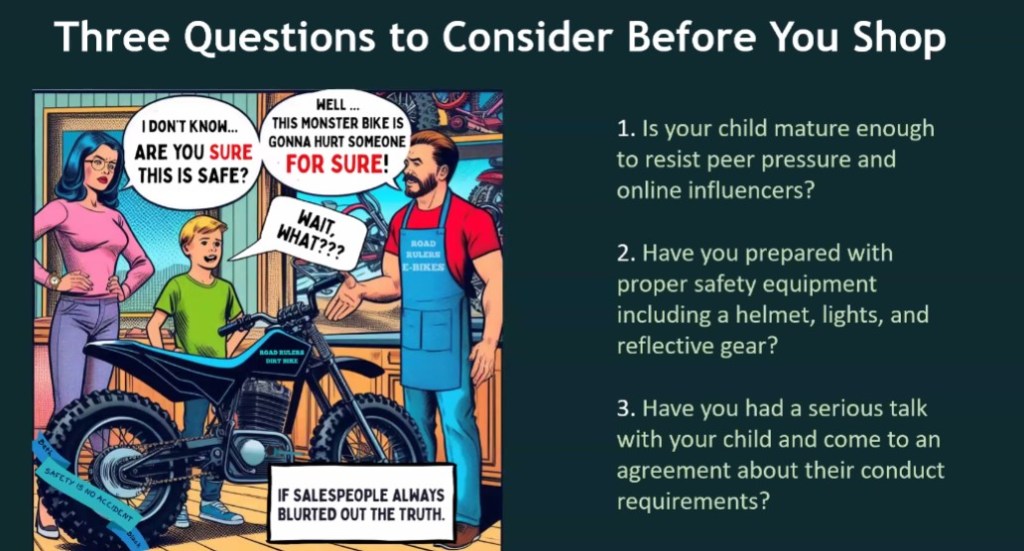
When picturing unsafe e-bike ridership, certain images tend to come to mind: a helmet not strapped on, multiple riders on one bike, speeding or doing hazardous tricks.
But few people picture the parents of the riders.
Thus, the role parents can play in promoting safe ridership was the focus of a May 12 webinar presented by the office of San Diego County Supervisor Terra Lawson-Remer, whose District 3 spans the coastline between Carlsbad and Coronado, including La Jolla.
It covered the latest facts and figures about electric bicycles and ways to help parents “cut through the noise” of what they might be hearing about them.
Series story gallery: Charged Up: The Rise of E-bikes
“We know parents are getting mixed messages right now,” said Paige Colburn-Hargis, injury-prevention community outreach coordinator for Scripps Memorial Hospital La Jolla. “On one hand, e-bikes are being marketed as fun and convenient. On the other hand, trauma teams across San Diego are seeing a real rise in devastating injuries involving young riders. … Many parents simply do not realize how powerful these devices really are.”
Colburn-Hargis, who has been in her role for 10 years, said Scripps La Jolla’s trauma center has been tracking e-bike-related injuries for five years.
“E-bike-related injuries are now the leading cause of emergency trauma visits at Rady Children’s Hospital, surpassing falls and motor vehicle crashes,” she said. “When we say injuries have increased by 4,000%, parents can understandably tune out because that number feels so abstract. But what it means in real life is that trauma teams that used to occasionally see an e-bike injury are now seeing them constantly.”
Colburn-Hargis said the biggest cause of the injuries is speed.
“Injuries from 25 or 35 mph look very different from traditional bike injuries … so speed is the critical factor in the severity of these injuries,” she said. “And [unlike adults], it can be really difficult for our young children to be able to assess the risk and anticipate consequences when going those speeds on these devices.”
Colburn-Hargis said a helmet — the right one for an e-bike — is an important first step in reducing injuries.
Having a proper helmet “significantly reduces the risk of head injury, traumatic injury, brain trauma and death … by as much as 85%,” she added.
However, not all helmets are designed to take impacts at speeds that e-bikes can reach.
“A typical bicycle helmet has only been rated [to sustain impacts] at 15 mph,” she said. “A Class 1 or 2 e-bike can reach speeds of up to 20 mph. … So that makes it critically important to choose the helmet that is rated to protect the rider from that type of speed.”
Colburn-Hargis said there are helmets rated to protect at speeds e-bikes can reach, but she also recommends motorcycle helmets.
Panelists in the webinar recommended speaking to local bike shops about finding the right helmet.
Scripps Health Trauma Prevention Team member Pualani Vazquez said that when parents and children have discussions before getting an e-bike, it creates the opportunity to establish “clear expectations” and “what will happen when those expectations are not met.” That can include an agreement about proper helmet usage.
“We have co-created with the San Diego County Bike Coalition a parent/student e-bike safety contract” that families can use when considering e-bikes, Vazquez said. The contract will be released soon and available for download.
Beth Black, author of “The Caring Parent’s E-Bike Survival Guide,” agreed that speed is a factor that parents need to address, but she said the way that conversation is framed can be crucial.
“As parents, you are the ultimate speed governors,” Black said. “But it is important to remember that teens are capable and smart, but their priorities are different from ours. They are deeply motivated by a strong need for status and respect. … An e-bike represents social currency, it represents independence, maturity and the opportunity for status and respect.”
Thus, young riders may attempt unsafe stunts or travel at unsafe speeds.
“We must stop fighting these priorities and start working with them,” Black said.
To help parents determine what their children’s priorities are when using their e-bikes, she recommended asking them if they follow certain influencers on social media and what they might be promoting.
“Do [the riders] talk about street takeovers or ask for a certain brand and model bike?” Black said. “Those are clues that an influencer or peer pressure is at work on your child. If we want to change the behavior, we have to show that mastery as a pro-level rider will earn more rewards than the three-second glory of being an anonymous stuntman for some influencer. If we want them to prioritize safety, we can’t frame it as safe, we have to frame it as mastery.”
“Telling them to ‘Just ride safely’ feels like an insult to their skill,” she added. “We want to raise the bar to athletic professionalism. We stop treating that bike as a toy and start treating the rider as an athlete. … By holding them to this standard, we validate their desire for status while demanding the discipline that keeps them out of the trauma bay. We aren’t taking away their stage, we are supporting their move to a professional one.”
When deciding which e-bike to get (and knowing whether it is actually an e-bike or a more powerful electric motorcycle or e-moto, which is not street-legal), Black recommended searching online for the brands being considered and see if there have been lawsuits associated with them.
Lawson-Remer’s office plans to hold free e-bike safety training for youths ages 12-16 in partnership with the Bike Coalition. Every participant will receive a free e-bike-rated helmet.
A training session in La Jolla is scheduled for Saturday, Aug. 8, at the Dan McKinney Family YMCA, 8355 Cliffridge Ave. The time is to be determined. ♦