
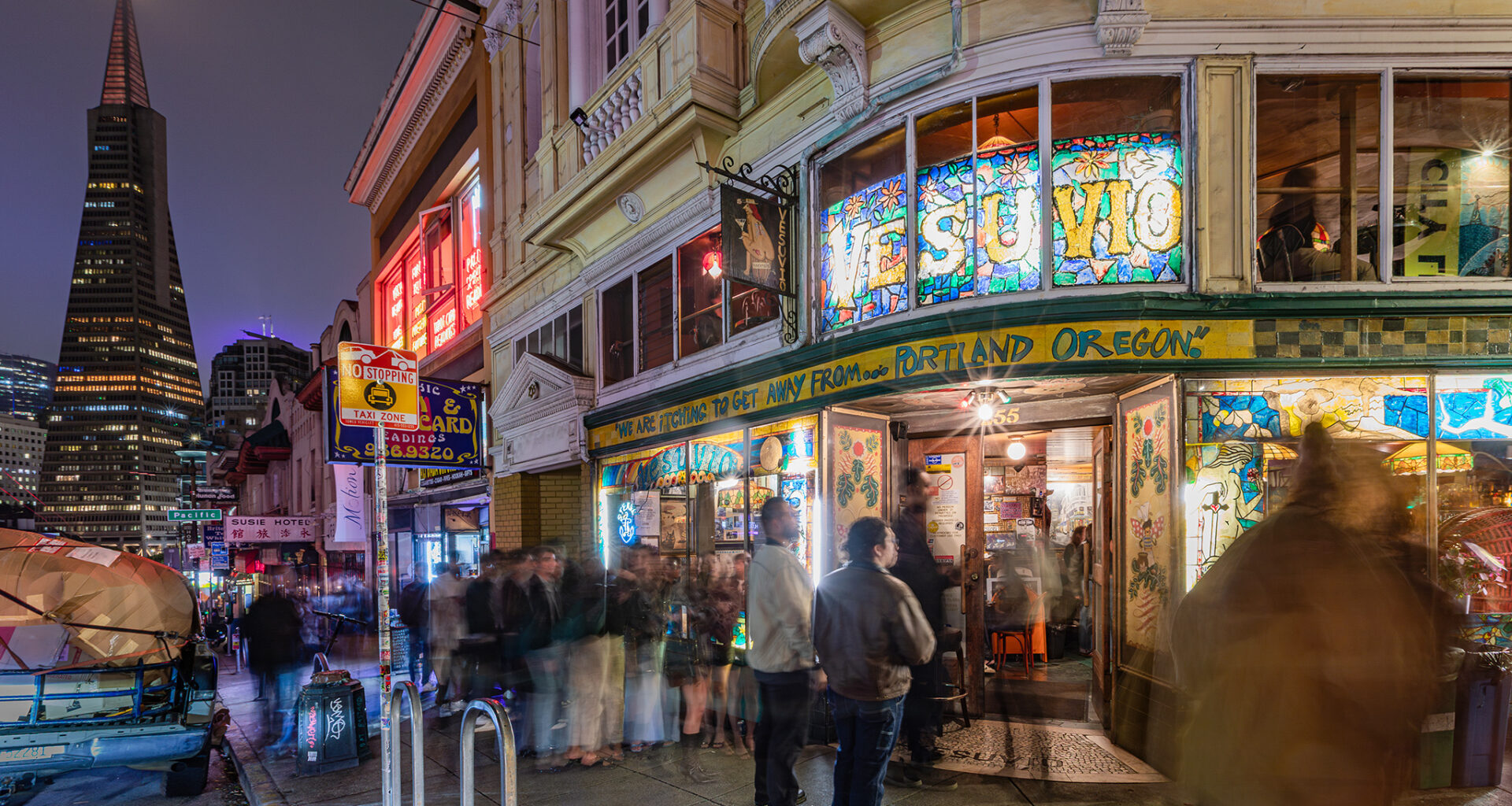
On a recent Friday night, bargoers lined up outside Vesuvio Cafe dressed in everything from leather jackets to sports jerseys. They are as young as 21 but rarely look over 29. As they wait for a stamp on the wrist at the door, their faces are illuminated by light coming through a large window with stained-glass borders featuring the word “Vesuvio.”

Four men joke with each other as they walk to the end. On the way, one of them trips over a bike rack. His name is Joe Boyden, and he is here to celebrate his friend’s 25th birthday. When asked why the group is willing to wait in line, his friend, Robert Burgeson, 24, says, “The drinks aren’t too expensive, and you can smoke cigarettes, and that’s pretty much it.”
Boyden is more introspective: “The upstairs is kind of cool. Um, Hemingway wrote here. What was the other dude’s name?”
Article continues below this ad
Patrons play a game of cards at Vesuvio in San Francisco’s North Beach neighborhood on Friday, May 1, 2026.
Kevin Kelleher & Emily Trinh/For SFGATE
The line stretches beyond the back edge of the bar to the storefront that follows. It’s a new phenomenon here in North Beach, one that perplexes longtime patrons of the historic bohemian bar, known for its past as a beatnik rendezvous (but was never frequented by Ernest Hemingway).
Lor O’Connor, a 36-year-old photographer, has lived in the neighborhood for years.
Make SFGATE a preferred source so your search results prioritize writing by actual people, not AI.
Add Preferred Source
“None of us get it,” she says, of Generation Z “finding” Vesuvio. “There’s no entertainment. There’s no DJ.”
Article continues below this ad
The Friday night crowd mingles in the alley outside Vesuvio in San Francisco’s North Beach neighborhood on May 1, 2026.
Kevin Kelleher & Emily Trinh/For SFGATE
The bar takes up no more space than a bodega. Bouncers at the door have had to kick people out for trying to sneak in. Those in the literary and arts industry, long synonymous with the area, can’t get a table on weekends and don’t even try.
Vesuvio’s past
Henry Lenoir founded Vesuvio in 1948, five years before City Lights Bookstore opened. Jack Kerouac and Allen Ginsberg ordered their drinks at the same wooden countertop the kids now push through to reach, and the walls brimming with black-and-white photographs won’t let you forget it. Tiffany lamps hang overhead.
Article continues below this ad
Mike Boyd knew Lenoir as a little guy who always wore a beret. Boyd, 78, comes here for the Graffeo coffee he’s been drinking at Vesuvio since the ’70s. “I predate all these people here,” he says.
A portrait of Jack Kerouac hangs high on the wall, along with other Beat Generation memorabilia, at Vesuvio in San Francisco’s North Beach neighborhood, as seen on Friday, May 1, 2026.
Kevin Kelleher & Emily Trinh/For SFGATE
In Boyd’s youth, North Beach was frequented by merchant seamen and those who came for union jobs. Now, San Francisco is in its third tech boom.
“There were a lot of characters, but they ended up dying,” Boyd says, “and they’re not replaced by characters.”
Article continues below this ad
Self-proclaimed bartender emeritus Jack Yaghubian stands at the counter in a straw fedora, collecting what he calls his pension: the daily beer he’s been given free of charge since his retirement in 2020. He became a regular in 1974 and started working at Vesuvio in 2002.
The new crowds, those who arrive past nightfall on Fridays and Saturdays, he’s noticed, tend to be outsiders. Locals and regulars still come during the day, timing their stay to end as the crowds ramp up. Yaghubian doesn’t have a problem with all outsiders, only those who don’t know what they’re doing and don’t care to learn. In an effort to educate, he wrote a book on bar etiquette: “The Dim Light Bar Guide.” He sells copies out of his cloth satchel for $8, cash only.
Why no credit cards? “I don’t like playing the banker’s game,” he says.
Patrons hang out in Vesuvio in San Francisco’s North Beach neighborhood on Friday, May 1, 2026.
Kevin Kelleher & Emily Trinh/For SFGATE
Angie Adler, a bartender who has worked at Vesuvio for over two years and previously worked at Toronado Pub, another San Francisco staple undergoing change, would rather the new crowds read Yaghubian’s book than Kerouac’s “On the Road.”
Article continues below this ad
She has bright eyes and a languid voice that should clash but don’t. Adler believes the younger groups come to this bar for a cheap drink and an attempt to chase a sense of nostalgia in a city that’s constantly changing. “But they’re so young, I find it ironic,” she says. “It’s a generation that’s completely divorced from the things that make this a historically attractive place to spend time.”
Yaghubian finishes his beer and heads across Columbus Avenue to Vesuvio’s unofficial sister bar, Specs’ Twelve Adler Museum Cafe. Specs, for short. The bouncer working the door says they — the older crowd leaving — call this moment crossing the “Columbus River.” It’s 8:30 p.m.
Vesuvio’s present
Within an hour, Vesuvio begins to fill. Snapbacks replace gray hair, and an endless supply of glossy, excitable faces push out the last of the old guard— what they are affectionately called in the community. The bar has two floors and a seating area on Jack Kerouac Alley, all filled by 10 p.m.
Article continues below this ad
The Friday night crowd mingles in the alley outside Vesuvio in San Francisco’s North Beach neighborhood on May 1, 2026.
Kevin Kelleher & Emily Trinh/For SFGATE
Overcrowding is a concern for manager Joanna Loice, who has worked at Vesuvio for 22 years. Drunk customers often sit on the second-floor railing until one of the bartenders rings a large bell to get them off.
It really is an alluring place. Groups snap pictures in nearly every ornate corner to take a souvenir of Vesuvio’s eclectic charm. The alley is enclosed with multicultural murals and provides customers with the freedom to smoke and drink amid the city’s cool breezes after outdoor drinking regulations changed during the pandemic.
Owner Janet Clyde feared that small businesses like hers would close during the pandemic, but what she actually saw was a civic push to support classic establishments that the community recognized and loved.
Article continues below this ad
Olivia Moriarty of Houston, Texas, left, and Rae Ellis of Missoula, Mont., are next in line to get in at Vesuvio in San Francisco’s North Beach neighborhood on Friday, May 1, 2026.
Kevin Kelleher & Emily Trinh/For SFGATE
She started as a cocktail waitress at Vesuvio in 1978, when the bar “was popping,” she says, just as busy as it is now. North Beach was crowded and dynamic. Full of young people working in the service industry and listening to live music on Broadway Street during their time off.
Then the neighborhood got more expensive, driving young people out. The influx of Gen Z customers started around two years ago.
“I love it,” Clyde says, “when people come by, and they’re attracted to us, and they enjoy the kind of whimsical, colorful, lively atmosphere that is Vesuvio, you know. I think it’s great.”
Article continues below this ad
The Gen Z attraction
When asked what draws them to Vesuvio, Gen Z patrons say “vibe” or “aesthetic.”
Hattie Sanness, 21, says she feels cool when she hangs out here. “We all often talk about, like, I gotta put on my Vesuvio outfit,” she says. Tonight, that’s cowboy boots and a long denim coat with faux fur lining.
“Obviously, it has a lot of character,” 28-year-old Ati Pittman says.
Article continues below this ad
Marissa Paredes of Long Beach, Calif., left, and Georgie Guevara of Alhambra, Calif., enjoy drinks and the view on a Friday night at Vesuvio in San Francisco’s North Beach neighborhood.
Kevin Kelleher & Emily Trinh/For SFGATE
Anuj Panta, 22, and his two friends explain a card game to three girls they just met. “This bar is really good for social interactions,” he says.
At 10:30 p.m. in the alley, various cliques of 20-somethings become permeable as drinks threaten to spill and laughs are exchanged with strangers. A tile at their feet reads: “Poetry is the shadow cast by our streetlight imaginations. Lawrence Ferlinghetti.”
Isabella Harang, 22, sits at a table with four friends, a cocktail in front of each. She comes here every other week.
Article continues below this ad
The sign for San Francisco’s Vesuvio is illuminated on Friday, May 1, 2026.
Kevin Kelleher & Emily Trinh/For SFGATE
Alexa Glinski, also 22, sits to her right, cigarette in hand. They started their night at City Lights. The old guard would approve. “It has to do with a lot about San Francisco culture and kind of what San Francisco was built on,” she says of the bar’s appeal.
They might still be here in 50 years, reminiscing on what Vesuvio is today.
Article continues below this ad
Nicolle Delgado is a student at the UC Berkeley Graduate School of Journalism. She has a background in English Literature and has contributed to the graduate publication Oakland North.