
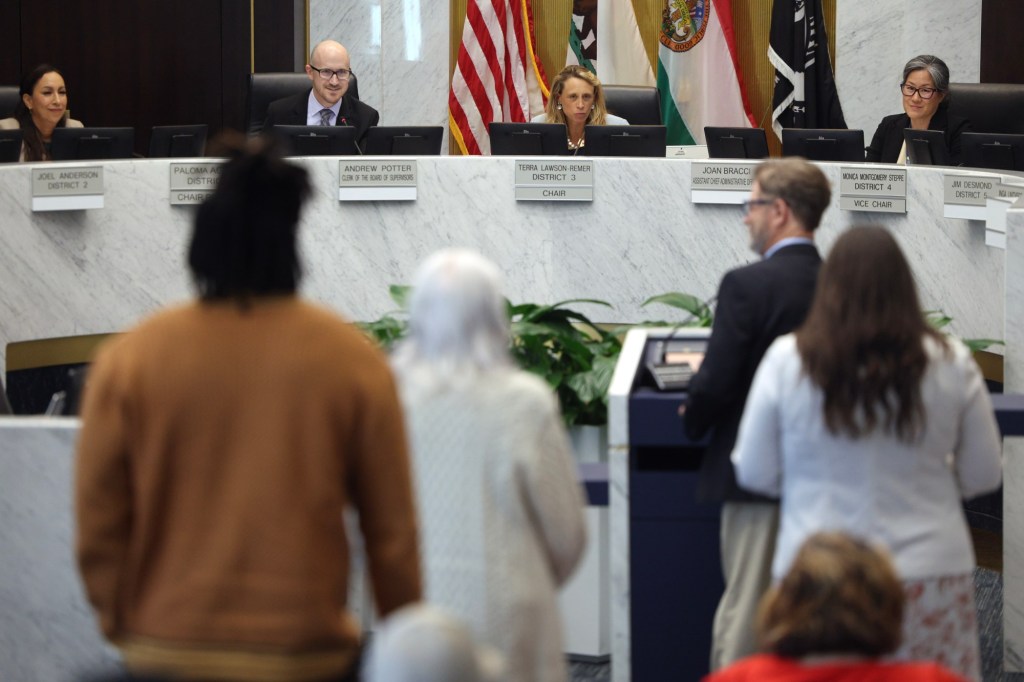
San Diego’s County Charter has not been significantly updated since the 1970s, so proposals for reform should be both welcomed and due. Current reforms being considered by the San Diego County Board of Supervisors, however, are a missed opportunity to truly “modernize” county government.
The proposed changes championed by board Chair Terra Lawson-Remer — which are expected to go before county voters in November — promise greater transparency and accountability in county government. A new independent budget analyst and independent auditor will be hired. An independent ethics commission will be appointed. A community-led Charter Reform Implementation Task Force will be convened to be sure voters get what they voted for. It all sounds good, of course. Who could argue with increasing government transparency and accountability? They are the political equivalent of promising to take everyone out for ice cream after the election.
But the independent budget analyst and auditor, along with the majority of members of the ethics commission, will be hired and fired by the same board they are supposed to hold accountable, complicating perceptions of “independence.” Even if these positions truly act as independent stewards of good governance, their recommendations to the board are just that. The city of San Diego adopted an independent auditor in the wake of the 2004 pension crisis. Two decades later, city finances and budget may be more transparent but aren’t a whole lot more stable. Meanwhile “community-led” task forces often become little more than a forum for the public and community groups to vent without the authority to turn recommendations into policy realities. It is, ultimately, the board that is responsible for policy, not whatever the independent overseers or task forces they appoint.
The proposed changes to supervisor term limits, extending them from two to three four-year terms, are problematic in two ways. First, Lawson-Remer’s office characterizes this as creating “clear and reasonable term limits.” Who doesn’t like “clear” and “reasonable”? But many voters could end up believing the proposed term limits are both new (they were first adopted by voters in 2010) and will reduce (hence “limit”) how long supervisors can serve. It would be more transparent to present the proposal as “increasing” terms of office.
Second, the proposal would grandfather in current supervisors, allowing them to serve up to 12 years rather than eight. Changes to term limits (like those adopted for state legislators in 1990 and 2012 and for San Diego County supervisors in 2010) usually don’t apply retroactively to incumbents like these proposed changes do. The theory is that incumbents’ term of service should be bound by the conditions that prevailed when the voters elected them — a contract of expectation. And San Diego Democrats, having pushed through supervisor term limits when in the minority on the board, could be seen as self-servingly extending term limits to solidify their control of the board.
If San Diego County voters really want to “modernize” county governance, perhaps we should reconsider the entire structure of the Board of Supervisors. When San Diego was chartered as a county in 1893, it had a population of 35,000 and a five-member board (which California county governments have had since the 1850s). Yet San Diego County is bigger in population (over 3 million) and budget (over $8 billion) than 20 states. Each of these states administer their (smaller) populations and budgets with an average of 150 elected legislators. San Diego County does it with five. Five! Am I the only one who finds this a tad — er — nuts?
The only people who truly benefit from this system are the leaders of the region’s powerful interest groups, be they real estate developers or labor union bosses, who probably have all five supervisors on their speed dials. They and the gang of five supervisors, regardless of partisan affiliation, have tremendous power to shape policy with limited input or attention from average voters.
As a “charter county,” San Diego voters have great discretion to shape county government. So rather than tweaking a system of government that leaves San Diego County’s 3 million residents with the same number of representatives as Alpine County (population 1,200), how about we consider a real reform? Increase the size of the Board of Supervisors to allow every community in the county greater local representation and control. Now that’s a proposal to make county government more transparent and accountable to average voters and not just powerful interests.
Luna is professor emeritus of political science at San Diego Mesa College and director of the University of San Diego’s Institute for Civil Civic Engagement.