
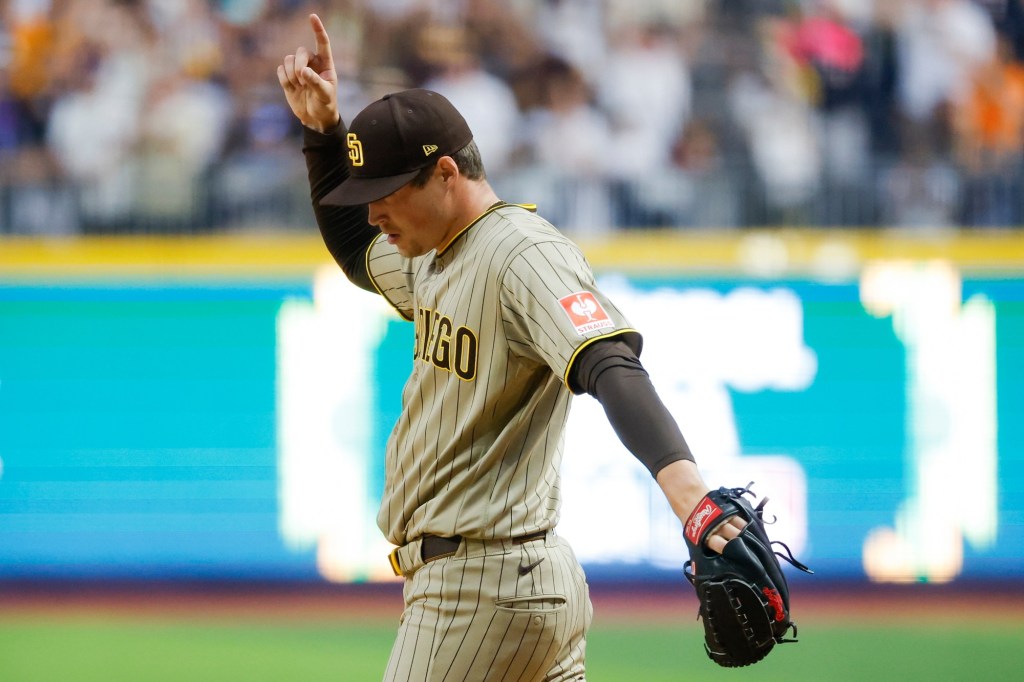
Long before Mason Miller delivered-triple digit heat, he delivered the news.
Literally.
While plenty of Padres count baseball as their first and only job — from Ramón Laureano to Sung-Mun Song — some needed walking around money well before the diamond became their primary source of income. So once a week, for 10 cents a newspaper, Miller’s parents would pick up stacks of The Almanac in the Pittsburgh area and he’d bag them and then throw ‘em for roughly two hours.
“Sixty bucks goes a long way for a 14-year-old,” Miller said. “Not anymore, but back then it did.”
Miller ultimately drove his siblings around for essentially car insurance money. The delivery route that Rodolfo Duran took as an 11-year-old in Santo Domingo had him delivering groceries — beans, bananas, plantains, etc. — from uncle Jose Gonzalez’s supermarket to nearby neighbors by bicycle or by foot.
Duran made $10 a day, a small fortune for a pre-teen in the Dominican Republic.
“It was fun because at that moment you’re so little in your life and you enjoy whatever you do,” Duran recalled. “ … At that moment (the money) was good, because I could buy candy, soda, everything.”
Knuckleballer Matt Waldron was about the same age as Duran when he and his twin brother, Mike, started a lawnmowing business in Omaha, Neb. For an extra $50, they’d pull your weeds.
“When you’re a kid, any cash is great,” Waldron said. “It was some good labor. … The hardest part was going door to door. I hated that more than anything.”
Xander Bogaerts also worked alongside his twin brother, Jair, restocking a hardware store as teens in Aruba.
“I got $7.50 an hour,” Bogaerts, who signed an $280 million contract with the Padres in December 2022, said with a smile. “I thought we were rich.”
Jackson Merrill returned to his roots for his first job in his early high school days, working after-school care at his mom’s elementary school — the same program he was in as a kid.
The job for “Mr. Jackson”: Wear those kids out on the playground.
Were you hard on them?
“Always,” Merrill recalled. “I played as hard as I could in those sports, too.”
Michael King got his first paychecks as a busboy at an Italian restaurant in Greenwich, R.I., while in high school. He learned pretty quickly that he was not exactly cut out for the work.
“I broke a couple bottles, a couple glasses,” King said. “ … Regulars would come in, and apparently, my memory is not good enough for that. People would know their name and their order for everything. Waiters would say, ‘You’ll start to get it.’ I never once got it. It was like new faces every time they came in.”
Ty France’s first job — at his best friend’s dad’s barbecue joint — became more of a bridge job as a minor-leaguer. He did everything from washing dishes to manning the grill for chicken or rib orders to making 1,000 mini-tri-tip quesadillas in a six-hour shift.
“I spent countless hours in that kitchen,” France said. “His busy time was at Christmas, so when I was in the minor leagues, he’d give me 40 hours on top of my training. Whenever I needed work, he was always there to help me out.”
In an alternate universe, Padres manager Craig Stammen’s first job might have been his only job. The Stammen family opened what became North Star Hardware & Implement Co. in 1924, and the pitcher-turned-big-league-skipper joined the ranks on the grain bin crew as a 14-year-old.
He worked there throughout his days at Versailles (Ohio) High School and even while at the University of Dayton before the Washington Nationals drafted him in the 12th round in 2005.
“I didn’t get to move to the office until I got drafted,” Stammen said. “Because it’s dangerous — a lot of galvanized metal. I still have scars on my hands from it. Dad said we’re not risking it now. You’re going to sit in the office and answer phones. (The family business) was the plan if baseball didn’t work out.”