

 Students work on yearbook layout during the after-school program at Washington Elementary School on May 15, 2025. All nine program coordinators received layoff notices in the last two years. Credit: Ximena Natera, Berkeleyside/CatchLight Local
In March of last year, Kimberly Wright, coordinator of Willard Middle School’s after-school program, received word that the school district was considering eliminating her job as it sought to plug a nearly $8 million budget deficit.
Wright, a Berkeley native working in the district since 2018, said it was “extremely stressful.” She worried how she’d stay in her home. Colleagues said they were struggling to sleep, joining therapy groups to cope, going to the grocery store less and the food bank more, donating plasma to make ends meet and searching for new jobs.
After a two-month limbo, Wright’s job was spared. District leaders decided to push tough financial cuts into the future, with most layoff notices ultimately rescinded.
But this March, Wright’s after-school role was again on the chopping block.
And after last week’s school board meeting, Wright learned that while most of the 350 layoff notices issued this year were being rescinded, her job was among 21 the district did not immediately have a plan to save. All now could lose their jobs at the end of the school year if the district can’t identify additional resources.
“We really appreciate all of the support we received from families reaching out to the board members, but I just know that it’s going to be — I’m getting emotional talking about it — really kind of sticky as we move forward,” Wright told Berkeleyside after the board meeting.
Layoff notice cycle stems from misalignment between state and district budget timelines
California law requires school districts to notify employees of potential layoffs by March 15 each year and issue final notices by May 15. The early timeline is meant to give staff time to request hearings or seek other work, and to force districts to publicly analyze budgets and justify proposed cuts.
The mandate dates back to the 1970s, when districts were funded primarily through local property taxes rather than state allocations. In 2022, Assembly Bill 438 extended the March 15 layoff‑notice requirement to permanent support staff. BUSD won’t know its actual budget until late summer, after the state finalizes its own spending plan, leaving districts to make staffing decisions months before they know what they can afford.
Complicating matters, school districts like BUSD are also being squeezed by expiring COVID-19 relief grants, state cost-of-living-adjustments that don’t keep up with rising expenses, and delayed cuts from last year catching up to them, according to Sara Hinkley, the California program manager for UC Berkeley’s Center for Cities and Schools.
“Regardless of how early districts begin their own planning, they’re not going to know until July how much money they’re actually going to get from the state,” Hinkley said. “There’s a lot of evolving uncertainty and March 15 sits in this weird spot in the middle.”
Because the state and district budget timelines don’t align, districts end up “flying blind” each year and often “overcompensate” by issuing notices based on worst‑case scenarios, Hinkley said.
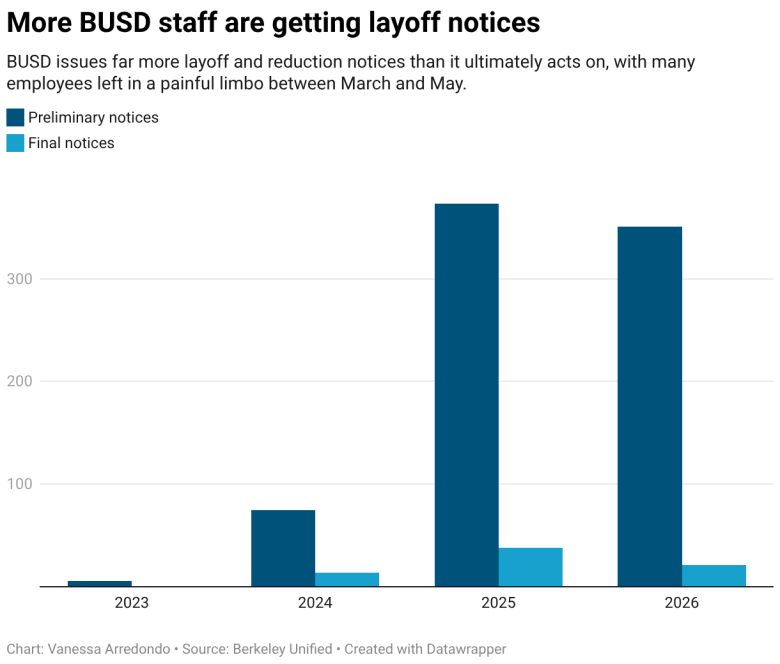
But for employees like Wright, caught in a cycle of often-rescinded layoff notices, the routine can feel inhumane.
“We should be capable of coming up with a solution so that we don’t have to go through this every year,” Wright said in a recent interview. “So that I can build job security and be able to rest my head at night knowing that, yes, I am going to have a job, yes, I’m going to be able to pay my bills.”
Yearly layoff notice cycle is emotionally draining and leads to burnout
Hinkley said most districts generally feel as though they “don’t have a choice but to budget responsibly,” which means preparing for cuts and staff reductions. But she noted that morale and retention problems tend to surface in districts that repeatedly rely on this cycle.
Public education staff have described the yearly layoff cycle as emotionally draining, saying that the constant threat of losing their jobs leaves them anxious and worried about their livelihoods. Although March 15 notices haven’t been widely studied in labor research, job insecurity is repeatedly identified as a major contributor to burnout among educators.
“It’s a mess with all of us,” Ana “Anita” Zamudio, the Sylvia Mendez Elementary after-school bilingual coordinator, told Berkeleyside. “We fought so hard last year, and we had this momentous victory where we got to keep our jobs. You still have that hope, but you also know that, ‘OK, this might be it.’”
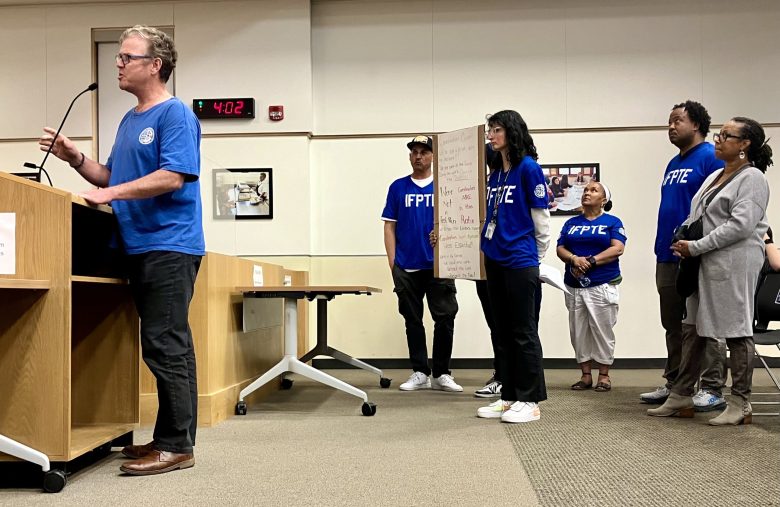 Members of the International Federation of Professional and Technical Engineers (IFPTE) Local 21, including Ana Zamudio (center), spoke in support of after-school coordinator roles at a May 2025 board meeting. Credit: Vanessa Arredondo/Berkeleyside
Zamudio, who has worked in BUSD for about three years, said she is the district’s only bilingual Spanish‑speaking coordinator. She said her placement at Sylvia Mendez is ideal because the school serves as a magnet for all native Spanish-speaking families in BUSD.
“A lot of us are trying really hard to keep doing that work, and it’s kind of hard to plan your life around that when you’re at the mercy of the board,” she said. The budget process, Zamudio added, is “traumatizing” and discourages talented people from working in public education.
Daniel Brownson, a clerical assistant at the Berkeley High School College and Career Center, was laid off last year from a similar district office role. He’s been with BUSD since 2019 and has remained employed because his current position opened after a voluntary resignation.
“I can’t count on that again,” he said. “I’m trying not to let it get to me because I’ve got my job responsibilities, but I’d be lying if I said it wasn’t a big weight on my shoulders.”
At the end of last week’s board meeting, Brownson was still unsure whether his job was on the line. Two days later, he received an email confirming that he’d been spared.
“It’s difficult to describe the relief of not having to look for a job in an economy that’s quite frankly terrible,” he said.
Brownson lives in a studio apartment in the East Bay and told Berkeleyside he wasn’t sure unemployment benefits would have covered his basic expenses. Half his paycheck goes to rent and bills.
“My position is fine, but I’m still worried about the other people on the list. I don’t want them to get laid off either,” he said. “It’s really aggravating that those of us who have the least say in the district’s finances are the ones who always have to pay the price.”
Wright said she puts on a courageous face for students and then goes home and wonders whether she’ll be able to afford rent in a few months. Although the school board’s layoff resolution reduces the cuts to nameless titles, Wright said it’s “hard to separate the people who have made a commitment to serve the youth of Berkeley” from the roles.
She said the after-school program generates revenue for service costs and coordinators’ salaries, “but yet once again this year we’re still on the chopping block.” Wright said some coordinators could be demoted to aftercare specialists or other roles, but she doesn’t want to leave her position.
“I want to stay with the Willard community, that’s how I got into the field,” Wright said. “I want to keep working with youth to give back to my community.”
“*” indicates required fields